December 26: Love Incarnate | Love Divine
♫ Music:
Day 27 - Friday, December 26
Title: Love Incarnate | Love Divine
Scripture #1: 1 John 4:7–11 (NKJV)
Beloved, let us love one another, for love is of God; and everyone who loves is born of God and knows God. He who does not love does not know God, for God is love. In this the love of God was manifested toward us, that God has sent His only begotten Son into the world, that we might live through Him. In this is love, not that we loved God, but that He loved us and sent His Son to be the propitiation for our sins. Beloved, if God so loved us, we also ought to love one another.
Scripture #2: John 3:16–17 (NKJV)
For God so loved the world that He gave His only begotten Son, that whoever believes in Him should not perish but have everlasting life. For God did not send His Son into the world to condemn the world, but that the world through Him might be saved.
Poetry & Poet:
“Prefix: Finding the Measure”
by Robert Kelly
Finding the measure is finding the mantram,
is finding the moon, as index of measure,
is finding the moon's source;
if that source
is Sun, finding the measure is finding
the natural articulation of ideas.
The organism
of the macrocosm, the organism of language,
the organism of I combine in ceaseless naturing
to propagate a fourth,
the poem,
from their trinity.
Style is death. Finding the measure is finding
a freedom from that death, a way out, a movement
forward.
Finding the measure is finding the
specific music of the hour,
the synchronous
consequence of the motion of the whole world.
Love Incarnate, Love Divine
In all the writings we have from the Apostle John, love is a dominant theme. Love is mentioned 39 times in his Gospel, and 25 times in 1 John alone — far exceeding even 1 Corinthians 16 mentions, with its famous 1 Corinthians 13, “Love is…” passage, that we love to hear at weddings.
Admittedly, I’m tempted to think of John as the hippie disciple. Peter is headstrong, Levi knows how to throw a party, but John — the disciple Jesus loved (John 13:23) — is all peace and love, all the time. Right?
Well, the other Gospels tell a different story. In Mark 3, Jesus nicknames John and his brother James, “The Sons of Thunder” — hardly a name for the meek and mild. In Matthew 20, the brothers (prodded by their mother) clamor for the top cabinet positions in Jesus’s coming administration. In Luke 9, the pair, full of thunderous prophetic zeal, ask permission to call down fire on their perceived enemies, just like Elijah did.
In response, Jesus issues a rebuke (Luke 9:55).
I wonder if this is the moment John begins to turn from thunder to love. He is so sure Jesus is the Messiah, and so sure he knows what that means: political and supernatural power to rule from on high. But each time he tries to express this power, in righteous zeal and religious aspiration, Jesus comes with a different message: “Not so with you” (Matthew 20:26).
What does it take for this son of thunder to pen the words, “He who does not love does not know God, for God is love”? It is a prolonged encounter with Love Incarnate. John discovers that “God so loved the world” and that “God did not send His Son into the world to condemn the world, but that the world through Him might be saved.” He discovers that Jesus is “the love of God[,] manifested toward us.”
Joy to the world! Love is come.
All his boyhood training in the synagogue, all his absorption of the Pax Romana by osmosis, and the harsh reality of first-century living had taught him that the goal of life was to display power over others — be it neighbors or enemies. But John came to know “the Word became flesh” (John 1:14), and proximity to Divine Love in human form unmasks a truth stitched into the fabric of the universe, fully revealed in Christ: Love is of God and God is love.
Love is, as the poet says, “the synchronous consequence of the motion of the whole world.” To dance with the movement of love, is to step in time with the universe as God created it to be. And that dance transformed a son of thunder into a beloved disciple.
Love becomes John’s measure and mantram. The invitation of discipleship is to let it become ours, too. As we reflect on the Christmas dinner conversations of last week, the conference room meetings of next week, the neighborhood disputes, or the Sunday morning squabbles, how might love act differently than the power-over impulses that we’ve garnered by osmosis?
Prayer:
Word of God, Incarnate Love, thank you for revealing to us Abba’s love. Thank you for not condemning us, but for becoming the propitiation for our sins. Jesus Christ, Love Divine, help us to love one another as you have loved us. Because we do love you, but we know we can only say that because you loved us first.
In Jesus’s name,
Amen.
Chase Andre, M.A.
Instructor in Communication Core and Digital Learning
Department of Communication Studies
Biola University
About the Artwork:
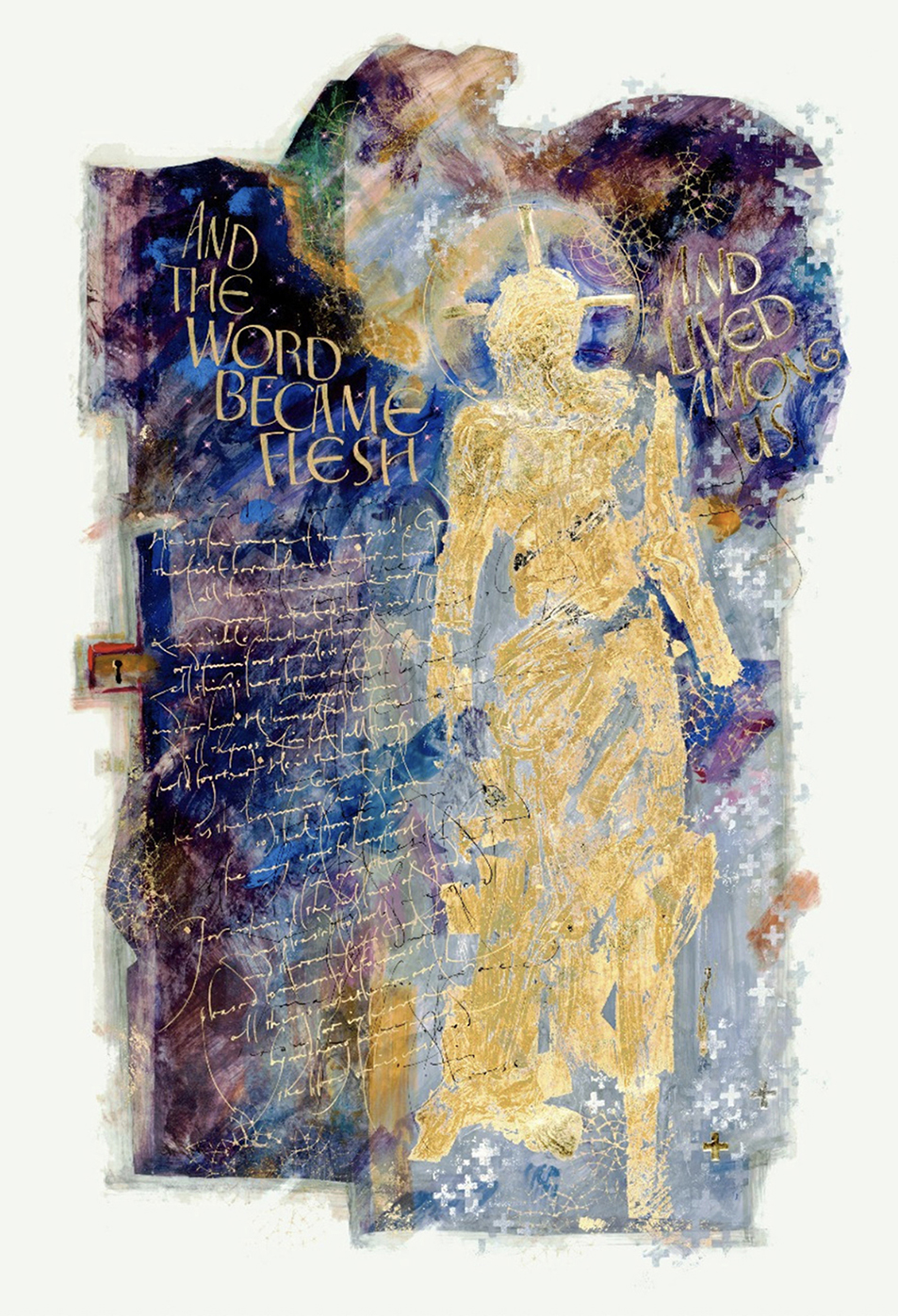
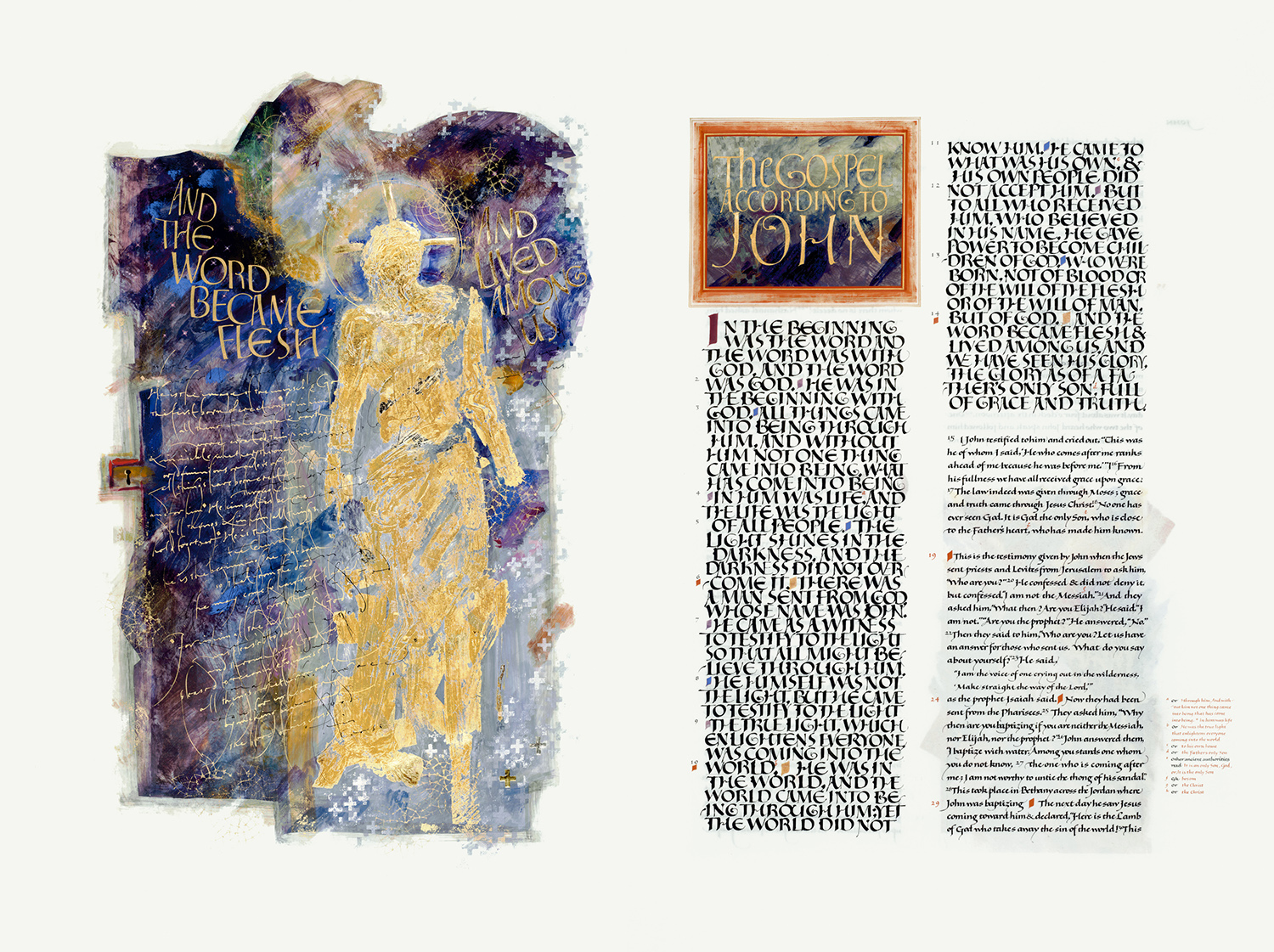
Word Made Flesh, John Frontispiece
Donald Jackson
© 2002
The Saint John’s Bible
Saint John’s University, Collegeville, Minnesota, USA
Scripture quotations are from the New Revised Standard Version of the Bible, Catholic Edition, © 1993, 1989
National Council of the Churches of Christ in the United States of America.
Used with permission
All rights reserved
Stepping out of darkness which alludes to the chaos and nothingness in the creation story, the golden figure of Christ, the Living Word, brings light and order. The words in golden script, from Colossians (1:15–20, NRSV)), link the figure of Christ with the words “And lived among us” at the upper right:
“He is the image of the invisible God, the firstborn
of all creation: for in him all things in heaven and
on earth were created, things visible and invisible,
whether thrones or dominions or rulers or powers—
all things have been created through him and for
him. He himself is before all things, and in him
all things hold together.”
A keyhole jutting into the left margin recalls the tradition of locked and hinged manuscripts in securing, protecting, and holding the “key” to the Word of God. The decorative script found at the beginning of John’s gospel marks the start of the book in a decorative way, a common practice in manuscripts. Such a treatment found at the start of a book or section is called an incipit. In a departure from traditional approaches, the texture behind the head of Christ references an image taken from the Hubble telescope and lends a breathtaking cosmic character to the whole action taking place.
https://library.nd.edu.au/sjbtour/wordmadeflesh
https://litpress.org/Products/GA081000NF/The-Word-Made-Flesh
About The Saint John's Bible:
The Saint John's Bible is the first completely handwritten and illuminated Bible commissioned since the invention of the printing press. After a Saint John’s University–sponsored calligraphy presentation in 1995, master calligrapher Donald Jackson proposed a handwritten Bible to Fr. Eric Hollas, OSB, the former executive director of the Hill Museum & Manuscript Library at Saint John's University in Minnesota. Between 1996 and 1997, Jackson created the first sample illuminations while theologians at Saint John’s University developed an illumination schema for the project. The Saint John’s Bible, officially commissioned in 1998, was completed in 2011. During production, artistic director Donald Jackson oversaw a group of artists working in a scriptorium located in Monmouth, Wales. Using a mixture of the ancient techniques of calligraphy and illumination, the artists created illuminated manuscripts that were handwritten with quills on calfskin vellum decorated with gold and platinum leaf and hand-ground pigments. Gold leaf was used liberally to represent the divine, silver/platinum to reflect the principle of wisdom, and rainbows to show God’s faithful promises. A wide range of artistic styles, including iconography, abstraction, chrysography, and illustration, were incorporated to create a contemporary visual vocabulary for the sacred. A new script for the sacred text was devised by Donald Jackson to be readable, modern, and appropriately dignified. Meanwhile at Saint John’s Abbey and University in Minnesota, a team of biblical scholars, art historians, and theologians gathered weekly to develop the theological content behind the illuminations. This included not only developing the schema for the illuminations, but also identifying underlying themes and elements for the artists to incorporate. The Saint John’s Bible is divided into seven volumes and is two feet tall by three feet wide when open. It is made of vellum, with 160 illuminations on 1,165 pages. The Saint John’s Bible contains the text and notes of the New Revised Standard Version (NRSV) translation.
About the Artist:
Donald Jackson (b. 1938) is one of the world's leading calligraphers and the artistic director and illuminator of The Saint John's Bible, a handwritten and illuminated Bible commissioned by the Benedictine Monastery of Saint John's Abbey in Collegeville, Minnesota. At the age of twenty, Jackson was appointed to be a visiting lecturer at the Camberwell College of Art, London. Within six years he became the youngest artist calligrapher chosen to take part in the Victoria and Albert Museum’s first International Calligraphy Show after the war and appointed a scribe to the Crown Office at the House of Lords. As a scribe to her majesty Queen Elizabeth II, he was responsible for the creation of official state documents. In 1985, he received the Medal of the Royal Victorian Order (MVO). Jackson is an elected fellow and past chairman of the Society of Scribes and Illuminators and, in 1997, was named master of the six-hundred-year-old Guild of Scriveners of the city of London. He is the author of The Story of Writing and The Calligrapher's Art. Jackson and his wife, Mabel, live and work in the Hendre, a converted town hall and outbuildings in Monmouth, Wales.
https://saintjohnsbible.org/creative-team/
About the Music #1: “Noel”
Lyrics #1:
Star and angels gave the sign.
Bow to babe on bended knee,
The Savior of humanity.
Unto us a Child is born,
He shall reign forevermore.
Noel, Noel.
Come and see what God has done.
Noel, Noel.
The story of amazing love!
The light of the world, given for us
Noel.
Son of God and Son of man.
There before the world began.
Born to suffer, born to save.
Born to raise us from the grave.
Christ the everlasting Lord,
He shall reign forevermore.
Noel, Noel.
Come and see what God has done.
Noel, Noel.
The story of amazing love!
The light of the world, given for us,
Noel.
Noel, Noel.
Come and see what God has done.
Noel, Noel.
The story of amazing love!
The light of the world, given for us,
Noel, Noel.
About the Composer #1:
Chris Tomlin (b. 1972) is an American contemporary Christian music singer, songwriter, and worship leader. Some of his most well-known songs are "How Great Is Our God," "Our God," "Whom Shall I Fear (God of Angel Armies)," and his cover of "Good Good Father." Tomlin has been awarded twenty-three GMA Dove Awards, and he won a Grammy Award for Best Contemporary Christian Music Album in 2012. Planning for a medical career, Tomlin enrolled in Texas A&M University to study medicine. However, Tomlin participated in a Bible study led by Choice Ministries founder Louie Giglio and together they founded the Passion Conferences—conferences that seek to glorify God by uniting students in worship, prayer, and seeking justice for spiritual awakening. In 2000, Tomlin signed onto newly founded sixstepsrecords, a subsidiary of Passion Conferences, and has since then released nine full-length studio albums. Tomlin has toured with many contemporary Christian artists, such as Delirious?, Steven Curtis Chapman, Michael W. Smith, and MercyMe. Tomlin has headlined several tours, and has also joined Passion Conferences for national and global tours. In 2008, Tomlin started a new church with Giglio in Atlanta, Georgia: the Passion City Church. In 2019, Tomlin and his wife, Lauren, started Angel Armies, a nonprofit organization that works to bring people and ministry organizations together to attempt to solve issues related to vulnerable at-risk youth in the United States.
https://en.wikipedia.org/wiki/Chris_Tomlin
https://www.christomlin.com/
About the Performer #1:
Lauren Ashley Daigle (b. 1991) is an American contemporary Christian music singer and songwriter. After being signed to the label Centricity Music, she released her debut album, How Can It Be, in 2015. The album and the single "You Say" earned Daigle two Grammy Awards. In addition to two Grammy Awards, Daigle has won twelve GMA Dove Awards, six Billboard Music Awards, and four American Music Awards. Daigle has experienced significant success in mainstream pop music, leading the New York Times to remark that as an explicitly Christian artist, she "has crossed over into the pop world with greater success than anyone since Amy Grant in the early ’90s."
https://en.wikipedia.org/wiki/Lauren_Daigle
https://www.laurendaigle.com/
About the Music #2: “Joy to the World (Emmanuel)”
Lyrics #2:
Joy to the world; the Lord is come;
Let all the Earth receive her King;
The King of kings
Let ev'ry heart prepare him a room,
Let heav'n and nature sing.
Let them sing to the Lord
Joy to the Earth, the Savior reigns;
Let every heart their songs employ
To sing his praise.
While fields and floods, rocks, hills, and plains,
Repeat the sounding joy.
The sounding joy to the Lord.
Emmanuel, our Lord is come.
Emmanuel, our God with us.
He rules the world with truth and grace,
He makes the nations prove,
The glories of his righteousness,
And the wonders of your love,
His all amazing love.
The wonders of your love.
His love, his love for us.
The wonders of your love.
His all amazing love.
The wonders of your love.
His love, his love for us.
Emmanuel, our Lord is come.
Emmanuel, our God with us.
About the Composers #2: Music arranged by Craig Gower, lyrics by Isaac Watts
Craig Gower is an Australian Christian singer-songwriter who is based at the Hillsong Church in Australia. He has been music director to Barry Crocker, an Australian variety entertainer, for over seventeen years, as well as working as a technical director for productions at the Sydney Opera House and other theatre venues across Australia. Gower is also the music director for the television show called Wesley Impact, which airs nationally in Australia. The show provides a platform for Australian Christian singer-songwriters to showcase their unique and diverse styles of presenting the gospel.
https://craiggower.com/hello/
English hymn writer Isaac Watts (1674–1748), known as “the Father of Hymns,” wrote over seven hundred fifty hymns of praise to God during his lifetime. Many of these hymns still remain in use today and have been translated into numerous languages. Watts based many of his hymns on particular psalms since in the early Church of England only hymns from the Psalter were allowed. "Joy to the World,” written in 1719 by Watts, is an interpretation of Psalm 98. It is usually sung to an 1848 arrangement by the American composer Lowell Mason (1792–1872). Since the twentieth century, "Joy to the World" has been the most-published Christmas hymn in North America.
https://www.christianitytoday.com/history/people/poets/isaac-watts.html
https://en.wikipedia.org/wiki/Isaac_Watts
About the Performers #2: Deborah Ezzy-Walton and David Holmes
Deborah Ezzy-Walton is a popular backing vocalist with many worship groups, including the Wesley Impact! Band.
https://www.youtube.com/watch?v=bSvTvj-xODE
David Holmes (b. 1969) is a Northern-Irish musician and composer from Northern Ireland. He worked as a DJ before releasing several solo albums that incorporated elements of trip hop, big beat, rock, and electronic music. In the late 1990s, he also began composing film scores, establishing a long-standing collaboration with director Steven Soderbergh that includes films Out of Sight (1998) and the Ocean's trilogy. Holmes is currently a member of the band Unloved, whose music has been used extensively in the television series Killing Eve, for which Holmes is also a composer.
https://en.wikipedia.org/wiki/David_Holmes_(musician)
About the Poetry & Poet:
Robert Kelly (b. 1935) is an American poet. Educated at the City College of the City University of New York and Columbia University, Kelly is known as a founder of the Deep Image movement, which he described in a 2006 interview as “the journey to the depths with language as our only tool and music our only weapon.” Kelly’s free-verse poetry, both spare in language and wide-ranging in its attention, is often engaged with the intimacy of the audience—the connection forged between individuals looking outward together. He was named the first Dutchess County poet laureate in 2016. Kelly’s honors include an Award for Distinction from the American Academy and Institute of Arts and Letters and a fellowship from the National Endowment for the Arts (NEA). He has taught at Bard College in Annandale-on-Hudson, New York, where he was a founding member of the Milton Avery Graduate School of the Arts.
https://en.wikipedia.org/wiki/Robert_Kelly_(poet)
About the Devotion Author:
Chase Andre, M.A.
Instructor in Communication Core and Digital Learning
Department of Communication Studies
Biola University
Chase Andre is an assistant professor in Biola University’s Division of Communication. He is passionate about helping students cultivate Christ-like communication in the diverse contexts to which God calls them. Chase lives in Los Angeles with his wife, Alicia Miller Andre, and their two kids, where they are active community members and lay leaders in a small multiethnic church on LA’s eastside.