December 28: Names Associated with the Supremacy of Christ
♫ Music:
Week Five Introduction
December 28–January 07
Title: Names Associated with the Supremacy of Christ
During our last week together, we’ll explore some of the names and titles associated with the supremacy of Christ. Evangelist Billy Sunday once said that Christ had so many names because “He is infinitely beyond all that any one name can express.” That’s a pretty good definition of supremacy. Even biblical language fails to adequately capture the infinite fullness of who and what Christ truly is. As Christians, we readily acknowledge that our Lord is above all in authority, power, and status. Indeed, Christ reigns supreme over everything humans know or hope to ever comprehend.
The supremacy of Jesus Christ is on full display in the book of Revelation, from which a number of this week’s texts are taken. The Apocalypse provides one of the most robust pictures of our Lord in Scripture. Seventy-two names and titles of Jesus are found within the last book of the Bible. John, the beloved disciple, has collaged together a breathtaking glimpse of Christ’s eternal eminence and sovereignty, revealing the indescribable majesty of His being. He is worthy of our worship as the Lord God Almighty. His names, above all other names, are precious because He has redeemed those from every tribe, tongue, and nation. We end our celebration of Christmas by focusing on names associated with the risen, glorified, and coming King. Treasuring our exalted, perfect sovereign, we humbly come into His presence with wholehearted praise. “To God our Savior, Who alone is wise, Be glory and majesty, Dominion and power, Both now and forever. Amen” (Jude 1:25, NKJV).
Amen!
Day 29 - Sunday, December 28
Title: Prince of Peace
Scripture #1: Daniel 9:25 (NKJV)
“Know therefore and understand, that from the going forth of the command to restore and build Jerusalem until Messiah the Prince, there shall be seven weeks and sixty-two weeks; the street shall be built again, and the wall, even in troublesome times.”
Scripture #2: 2 Thessalonians 3:16 (NKJV)
Now may the Lord of peace Himself give you peace always in every way. The Lord be with you all.
Scripture #3: Acts 5:31–32 (NKJV)
“Him God has exalted to His right hand to be Prince and Savior, to give repentance to Israel and forgiveness of sins. And we are His witnesses to these things, and so also is the Holy Spirit whom God has given to those who obey Him.”
Poetry & Poet:
“Prince of Peace”
by William Dunkerley
O Thou who standest both for God and Man,
O King of Kings, who wore no earthly crown,
O Prince of Peace, unto Thy feet we come,
And lay our burden down.
The weight had grown beyond our strength to bear,
Thy Love alone the woful thrall can break,
Thy Love, reborn into this world of care,
Alone can life remake.
How shall we turn to good this weight of ill?
How of our sorrows build anew to Thee?
"Of your own selves ye cannot stand or build,--
Only through Me,--through Me!"
O, turn once more to Thee the hearts of men,
Work through the leaven of our grief and pain,
Let not these agonies be all in vain,
Come, dwell with us again!
The world has nailed itself unto its cross;
O, tender to Thy hands its heart will prove,
For Thou alone canst heal its dreadful loss,--
Come Thou and reign in love!
Peace and the sword, Lord, Thou didst come to bring;
Too long the sword has drunk to Thy decrease.
Come now, by this high way of suffering,
And reign, O Prince of Peace!
Prince of Peace
Jesus is “The Prince of Peace.” Wrapped up in this we find the beautiful reality of relationships. To be a prince is to be a son, a child. While sons and daughters grow up, they always remain children to their parents. And it is the Parent-Child relationship of the Trinity that is our entry point into Divine Love. When we follow Jesus and receive him as our Savior, we become folded into the relational love of God, and thus empowered to be at peace with God and each other.
Yet in recent years, I’ve been troubled that the loving relationships of those within the Body of Christ have been strained to near breaking. I grieve the division between my very brothers and sisters in Christ, division not rooted in our prophetic cries for truth and justice, but our fights over mis-aligned fears and allegiances. It seems as if Christians have forgotten to center ourselves on the Prince of Peace, instead reacting with rage over social and political views.
The poet William Dunkerley captures this overwhelm: “The weight had grown beyond our strength to bear/Thy Love alone the woful thrall can break.” That is the core of our relational peace—we must lay our burdens down, trusting in the love of Jesus to help us overcome.
When we lose sight of this trust, we forget to hold disagreements with grace. I’m glad that the Church has moved past its tragic wars over theological differences (like baptism or communion). This current peace is exemplified as I lead a visual arts nonprofit for people from across all Christian traditions—Catholic, Orthodox, Protestant. However, current Christian division comes not from our beliefs, but from our allegiances.
It is here that we must hold onto the promise from 2 Thessalonians 3:16: “Now may the Lord of peace Himself give you peace always in every way. The Lord be with you all.” This is the peace we are called to model, regardless of our earthly allegiances.
Celtic Worship gives us a song to sing in this place: “What was prophesied has come to pass / Hope arriving means I’m free at last / Prince of Peace rule over me / Prince of Peace reign.”
Prophets like Daniel looked toward this future reign, as did Isaiah:
The wolf also shall dwell with the lamb,
The leopard shall lie down with the young goat,
The calf and the young lion and the fatling together;
And a little child shall lead them. Isaiah 11:6 (NKJV)
This prophecy reminds us that while Jesus has already inaugurated his kingdom, our full and complete peace is still our hope for the age to come.
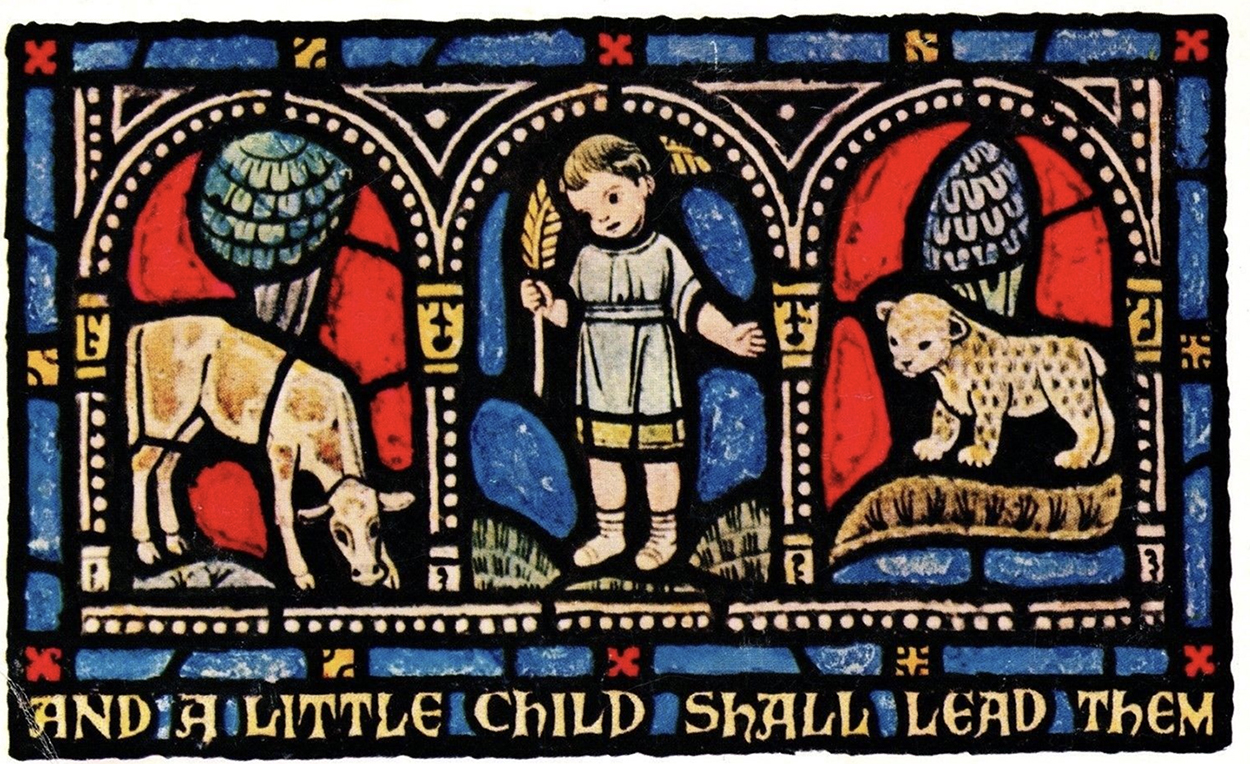
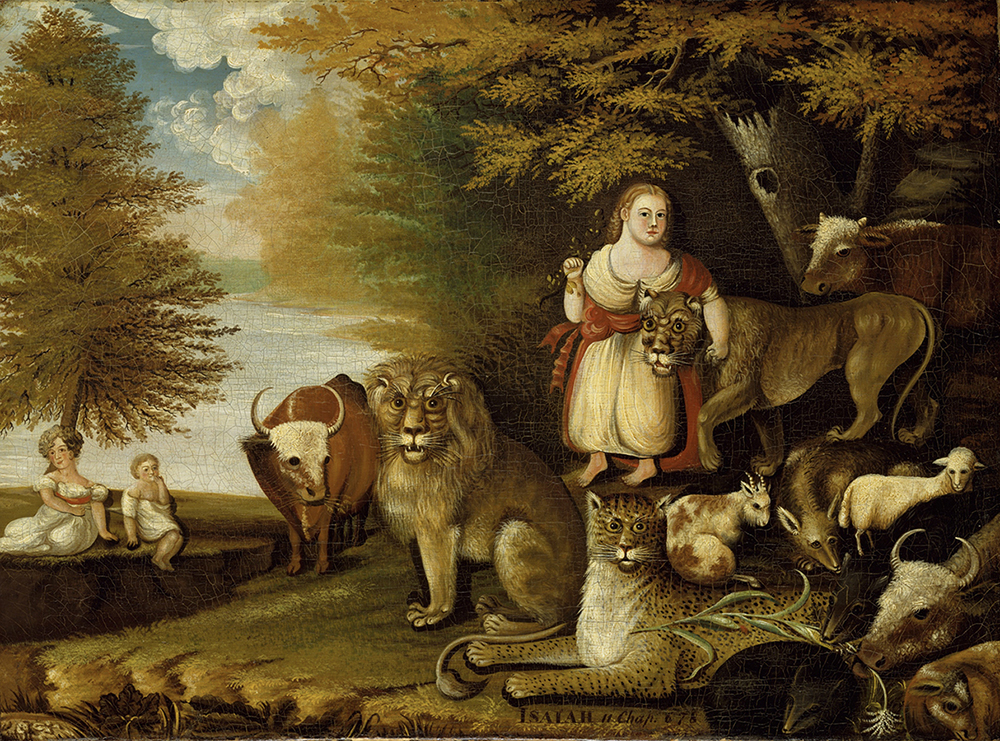
Today’s art invites us to see the child from this prophecy, read as the Prince of Peace. Reynold depicts a child making peace between animals that formerly would have been prey and predator. Likewise, Hicks' The Peaceable Kingdom (one of 62) is rich with animal imagery and child companions, speaking to the depth and breadth of Christ's peace.
The richness of this invitation to the Child is deepened by the nuances of Isaiah’s Hebrew—ha qāṭān—translated in other parts of Scripture as small, least, lesser, youngest, and even insignificant. To see this visualized is to bring it into stark reality. And hearing the song, “A Little Child Shall Lead Them,” we are urged to look past worldly power toward the humble child. It is in this view of Christ that we can still hold differences, disagreements even, but these won’t drive destructive division.
In the midst of Christmas, we are asked to find the royal child seemingly so insignificant that an animal's food trough was his bed. Yet like those with eyes to see and ears to hear, the Magi who studied Daniel's prophecy knew a king was born. Their revelation connects today with the Feast of the Holy Innocents, which contrastingly commemorates King Herod's attempt to destroy that king. It highlights the conflict between worldly power and divine humility. As Dunkerley’s poem concludes, it is not the power of the sword that increases the peaceable kingdom we long for, but the power of Christ in humility.
So, we must let Jesus lead us. Peter reminds us that God has exalted and honored Jesus “to be Prince and Savior, to give repentance to Israel and forgiveness of sins" (Acts 5:31). This is the ultimate relational peace: a forgiving one. We must follow and allow Christ to reign in our lives. Because only Jesus, “who wore no earthly crown,” embodies the humility, the qāṭān, to truly bring us and the world to peace.
Then each of us, whether as a wolf or lamb, leopard or young goat, donkey or elephant, should let go of our heavy burdens of power, rage, apathy, or pain, and gather around the “insignificant” child whom we find in the manger to restore us to the peace of our relationships with one another and with God.
Prayer:
Jesus, you are the Prince of Peace and Savior. Thank you that through your Salvation I am restored to peace with the Father and folded into your love even more deeply. May you reign in my life, leading me and your Church as the all-powerful yet humble Child. Lead me as a child in living out your peace in the world.
Amen
Steven Homestead
Artist, Composer, Writer, and Curator
About the Artwork #1:
A Little Child Shall Lead Them
Universal Peace Window
Joseph G. Reynolds
Date unknown
4 x 6 in. Continental-sized postcard of stained glass window
from the Washington National Cathedral
Washington, D.C.
Public Domain
About the Artist #1:
Joseph G. Reynolds (1903–1972) was an American stained glass artist and designer and partner in the glass studio of Reynolds, Francis & Rohnstock in Boston, Massachusetts.
https://www.aaa.si.edu/collections/joseph-g-reynolds-papers-9199
About the Artwork #2:
Peaceable Kingdom
Edward Hicks
c. 1830–32
Oil on canvas
45.4 x 60.6 cm
Gift of Edgar William and Bernice Chrysler Garbisch, 1970
The Metropolitan Museum of Art
New York, New York
Public Domain
The Quaker minister and painter Edward Hicks is best-known for his Peaceable Kingdom paintings, of which sixty-two exist. The paintings represent a messianic prophecy in the book of Isaiah (11:6, KJV): “The wolf also shall dwell with the lamb, and the leopard shall lie down with the kid; and the calf and the young lion and the fatling together; and a little child shall lead them.” During the 1820s, a severe schism formed within the Society of Friends (Quakers). In this version of Hicks’s favorite motif, the split is represented by the shattered tree trunk, and the desire for peace between the factions by the menagerie of discordant beasts lying down in perfect harmony. The lion and his companion the ox were, for Hicks, symbols of redemption.
https://www.metmuseum.org/art/collection/search/11081
About the Artist #2:
Edward Hicks (1780–1849) was an American folk painter and distinguished minister of the Society of Friends. He became a Quaker icon because of his paintings. Although they are not considered religious images, Hicks' Peaceable Kingdom paintings exemplify Quaker ideals of harmony, nonviolence, and peace. He painted sixty-one versions of this composition. Hicks used his paintings as a way to define his central interest, which was the quest for a redeemed soul.
https://www.nga.gov/collection/artist-info.1396.html
https://en.wikipedia.org/wiki/Edward_Hicks
About the Music #1: “Prince of Peace”
Lyrics #1:
Birth that brought the morning
A cry that meant the night would have to end
Angels’ song announcing
Blessed son come down to all mankind
What was prophesied has come to pass
Hope arriving means I’m free at last
Prince of Peace rule over me
Prince of Peace reign
O come all you despairing
There’s rest and comfort here under the star
Love fulfilled the promise
Messiah take the crown here in my heart
I’ll drop everything and run to you
Spend my life declaring this good news
Glory to God
Glóir a bhith dhut
About the Composers #1: Naomi Stirrat (lyrics), Gus Stirrat and Mhairi Marwick
Naomi Stirrat is a Scottish singer-songwriter and member of Celtic Worship. She studied at Edinburgh Napier and Queen Margaret Universities. Her recent theatre credits include The Snow Queen (Royal Lyceum Theatre), The Stamping Ground (Raw Material), The Prognostications of Mikey Noyce (Play Pie Pint), Every Brilliant Thing (Mull), and Still (Traverse).
Gus Stirrat is a freelance musician and bass player living in Glasgow, Scotland, who is also a member of Celtic Worship. He studied at the University of Strathclyde.
https://www.facebook.com/gstirrat/
Mhairi Marwick a freelance musician who studied music at the University of Strathclyde. Currently living in Glasgow, Scotland, Marwick is a private music instructor and a member of Celtic Worship.
https://www.facebook.com/mhairi.marwick/
About the Performers #1:
Celtic Worship is an organic cultural expression of sung worship in Scotland today. Composed of some of the most interesting and innovative musicians in Scotland’s flourishing contemporary music scene, the band is driven by a sincere desire to use their skills, giftings, and various abilities to praise and make known Jesus Christ. Together they explore the beautiful timeless truth of the Psalms and older hymns while contributing original works to the canon of Christian music—all with the instrumentation and musical language of their native Scotland, including bagpipes, whistles, and fiddle. The band has performed in the UK and Europe, and has released two studio albums. Celtic Worship are: Naomi Stirrat, David Hogg, Mhairi Marwick, Scott Wood, Chris Amer, Gus Stirrat, and Ifedade Thomas.
Music #2: “A Little Child Shall Lead Them” from the album The Cry - A Requiem For The Lost Child
Lyrics #2:
And a child shall find them, free them, lead them
From the lonely prison of the heart
There the breath of God is blowing, burning
All the death and hatred that tears apart
And the child shall take them
Hand outstretched to guide them
In the way of beauty, through the mind
There the power of good, is moving, healing
Turning blindness, into sight
The wolf and the lamb together are dwelling
The calf and the lion, asleep they lie
The bear and the kid together are feeding their young
While they’re playing side by side
And the child shall lead them to a land of freedom
Where darkness is forever turned to day
Where the world was broken, wounded, weeping
Then a child will kiss their tears away
And a little child will call them, soothe them
Bless them, hold them tenderly
The earth shall be filled with the glory of the Lord
As the waters cover the mighty sea
The world shall follow, humble, forgiven
No more sorrow, no more sorrow
And all creation, that once was groaning
Now shall rejoice in the way of the Lord
And the child shall lead them to a land of freedom
Where darkness is forever turned to day
Where the world was broken, wounded, weeping
Then a child will kiss their tears away
Where the world was broken, wounded, weeping
Then a child will kiss their tears away
Performer/Composer #2:
Adrian Snell (b. 1954) is an English pianist, keyboard player, singer, and composer. Classically trained at the Leeds College of Music in Leeds, England, Snell's musical career spanned nearly four decades. During this time, he produced twenty-three original albums, seventeen solo albums, and six major concept works. His album The Cry: A Requiem for the Lost Child premiered at St. Paul's Cathedral in aid of the charity Save the Children. He has performed in the United Kingdom, Israel, the United States, Australia, and throughout Europe, and has had many TV and radio performances worldwide. In the late 1990s, Snell semi-retired as a professional musician to train as a music therapist. This was a bold move by an artist whose albums and concerts attracted audiences across Europe. He completed the postgraduate diploma in music therapy awarded by the University of Bristol. He now works as a music therapist and arts therapy consultant for children with special needs at Three Ways School in Bath, England.
https://en.wikipedia.org/wiki/Adrian_Snell
https://www.adrian-snell.com/
About the Poetry & Poet:
William Arthur Dunkerley (1852–1941) was an English journalist, novelist, and poet. He lived in Ealing, West London, where he served as deacon and teacher at the Ealing Congregational Church beginning in the 1880s. In 1922, he moved to Worthing in Sussex, where he became the town's mayor. Dunkerley wrote under his own name, and also as John Oxenham for his poetry, hymn-writing, and novels. His poetry includes Bees in Amber: A Little Book of Thoughtful Verse (1913), which became a bestseller. He also wrote the poem "Greatheart." Perhaps one of his best-known works in the twenty-first century is his hymn "In Christ There is No East or West," composed in 1908 and currently found in hymnals of multiple Christian denominations.
https://en.wikipedia.org/wiki/William_Arthur_Dunkerley
https://allpoetry.com/John-Oxenham
About the Devotion Author:
Steven Homestead
Artist, Composer, Writer, and Curator
Steven Homestead is a Renaissance creative with a passion for arts and the church. For over a decade, he has served as a leader with the arts ministry at Saddleback Church in Southern California. He is also the co-founder of the new arts organization the Network of Christians in the Visual Arts (ncva.community). In all, Steven works to promote honor, champion voice, share wonder, and develop unity. Discover more at stevenhomestead.com.