December 17: Rose of Sharon | Lily of the Valley | Tender Plant
♫ Music:
Day 18 - Wednesday, December 17
Title: Rose of Sharon | Lily of the Valley | Tender Plant
Scripture #1: Song of Songs 2:1 (NKJV)
I am the rose of Sharon, and the lily of the valleys.
Scripture #2: Hosea 14:5–7 (NKJV)
I will be like the dew to Israel; He shall grow like the lily, and lengthen his roots like Lebanon. His branches shall spread; His beauty shall be like an olive tree, and his fragrance like Lebanon. Those who dwell under his shadow shall return; they shall be revived like grain, and grow like a vine. Their scent shall be like the wine of Lebanon.
Scripture #3: Isaiah 53:1–2 (NKJV)
Who has believed our report? And to whom has the arm of the Lord been revealed? For He shall grow up before Him as a tender plant, and as a root out of dry ground.
Poetry & Poet:
“Wildflower”
by Stanley Plumly
Some—the ones with fish names—grow so north
they last a month, six weeks at most.
Some others, named for the fields they look like,
last longer, smaller.
And these, in particular, whether trout or corn lily,
onion or bellwort, just cut
this morning and standing open in tapwater in the kitchen,
will close with the sun.
It is June, wildflowers on the table.
They are fresh an hour ago, like sliced lemons,
with the whole day ahead of them.
They could be common mayflower lilies of the valley,
day lilies, or the clustering Canada, large, gold,
long-stemmed as pasture roses, belled out over the vase--
or maybe Solomon's seal, the petals
ranged in small toy pairs
or starry, tipped at the head like weeds.
They could be anonymous as weeds.
They are, in fact, the several names of the same thing,
lilies of the field, butter-and-eggs,
toadflax almost, the way the whites and yellows juxtapose,
and have "the look of flowers that are looked at,"
rooted as they are in water, glass, and air.
I remember the summer I picked everything,
flower and wildflower, singled them out in jars
with a name attached. And when they had dried as stubborn
as paper I put them on pages and named them again.
They were all lilies, even the hyacinth,
even the great pale flower in the hand of the dead.
I picked it, kept it in the book for years
before I knew who she was,
her face lily-white, kissed and dry and cold.
Like the Lilies
It is so easy to take time for granted. For example, there’s the obvious error of failing to be present in the time we’ve been given, and then only regretting the gift we have ignored when it is too late.
But there are other ways of taking time for granted, too. Perhaps one of the more common errors is to take an overblown sense of the temporal world’s importance for granted, to believe that the time we have now is all we will ever have and everything that happens within it is absolute. We can begin to regard current events as the most important events, lose our sense of Kingdom perspective in a fear that Reality is in fact as bad as it seems right now, and that it is up to us to solve every problem we see or else fail to save the world from itself.
A wise mentor in my life often observes that it should not surprise us that the world is falling apart, or that horrible things happen all the time. The world is and has always been dying, in every recorded age — especially since the moment it crucified Christ, the Source and Sustainer of all life. Part of the wisdom of Advent is its setting aside of time to contemplate this truth. Advent looks toward Christ’s coming at the manger, an arrival that heralded the beginning of new life in our dying world — but that life could only begin through Christ’s death on the Cross. And Advent also looks toward Christ’s second coming, when He will bring the end of the current age in order to inaugurate an age of fully renewed, healed life.
As we take these four weeks to anticipate the two arrivals of our Lord, we find ourselves called to inhabit a great and often painful tension: we are called to live like the Life of the World in a world that is slowly dying. This is a necessarily difficult state of being. Death and life do not sit comfortably beside each other. Living this way often requires us to sustain the pain of death as, like Christ on the cross, we die to ourselves or on behalf of others for the sake of bringing new life into the world. No one who is truly surrendered to the Life of Christ will be spared the call to participate in the birth pangs of creation.
Consider the flowers mentioned in today’s Scripture selections, poem, and music. Perhaps more than any other plant, flowers show us that in this world the glorious beauty of life cannot save itself from the ravages of time. Flowers grow and bloom and are quickly gone. They wilt before our eyes within a matter of days, or even hours.
By God’s mercy, though, the fading of the flowers is not the end of the story. For Christ — He who is Life itself — joined us in this world, chose to bind Himself to a body like ours, and He too likens Himself to the flowers of the field:
I am the rose of Sharon, and the lily of the valleys.
He shall grow like the lily and lengthen His roots like Lebanon.
He shall grow up before him as a tender plant, and as a root out of dry ground.
By joining us in being like the flowers, Christ confirms, recreates, and makes eternal every life that is bound to His life. The Root of Jesse is life Himself, and cannot die — time cannot wither His beauty, death cannot overtake His existence. Therefore, the Rose of Sharon that died will spring back to life, and after it is resurrected it will never fade again.
Those of us who join Christ, who willingly participate in His death and His life, find that no matter what we face in this world of passing time, the Life that is given to us is enough to sustain us. We must consent to die with Christ. But as we do so His life will hold and carry us, and He will make us like Himself. Like Him, we shall grow like the lilies, and in the fullness of Christ’s time — in that new earth He will inaugurate one day soon — we will never die.
Prayer:
Lord, from everlasting to everlasting, you are God. A thousand years in Your sight are like yesterday when it is past, and like a watch in the night. They are like grass: in the morning it flourishes, in the evening it withers. All our days have passed away in Your wrath. We finish our years like a sigh. Please, teach us to number our days so we may gain a heart of wisdom.
Return, O Lord! How long? Have compassion on Your servants. Satisfy us early with Your mercy, that we may rejoice and be glad all our days. Let the beauty of the Lord our God be upon us and establish the work of our hands for us. Establish the work of our hands. Amen.
—from Psalm 90, NKJV
Alea Peister
Copywriter for Deloitte Digital
Alumna, Torrey Honors College
Biola University
About the Artwork:
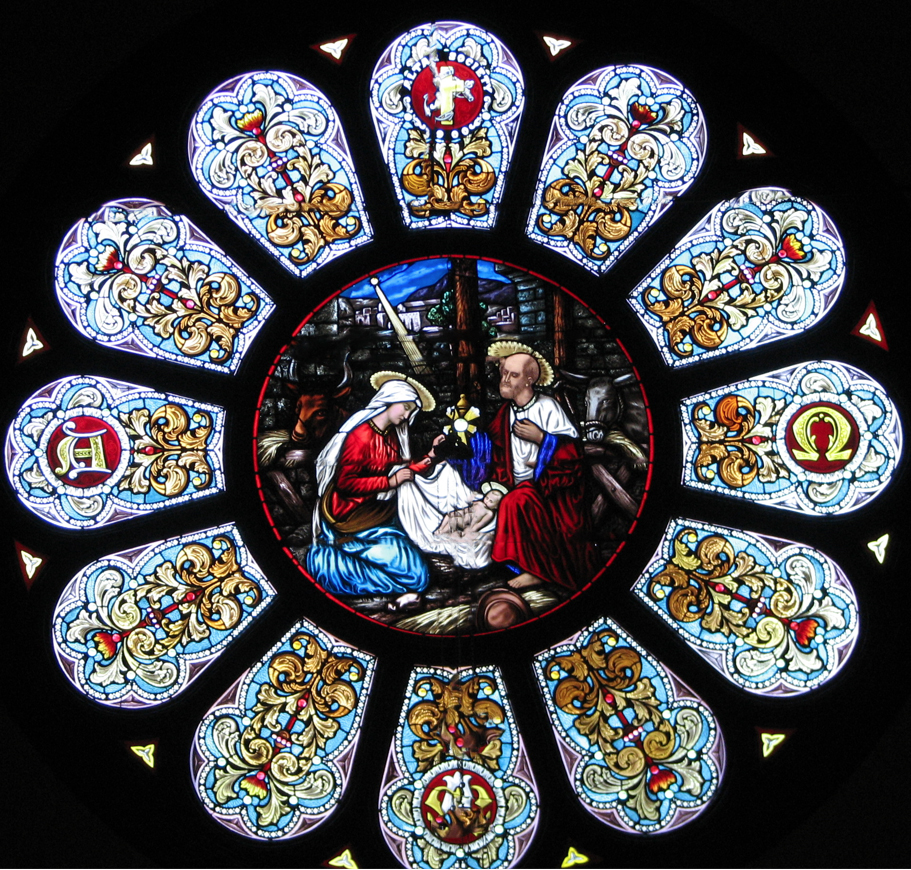
Rose Window
Unknown Artisans
1900
Stained glass window
Church of the Nativity
Menlo Park, California
Public Domain
The rose window of the Church of the Nativity was given to the parish in 1900 by the parish altar society, and not much more is known of its origins or the artist who designed it, but it is presumed to have been made in the United States. The window itself is a rose window—a circular stained glass window with a center image and radiating tracery resembling a flower with petals. Rose windows reached their height in high Gothic architecture in the thirteenth century and can be found in churches across the world, most famously in Notre-Dame de Paris Cathedral and Chartres Cathedral in France. “It’s a representation of the Nativity,” explained Msgr. Steven Otellini, pastor of the Church of the Nativity. The window’s illustration conflates several gospel accounts. “In Luke’s account, we have the details of the birth in Bethlehem in a stable, and in Matthew’s account we have the visit of the Magi with the star. So it has both of those combined together. It is Matthew’s star with Luke’s stable.”
https://sfarchdiocese.org/rose-window-illustrates-nativity-at-menlo-park-church/
About the Music: “Rose of Bethlehem” from the album Rose of Bethlehem
Lyrics:
There's a Rose in Bethlehem
With a beauty quite divine
Perfect in this world of sin
On this silent, holy night.
There's a fragrance much like hope
That it sends upon the wind
Reaching out to every soul
From a lowly manger's crib.
Oh, Rose of Bethlehem
How lovely, pure and sweet
Born to glorify the Father
Born to wear the thorns for me.
There's a Rose in Bethlehem
Colored red like mercy's blood
It's the flower of our faith
It's the blossom of God's love.
Though its bloom is fresh with youth
Surely what will be He knows
For a tear of morning dew
Is rolling down the Rose.
Oh, Rose of Bethlehem
How lovely, pure, and sweet
Born to glorify the Father
Born to wear the thorns for me.
There's a Rose in Bethlehem
With a beauty quite divine
Perfect in this world of sin
On this silent, holy night.
Oh, Rose of Bethlehem
How lovely, pure and sweet
Born to glorify the Father
Born to wear the thorns for me.
About the Composer:
Lowell Alexander (b. 1963) has had over six hundred songs published, and has worked with some of the best-known artists in music. His songs have been recorded by some of the top artists in the industry, including Point of Grace, Selah, Amy Grant, Art Garfunkle, Sandy Patti, Bill Gaither, Natalie Grant, Ellie Holcomb, and many others. Unlike the experience of most individuals in the music industry, instead of finding his career, the career actually found him. Lowell began his career as a teacher at a private Christian school, and was discovered by singer-songwriter Rich Mullins at the age of twenty-two.
https://www.nashvillechristiansongwriters.com/mastering-the-art-and-craft-of-songwriting-with-lowell-alexander/
About the Performers: Selah featuring Nicol (Smith) Sponberg
From their inception, the musical group Selah has been synonymous with the singing of hymns. In fact, the understated beauty of the trio’s 1999 debut album, Be Still My Soul, helped initiate a hymn revival in Christian music that continues today. Selah’s discography has significantly repopularized the church’s greatest songs and hymns while decorating the ensemble with numerous Dove Awards, number one singles, sold-out concert tours, and over two and half million sold albums.
https://en.wikipedia.org/wiki/Selah_(band)
https://selahonline.com/
Nicol (Smith) Sponberg (b. 1970) is an American Christian music singer. She was formerly a member of her brother's band Selah under her maiden name, Nicol Smith. She is best known for her 2004 album Resurrection and the title song "Resurrection.” The third single from her solo album Resurrection, "Crazy in Love," crossed over to peak at No. 13 on the Billboard Adult Contemporary chart and was one of the Top 30 most played adult contemporary songs of 2006. A stunningly powerful vocalist, she calls on her experience as the child of missionaries and of world travels to deliver an album steeped in musical diversity.
https://www.amazon.com/Nicol-Smith/dp/B00004ST62
https://en.wikipedia.org/wiki/Nicol_Sponberg
About the Poetry & Poet:
Stanley Plumly (1939–2019) was an American poet and the director of the creative writing program at University of Maryland, College Park. His working-class upbringing on farmland would feature heavily in his poetry and books. His upbringing was also influenced by Quakerism. He graduated from Wilmington College in Ohio and taught for a number of years at Ohio University, where he helped found The Ohio Review. He taught the writing program at the University of Maryland from 2009. Plumly was called "the most English American poet" and held Keats in high regard.
https://en.wikipedia.org/wiki/Stanley_Plumly
https://www.poetryfoundation.org/poets/stanley-plumly
About the Devotion Author:
Alea Peister
Copywriter for Deloitte Digital
Alumna, Torrey Honors College
Biola University
Alea holds an M.F.A. in spiritual writing from Seattle Pacific University. She is passionate about exploring the relationship between creativity and prayer in ministry with her church community, Saint Matthew’s Church in Newport Beach, CA. Alea daylights as a marketing copywriter at Deloitte Digital, and is an alumna of Biola’s English Department and the Torrey Honors College. You can follow her writerly escapades on Instagram at @alea_peister and Substack at aleapeister.substack.com.