December 12: Wonderful Counselor | Advocate
♫ Music:
Day 13 - Friday, December 12
Title: Wonderful Counselor | Advocate
Scripture #1: Isaiah 9:6 (NKJV)
For unto us a Child is born, unto us a Son is given; and the government will be upon His shoulder. And His name will be called Wonderful, Counselor.
Scripture #2: Romans 8:26–27 (NKJV)
Likewise the Spirit also helps in our weaknesses. For we do not know what we should pray for as we ought, but the Spirit Himself makes intercession for us with groanings which cannot be uttered. Now He who searches the hearts knows what the mind of the Spirit is, because He makes intercession for the saints according to the will of God.
Scripture #3: 1 John 2:1–2 (NKJV)
My little children, these things I write to you, so that you may not sin. And if anyone sins, we have an Advocate with the Father, Jesus Christ the righteous. And He Himself is the propitiation for our sins, and not for ours only but also for the whole world.
Poetry & Poet:
“Nicodemus”
by Ann Power
In the cool darkness, lit only by the Temple
braziers, the olive tones of your robe
are enfolded in the deeper
greens of evening, only the gold braid
at wrists and hem reflects in the
meager light.
Your presence, not your words,
frame the residual question,
artesian longing drawing you back
to the Rabbi whose words
startle you, whose actions magnify the
presence of a gracious God.
You knew He would be here in
the gazophylakion, the hall of the Treasury.
The fragrant oils stored nearby, whisper
their occasional message.
On a raised platform, eleven trumpets for
alms rest between marble pillars.
You have come perplexed, bringing
your cynicism, curious
to know more about this one whose
awesome wisdom upsets your own.
His eyes focus on your doubt.
He guesses your question. Chides.
He confounds your literalness,
the particulars,
makes them of no consequence.
Being born is not a matter of
being born.
He talks of Scripture, of
Moses raising the bronze serpent
before his impatient, suffering people
in the stillness of the desert, and of
Himself being lifted up.
How can you understand the sign—
not the mark on the lintel of the house,
the sign of exclusion for Passover,
but the sign of the cross, inclusion,
when it has yet to happen?
In enigma, in anticipation,
He calls you to contemplation,
to a gaze that will blind
the darkness of your life
and lift you up forever.
Wonderful Counselor
Jesus’ role as counselor and advocate is, perhaps, the most mysterious of all names this week. Certainly, it stands out from everything else Scripture records him doing (e.g. teaching, healing, serving, etc.). Could it truly be the case that the patient, long-suffering mercy of God displayed throughout salvation history is mirrored here in the gentle listening and patient attentiveness Jesus shows again and again to the lost, hurting, and confused? It seems almost too good to believe, but that is exactly what makes him a wonderful counselor.
In the pages of the New Testament, we get arresting glimpses of this ministry. Over and over, we see that Jesus attends to his disciples along with the many special people he encounters, like the Samaritan woman at the well (John 4:1-30), as a wise and experienced counselor. Through careful listening, he finds the right questions to ask, so often drawing out the deeper matters of the heart. In the midst of such honest revelations, he is bold to address those hurting and lost hearts with the right words - sometimes stern; sometimes soft, but always aimed at their healing.
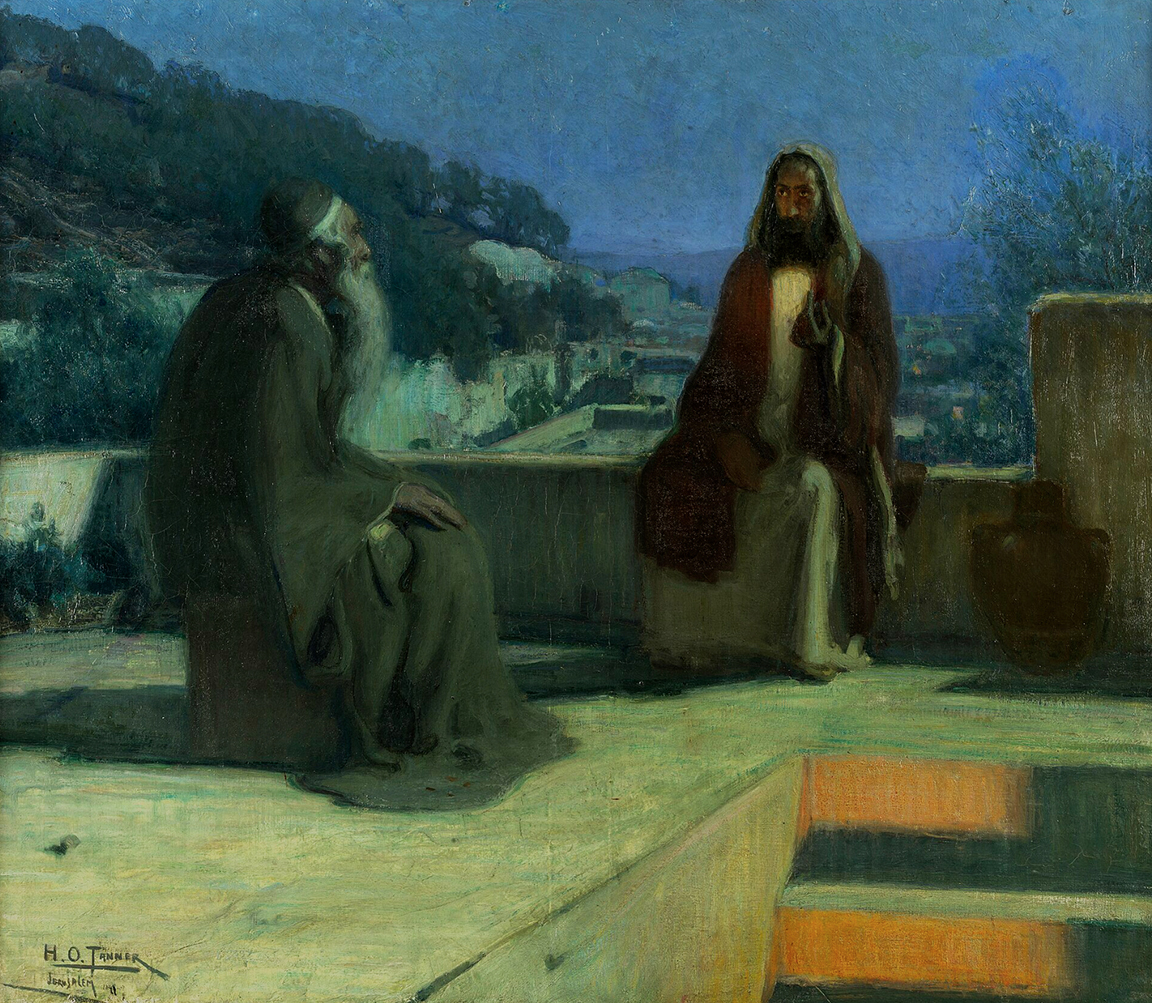
Today, we are given two imaginings of Nicodemus’ encounter with the Wonderful Counselor. They complement each other and, in their own ways, offer us imaginative access to this powerful moment alone with Jesus. In Ann Power’s poem, we can begin to feel our way through Nicodemus’ profound uncertainty and confusion and find that his questioning is nonetheless sustained by an utter fascination with this Rabbi who makes so palpable the “presence of a gracious God.” Startled and perplexed, Nicodemus, however, seems increasingly willing to see all his wisdom upset, if only he can get closer to grasping the mystery of who he is dealing with.
Henry Ossawa Tanner’s depiction showcases the steady and calm side of Jesus. Without judging the clandestine efforts of this ‘teacher of Israel,’ Tanner’s Jesus seems untroubled and open, waiting to see another heart unfold before him. Such mercy––like the painting’s warm lamplight from below - speaks of our true home in God and beckons Nicodemus to receive the fullness of divine love meeting him here.
And, there it is. “The soul felt its worth.” It’s exactly what the Counselor had in mind.
The name of Jesus is, indeed, full of wonders. Today, we should remember that he is a wonderful counselor and advocate, because he takes the longings and wounds of our hearts just as––if not more ––seriously than we do. The very manner of his counsel shows that if it matters to us, then, it matters to him. That is - as our musical selections display - great cause for singing, with a music full of radiant delight about the wonder of Jesus’ kindness and mercy.
May such exuberance grant us courage to bring our whole selves to the place where, like Blind Bartimaeus, we can hear the Advocate’s question afresh: “What do you want me to do for you?” (Mk. 10:51).
Prayer:
Father, Son, Spirit, you know me through and through; you love me as I am; you touch my life with healing; you call me to bear fruit. I give my wounded self to you, to be a channel of healing to others, to be a wounded healer, with Christ, who died, and rose, and comes again.
Amen.
Prayer from Pray as You Go (Jesuits in Britain)
Dr. Taylor Worley
Visiting Associate Professor of Art History
Wheaton College
Wheaton, Illinois
About the Artwork:
Nicodemus Visiting Christ
Henry Ossawa Tanner
1899
Oil on canvas
85.56 x 100.33 cm
Pennsylvania Academy of Fine Arts
Philadelphia, Pennsylvania
Public Domain
Artist Henry Ossawa Tanner achieved his greatest success with evocative biblical paintings marked by dramatic, even supernatural, light effects. Tanner's father was a bishop in the African Methodist Episcopal Church, and his religious convictions instill these works with a contemplative quietude and profoundly human sensitivity to his subject matter. Painted during the artist's second trip to the Holy Land (sponsored by Tanner's Philadelphia patron Rodman Wanamaker), Nicodemus Visiting Christ depicts a scene from the gospel of John in which the Pharisee Nicodemus visits Jesus by night to receive His teachings. Tanner remarked that the six months he spent in Jerusalem lent an air of authenticity to this work, and he used local people as sitters. This painting was shown at the Pennsylvania Academy of the Fine Arts’ 1899 annual exhibition, where it was awarded the Lippincott Prize for the best figurative work and purchased for their collection.
https://www.pafa.org/museum/collection/item/nicodemus
About the Artist #1:
Henry Ossawa Tanner (1859–1937) was one of the first African American painters to gain international acclaim. Born to a minister in the African Methodist Episcopal Church, religious themes pervaded much of Tanner’s work. After training at the Pennsylvania Academy of the Fine Arts in Philadelphia in 1879, he moved to Paris in 1891 and decided to stay there, being readily accepted into French artistic circles. Tanner made a pilgrimage to the Holy Land and responded to his journey with powerful paintings of the life of Christ. The story of Nicodemus visiting Christ at night spoke to African American worship habits that Tanner remembered from his youth. After emancipation, freed slaves continued to meet at night, as they had done when they had been forbidden to read the Bible. He painted this secret nighttime meeting many times, Nicodemus sitting in submission at the feet of Jesus in later ones. Themes of race and status pervade many of his biblical paintings.
https://www.pafa.org/museum/collection/item/nicodemus
About the Music #1: “For Unto Us a Child is Born” from the album Messiah
Lyrics #1:
For unto us a child is born,
Unto us a son is given,
And the government shall be upon His shoulder;
And His name shall be called Wonderful,
Counsellor, the Mighty God,
The Everlasting Father,
The Prince of Peace.
About the Composer #1:
George Frideric Handel (1685–1759) was a German baroque composer who spent the bulk of his career in London and became well-known for his operas, oratorios, anthems, and organ concertos. He was strongly influenced by the great composers of the Italian baroque and the middle-German polyphonic choral tradition. Musicologist Winton Dean writes that his operas show that "Handel was not only a great composer; he was a dramatic genius of the first order.” Handel’s Messiah was first performed in Dublin, Ireland, in April 1742 and received its London premiere nearly a year later. After an initially modest public reception, the oratorio gained in popularity, eventually becoming one of the best-known and most frequently performed choral works in Western music. Handel's Messiah has been described by the early-music scholar Richard Luckett as "a commentary on Jesus Christ's Nativity, Passion, Resurrection, and Ascension," beginning with God's promises as spoken by the prophets and ending with Christ's glorification in heaven. The music for the Messiah was completed in only twenty-four days and Handel wrote the letters SDG (Soli Deo Gloria, “To God Alone the Glory”) at the end of the manuscript. In many parts of the world, it is accepted practice for the audience to stand when the “Hallelujah” chorus is performed. The tradition is said to have originated with the first London performance of the Messiah, which was attended by King George II. As the first notes of the triumphant “Hallelujah” chorus rang out, the king was so moved that he rose to his feet and remained standing until the end of the chorus, initiating a tradition that has lasted well over two centuries. Indeed, the “Hallelujah” chorus is one of the most awe-inspiring pieces of music ever written.
https://en.wikipedia.org/wiki/Messiah_(Handel)
https://www.smithsonianmag.com/arts-culture/the-glorious-history-of-handels-messiah-148168540/
About the Librettist:
Charles Jennens (1700–1773) was a wealthy, reclusive English landowner and patron of the arts. Jennens attended Oxford University, where he formed his lifelong interest in music and literature and became a devout Anglican. As a friend of Handel, he helped author the libretti of several of his oratorios, most notably Messiah. Jennens' deep knowledge of the Bible and wide literary interest led him to prepare or contribute to many libretti for Handel, including Saul, L'Allegro, il Penseroso ed il Moderato, Messiah, Belshazzar, and possibly Israel in Egypt. It is also clear that, on occasion, Handel accepted Jennens' suggestions and improvements to his compositions. Their most famous collaboration is Jennens' libretto for Messiah, drawn entirely from the Bible. Musicologist Watkins Shaw describes it as "a meditation of our Lord as Messiah in Christian thought and belief” that "amounts to little short of a work of genius.”
https://en.wikipedia.org/wiki/Charles_Jennens
About the Performers #1: London Philharmonic Orchestra and London Philharmonic Choir
The London Philharmonic Orchestra (LPO) is one of the world's finest symphony orchestras, balancing a long and distinguished history with a reputation as one of the UK's most adventurous and forward-looking orchestras. The orchestra was founded by Sir Thomas Beecham in 1932, and since then has been headed by many of the great names in the conducting world, including Sir Adrian Boult, Bernard Haitink, Sir Georg Solti, Klaus Tennstedt, and Kurt Masur. The orchestra's current principal conductor is Vladimir Jurowski, who was appointed in 2007. The London Philharmonic Orchestra has been performing at Southbank Centre's Royal Festival Hall in London since it opened in 1951. Having long been embraced by the recording, broadcast, and film industries, the London Philharmonic Orchestra broadcasts regularly on TV and radio. The orchestra also works with the Hollywood and UK film industries, and has been recording soundtracks for over half a century.
https://www.lpo.org.uk/
London Philharmonic Choir was founded in 1947 as the chorus for the London Philharmonic Orchestra (LPO). Working under esteemed conductors such as Boulez, Elder, Gardner, Gatti, Haitink, Jurowski, Masur, Nézet-Séguin, Norrington, Rattle, Solti, Tennsted, and Welser-Möst, the choir has performed regularly with the LPO and other world-class orchestras at major venues and festivals throughout the years. From time to time, the choir tours abroad—recently to Budapest, Paris, Lucerne, Rome, Athens, Spain, Germany, the Czech Republic, Poland, the Canary Islands, and further afield to Hong Kong, Kuala Lumpur, and Perth. In January 2004 they were invited to sing in the Vatican’s Papal Concert of Reconciliation. They have also built up an impressive discography throughout their history and continue to participate in recording for CD, radio, and television.
https://lpc.org.uk/about-the-choir/
About the Music #2: “His Name is Wonderful” from the album Sunday Hymn Serenade
Lyrics #2:
His name is wonderful.
His name is wonderful.
His name is wonderful.
Jesus, my Lord.
He is the mighty King,
Master of everything.
His name is wonderful,
Jesus, my Lord.
He's the Great Shepherd,
The Rock of all ages,
Almighty God is He.
Bow down before Him.
Love and adore Him.
His name is wonderful,
Jesus, my Lord.
He's the Great Shepherd,
The Rock of all ages,
Almighty God is He.
Bow down before Him.
Love and adore Him.
His name is wonderful,
Jesus, my Lord.
Jesus, my Lord.
About the Composer #2:
Audrey Mieir (1916–1996) was the composer of many gospel songs, probably best known for her song “His Name Is Wonderful.” At age ten, Audrey was greatly influenced by the Canadian-born American Pentecostal evangelist Aimee Semple McPherson, and the music that was performed at the Angelus Temple in Los Angeles, California. Mieir started writing songs and conducting choirs at an early age, and in the early 1950s formed the world-famous Harmony Chorus, where she ministered with composer and evangelist Phil Kerr. In the 1960s, Mieir began her musical concert tour throughout the United States, where established and beginning gospel music artists would appear. She was instrumental in the careers of many gospel songwriters and performers, particularly the Grammy Award–winning Andrae Crouch. http://mannamusicinc.com/writers-songs/audrey-mieir.html
About the Performer #2:
Rosemary Siemens is a Canadian world-class improv violinist and vocalist. Rosemary Siemens has mesmerized audiences around the world since the age of three. Rosemary is a small-town farm girl dominating the world-stage playing a 300-year-old violin named “Sparkle” that was played in King Louis XIV’s orchestra. She’s performed four times at New York’s Carnegie Hall, played private concerts for two U.S. Presidents and Canadian Prime Ministers, and 16-time GRAMMY Award-Winner David Foster, and was the first violinist to ever perform at the Sistine Chapel and St. Peter’s Basilica at the Vatican since its first mass in 1483. In addition to having recorded nine-albums as a solo-violinist, Golden West Broadcasting recently commissioned Canadian composer Victor Davies to compose a violin concerto for Rosemary entitled “The Journey”, which was performed by the Winnipeg Symphony Orchestra in a sold-out world premiere at Centennial Concert Hall.
https://www.rosemarysiemens.com/meet-rosemary-siemens/
About the Poetry & Poet:
Ann Power is a retired faculty member from the University of Alabama. She enjoys writing historical sketches as well as poems based in the kingdoms of magical realism. Her work has appeared in publications such as Spillway, Gargoyle Magazine, The Birmingham Poetry Review, Dappled Things, The Copperfield Review, The Ekphrastic Review, The Loch Raven Review, Halfway Down the Stairs, Amethyst Review, and others. She was nominated for Best of the Net in Poetry for her poem “Ice Palace.”
https://stonepoetryjournal.com/ann-power/
About the Devotion Author:
Dr. Taylor Worley
Visiting Associate Professor of Art History
Wheaton College
Wheaton, Illinois
Taylor Worley is visiting associate professor of art history at Wheaton College and director of a research project on conceptual art and contemplation. He completed a Ph.D. in the areas of contemporary art and theological aesthetics in the Institute for Theology, Imagination, and the Arts at the University of St. Andrews and is the author of Memento Mori in Contemporary Art: Theologies of Lament and Hope (Routledge, 2020). Taylor is married to Anna, and they have four children: Elizabeth, Quinn, Graham, and Lillian.