December 10: Rabbi | Teacher
♫ Music:
Day 11 - Wednesday, December 10
Title: Rabbi | Teacher
Scripture #1: Matthew 23:8–12 (NKJV)
“But you, do not be called ‘Rabbi’; for One is your Teacher, the Christ, and you are all brethren. Do not call anyone on earth your father; for One is your Father, He who is in heaven. And do not be called teachers; for One is your Teacher, the Christ. But he who is greatest among you shall be your servant. And whoever exalts himself will be humbled, and he who humbles himself will be exalted.”
Scripture #2: Mathew 7:29 (ESV)
...for he was teaching them as one who had authority, and not as their scribes
Scripture #3: John 1:49 (NKJV)
Nathanael answered and said to Him, “Rabbi, You are the Son of God! You are the King of Israel!”
Poetry & Poet:
“Bartholomew: Disciple”
by Jack Ridl
I never knew what was going on.
He would say, “Let’s go,” and we
would follow. “Follow” was his word.
And we would. Fools we were to let that
take us all that way. Why we did to this day
I don’t know. Look how it ended. Look
what it became. But what did we have
to stay for? Nothing. There wasn’t much
work. Nothing much to do. There were no
stories left. Bread. Fish. So we ended up
with more bread and fish. But we did find
stories and stories. Well, what else is there?
I never did much along the way. Look it up.
In the big deal painting I’m the one who appears
rather glassy eyed, and believe me, it wasn’t the wine.
I just went along. The miracles had been done before.
I will say, though, that it was his words. Words!
Imagine. Words had never done what his did.
I’d listen, and I wasn’t much of a listener. Then
later I would try to make sense of them. I couldn’t.
But I could feel them. And maybe that was it, how
they got inside you and made you wonder and wrinkle.
They got in my brain’s garden and made it seem like
the roots were above ground and all the flowers and
vegetables, all the nourishing, were now below.
He didn’t reverse things, exactly—the first shall be
last and the last first and all that. It was that everything
changed inside me when he said those things. It was
what happened to me. I started looking at lepers and the poor
and paid no attention anymore to the kings and scribes and
Pharisees. I had thought the world of them. Now they seemed
unimportant in their importance. See? See how hard it is to
explain this stuff? You just started seeing everything with a
new mind. You began to be drawn to a whole new world,
and it was a world. Like now. A world within a world, one
drawing you, the other imposing itself on you. Why am I
telling you what you already know? Erosions. That’s it.
The reversals were erosions. And in what was left, I
wanted to plant what didn’t belong. Lilies in fields.
You might say, okay, whatever, and yet those words
did become flesh, my flesh. And my flesh, my body, held
the kingdom of God, and if it’s a place that’s a place
for children, then most of what I know really doesn’t matter.
Labor doesn’t, and money, and reason, and, well, you
go make a list. He’d get me so confused. And then we’d
head off worrying about how we would eat and where
we’d sleep. Our feet were filthy. My God, we were always
filthy. We stank. And then he’d go and point at birds or
stalks of grain, even stop and have us kneel before a flower,
and then he’d smile. That haunts me still. That smile.
And then he died. He brought out hate, not love. He had
a terrifying sense of justice. Nothing he said or did
was impossible. Maybe that was it. It was all possible.
Rabbi, Teacher
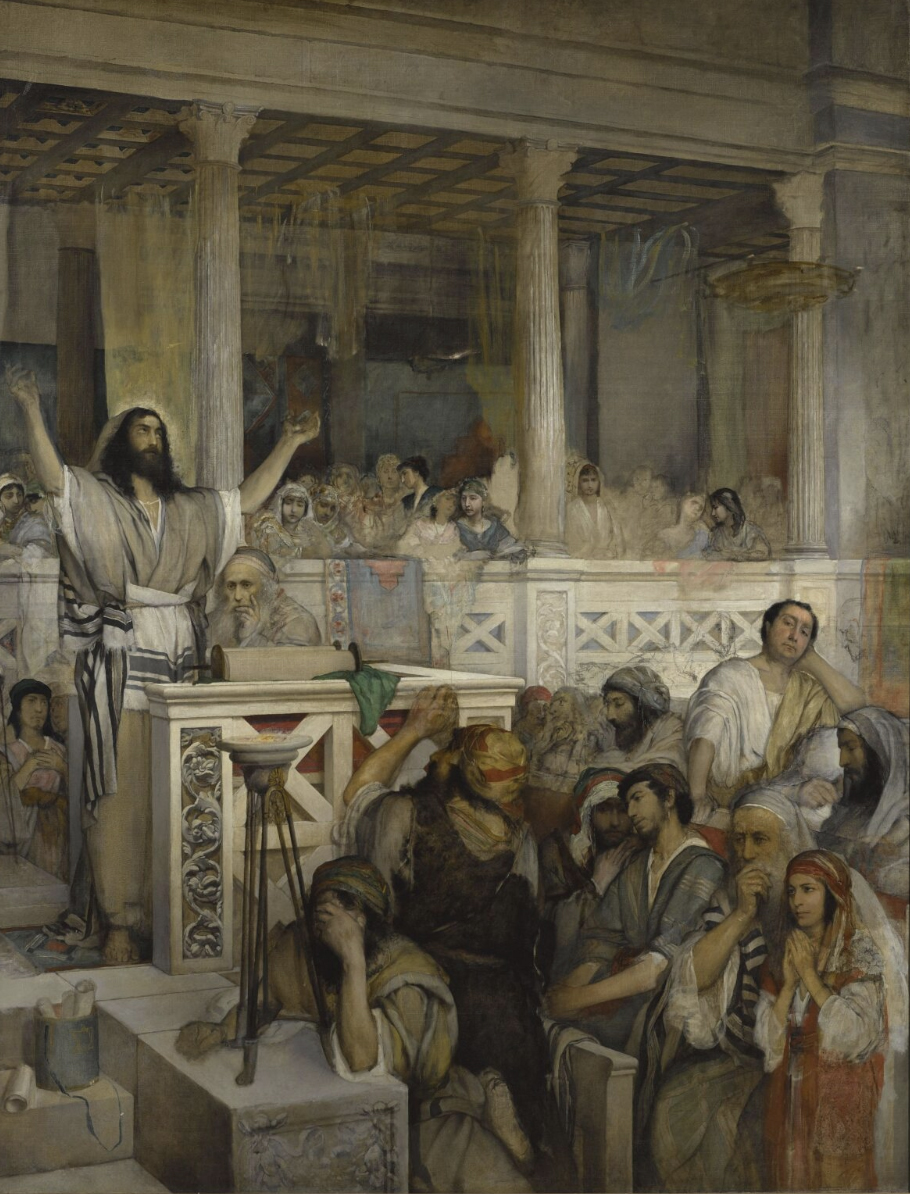
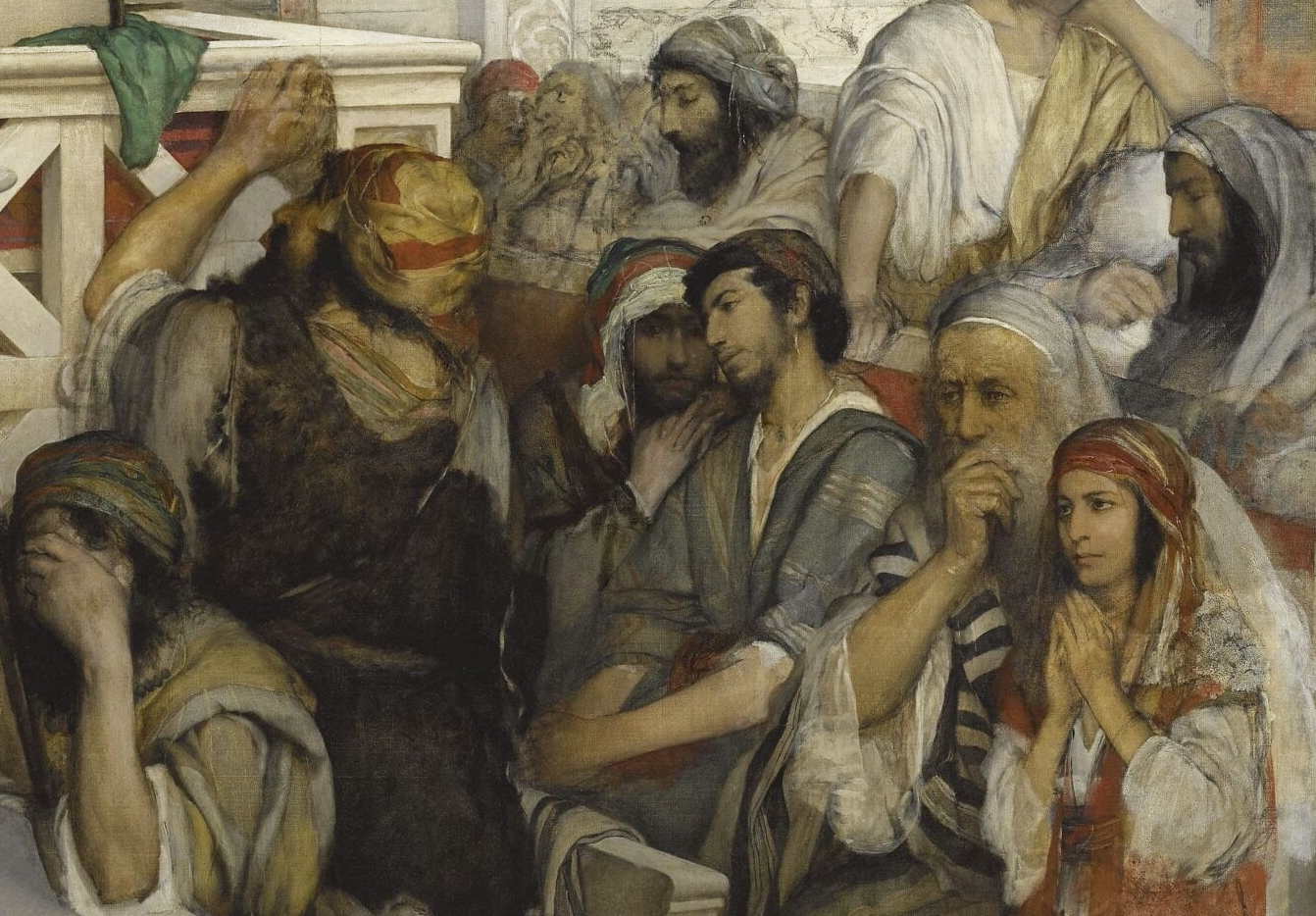
If you’ve ever done any teaching or public speaking, you will recognize the expressions on the faces in Gottlieb’s painting. These are not students who’ve drifted away into daydreams or boredom. Indeed, almost everyone seems to be attentive—but not quite the kind of attentive for which every speaker yearns.
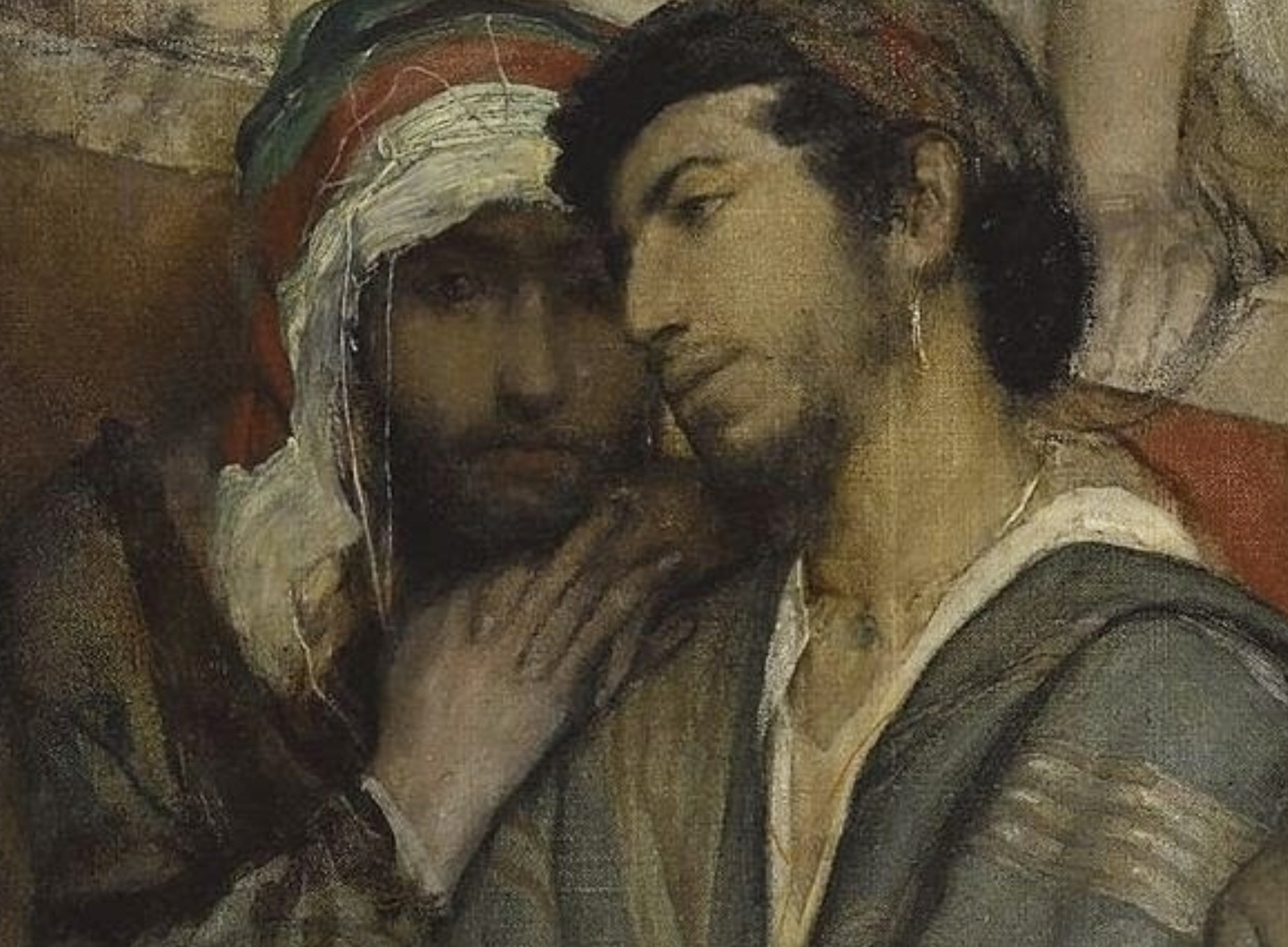
Most have understood only too well what Jesus has said, and you can almost hear the simmer of hushed comments exchanged by neighbors. One can listen to an argument and mentally toy with the evidence or turns of phrase quite calmly—like twiddling your thumbs. But these are more than minds at work; more than mere understanding passes here. Bodies take new shape under the weight of dawning conviction. That fellow in the foreground, about to knock over the tripod, barely holds himself up. He’s massaging his temples and coddling despair. Those two rascals hissing to each other in the detail of the image are aghast but trying to play it cool. Fingers lace and lips purse. The old man next to him sits deep in wonder, contemplation rippling through decades of memory. And the woman in red has decided that the end of the teaching is too long to wait. She’s heard all she needs to start praying immediately and in earnest.
Today’s Scripture passages include a set of commands which—I’ll admit—I seldom permit to bother me. In Matthew 23, Jesus takes aim at the names and titles that his disciples have traditionally used to express and receive honor and respect. But more than the names and titles, Jesus means to lay waste to traditions and systems used to determine how and why they award attention and dignity: “but the greatest among you shall be your servant.” To this humdinger he adds further paradox: “whoever exalts himself shall be humbled, and he who humbles himself shall be exalted.”
It sounds nice, doesn’t it? In the way that the beatitudes “sound” nice. And impossible. Would it ‘twere so simple: that the macho hooligans who exalt themselves and go strutting about on the bones of the poor would be humbled, and that the humble among us were lifted to glory and exaltation. I like it, but I seldom believe it. I let myself feel irritated with students who write me emails that don’t acknowledge my graduate degrees, and too often I casually disregard those who don’t have the titles that announce worldly achievement.
Ridl's poem provides a portrait of a man who refuses to live in cognitive dissonance with his Lord’s commands. Bartholomew refuses to let anything thwart his loyalty; he allows Jesus’ words to come alive in him, shaping character and commitment independent of mere understanding: “The words…got in my brain’s garden…/ and [I] paid no attention anymore to the kings and scribes and /Pharisees. I had thought the world of them.”
To abandon “rabbi,” “father,” “teacher,” and the tones with which I speak those words, is, I think, to abandon the ways I squirm and hustle for honor in a hierarchy that rises in the world like Babel. It is to declare that the goods I enjoy come to my hand from Christ, and not from my sweat, skill, or charm. It is to declare every man and woman my brother or sister in the family of God. “Nothing he said or did / was impossible. Maybe that was it. It was all possible.”
May it be so.
Prayer:
O God the Father of our Lord Jesus Christ, our only Savior,
the Prince of Peace: Give us grace seriously to lay to heart the
great dangers we are in by our unhappy divisions; take away
all hatred and prejudice, and whatever else may hinder us
from godly union and concord; that, as there is but one Body
and one Spirit, one hope of our calling, one Lord, one Faith,
one Baptism, one God and Father of us all, so we may be all
of one heart and of one soul, united in one holy bond of truth
and peace, of faith and charity, and may with one mind and
one mouth glorify thee; through Jesus Christ our Lord.
Amen.
- From the Book of Common Prayer
Dr. Phillip Aijian
Adjunct Professor
Torrey Honors College
Biola University
About the Artwork:
Christ Teaching at Capernaum (overall with detail images)
Maurycy Gottlieb
1878–79
209 x 271.5 cm
National Museum
Warsaw, Poland
Public Domain
Near the end of his short life, the Polish-Jewish artist Maurycy Gottlieb painted, but didn’t finish, the painting entitled Jesus Preaching at Capernaum. The artist rendered the scene with accurate details of the clothing and architecture of biblical Palestine. At the right side, a Roman figure in a toga turns toward the viewer in seeming boredom, though he is surrounded by those in Middle Eastern clothing who are listening attentively as Jesus teaches. Gottlieb’s painting includes distinctly Jewish elements, including the figure of Jesus, who wears a tallit (prayer shawl) around His waist as He preaches from an open Torah scroll on the synagogue’s bimah (lectern). His sacred status is indicated by a halo’s golden glow. In the painting, the congregation is clearly Jewish. Jesus teaches to His fellow Jews directly from the sacred Torah scroll, thus emphasizing the common roots that unify His mission with the biblical Scriptures of the Hebrew Bible. Their reactions are various, but mostly serious with varying degrees of intensity, ranging from the figure with hands uplifted in prayer to the moody introspection of his neighbor below the lamp, who covers his face in withdrawal or meditation. Also incorporating Jewish custom, Gottlieb shows a women’s gallery that is isolated above and behind the main sanctuary.
https://smarthistory.org/maurycy-gottlieb/
About the Artist:
Maurycy Gottlieb (1856–1879) was a Polish-Jewish realist painter of the Romantic period. Considered one of the most talented students of renowned Polish painter Jan Matejko, Gottllieb died at the young age of twenty-three. Despite his premature death, more than three hundred of his works survive—mostly sketches, but also oil paintings, though not all are finished. After the fall of the Iron Curtain, many Polish art collections unknown in the Western Bloc were popularized, and his reputation grew greatly.
https://smarthistory.org/maurycy-gottlieb/
https://en.wikipedia.org/wiki/Maurycy_Gottlieb
About the Music: “Teach Me Your Ways” from the album Calvary Chapel Music Volume One
Lyrics:
Teach me your ways, O Lord.
And I will walk in Your truth,
Give me an undivided heart,
That I may fear Your name.
Teach me Your ways, O Lord.
Grant me a humble heart.
Counsel me in Your ways,
That might see Your face.
I will praise You Lord, my God.
I will praise You with all my heart.
I will glorify Your name forever.
Teach me Your ways O Lord.
Teach me Your ways O Lord
And I will walk in Your truth.
Give me an undivided heart,
That I may fear Your name.
Teach me Your ways, O Lord.
Grant me a humble heart.
Counsel me in Your wisdom
That might see Your face.
I will praise You Lord, my God.
I will praise You with all my heart,
I will glorify Your name forever,
Teach me Your ways O Lord.
I will praise You Lord, my God.
I will praise You with all my heart.
I will glorify Your name forever,
Teach me Your ways O Lord.
Teach me Your ways O Lord.
About the Performers: Fernando Ortega and Celeste Krenz
Fernando Ortega (b. 1957) is an evangelical Christian singer-songwriter and worship leader, heavily influenced by traditional hymns, as well as his family’s New Mexico heritage. He is noted for his interpretations of many traditional hymns and songs, such as “Give Me Jesus,” “Be Thou My Vision,” and “Praise to the Lord, the Almighty.” Much of his current inspiration comes from the North American Anglican liturgy. It is from his heritage and classical training at the University of New Mexico that Ortega derives his sound, embracing country, classical, Celtic, Latin American, world, modern folk, and rustic hymnody. From the late 1970s to the mid-1990s, he served in music ministry at a number of churches in New Mexico and Southern California.
https://en.wikipedia.org/wiki/Fernando_Ortega
http://www.fernandoortega.com/
Celeste Krenz had a successful career spanning twenty years as a singer-songwriter. Celeste has shared the stage with LeAnn Rimes, Hall and Oates, and many others, while also filling venues as a headliner. She has released ten albums. In 2011, newly married, she and her husband, Bill Feehely, along with a family friend, were led to purchase a small juice bar in a Nashville-area YMCA and The Urban Juicer was born.
https://undalumni.org/news-stories/alumni/celeste-krenz.html
About the Poetry & Poet:
Jack Ridl (b. 1944) is an American poet and was a professor of English at Hope College in Holland, Michigan. Ridl graduated from Westminster College, Pennsylvania, with a B.A. (1967) and M.Ed. (1970). His poetry has appeared in LIT, The Georgia Review, FIELD, Poetry, Ploughshares, Prairie Schooner, Gulf Coast, The Denver Quarterly, Chelsea, Free Lunch, The Journal, Passages North, Dunes Review, and Poetry East.
https://ridl.wordpress.com/about/
https://poets.org/poet/jack-ridl
https://en.wikipedia.org/wiki/Jack_Ridl
About the Devotion Author:
Dr. Phillip Aijian
Adjunct Professor
Torrey Honors College
Biola University
Phillip Aijian holds a Ph.D. in Renaissance drama and theology from UC Irvine, as well as an M.A. in poetry from the University of Missouri. He teaches literature and religious studies and has published in journals like ZYZZYVA, Heron Tree, Poor Yorick, and Zocalo Public Square. He lives in California with his wife and children.
https://www.phillipaijian.com/
https://californiospress.com/2020/02/02/write-to-me-an-interview-with-poet-phillip-aijian/