December 5: Ancient of Days
♫ Music:
Day 6 - Friday, December 05
Title: Ancient of Days
Scripture #1: Psalm 90:1–2 (NKJV)
Lord, You have been our dwelling place in all generations. Before the mountains were brought forth, Or ever You had formed the earth and the world, even from everlasting to everlasting, You are God.
Scripture #2: Daniel 7:13–14 (NKJV)
“I was watching in the night visions, and behold, One like the Son of Man, coming with the clouds of heaven! He came to the Ancient of Days, and they brought Him near before Him. Then to Him was given dominion and glory and a kingdom, that all peoples, nations, and languages should serve Him. His dominion is an everlasting dominion, which shall not pass away, and His kingdom the one which shall not be destroyed.”
Scripture #3: 1 Timothy 1:17 (NKJV)
Now to the King eternal, immortal, invisible, to God who alone is wise…
Poetry & Poet:
“BC:AD”
by U. A. Fanthorpe
This was the moment when Before
Turned into After, and the future's
Uninvented timekeepers presented arms.
This was the moment when nothing
Happened. Only dull peace
Sprawled boringly over the earth.
This was the moment when even energetic Romans
Could find nothing better to do
Than counting heads in remote provinces
And this was the moment
When a few farm workers and three
Members of an obscure Persian sect
Walked haphazard by starlight straight
Into the kingdom of heaven.
Ancient of Days
I retired from fulltime work last year. I am now officially “old,” approaching “elderly.” Soon, if my life continues, I will be “ancient.” It’s likely to happen—my mom lived nearly 102 years, and she was ancient!
For us, being “ancient” means: greatly limited, failing, fragile, needing care, nearly dead.
But for God, it means potent majesty and greatness—the momentum of the Ancient of Days carries us all along through life as He rules over time. Only the Ancient of Days knows the end from the beginning—our end from our beginning!
And so, we trust Him, and we entrust ourselves to Him.
The blessed news is that this mighty, eternal, powerful being is also good!
He is outside of time and space, and yet he chose to join our limited existence to save us. Words fail to form in our mouths to tell of the bigness, the immensity of our God and his glorious kingdom. His kingdom encompasses all of our kingdoms. He, who is from the beginning, rules over all. All glory to him.
We find relief from this pressing weight of glory only through worship. He has chosen to reveal himself in the beauty of this creation, and we worship through mirroring his beauty with our (sub)creations, as words fail. Beauty reflects his glory. And so, we sing, we paint, we dance, we craft poetry, and we worship. All of today’s artworks are expressions of worship.
Faced with the heavy glory of the Ancient of Days, we explode in grand hymns: “Oh help us to see, ’tis only the splendor of light hideth thee.”
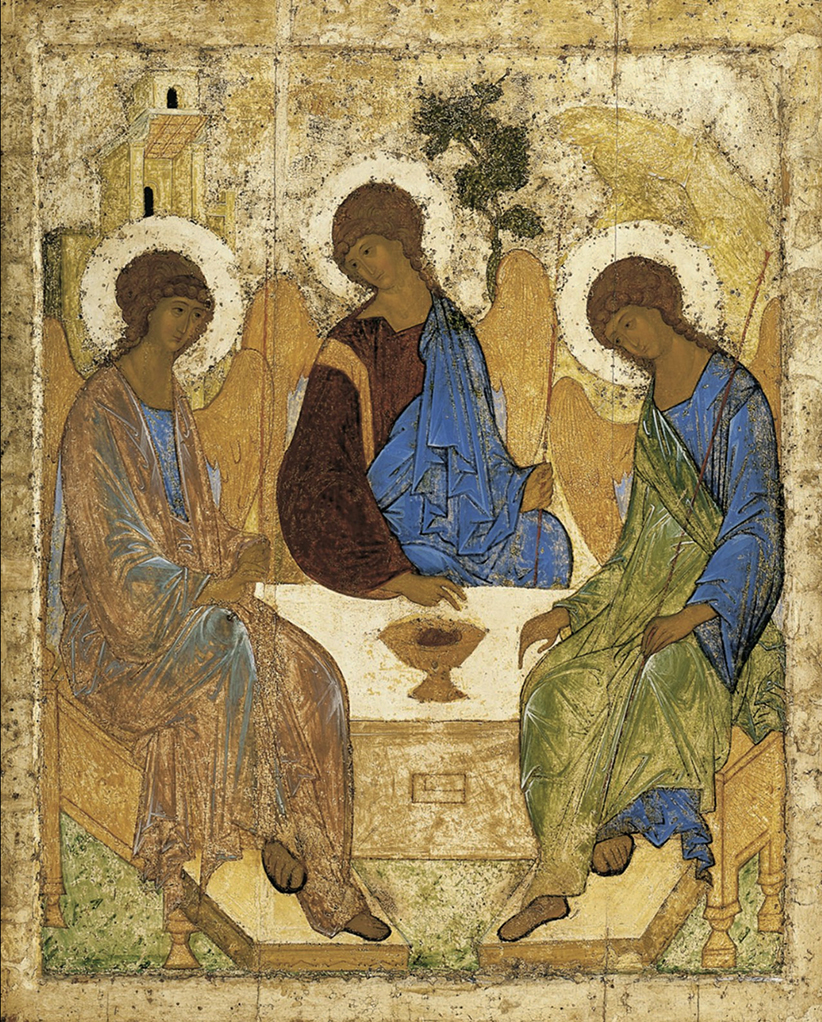
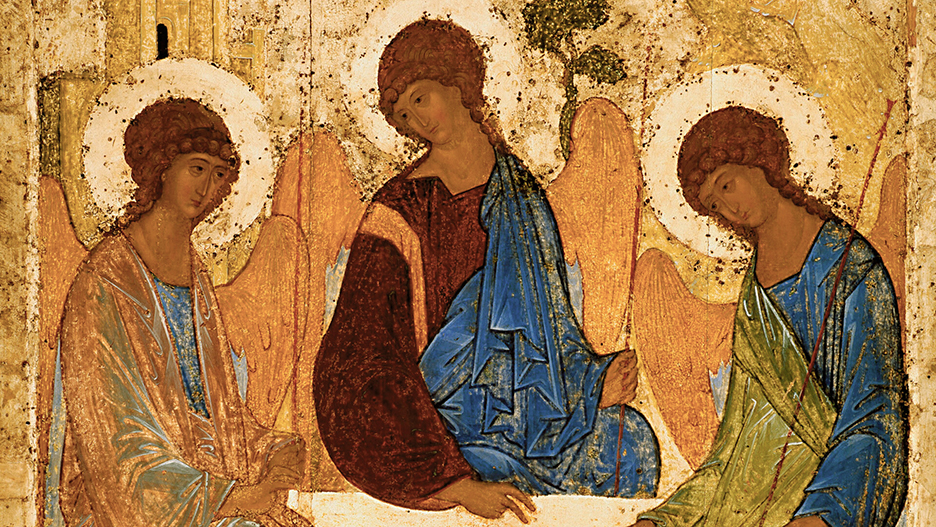
Artist Rublev’s Trinity icon emphasizes God’s glorious light. Notice the icon itself is the source of light; notice the translucent, glowing robe of God the Father on the left; notice the radiant halos of the Trinity. Notice how the perspective of the icon extends out to us, the viewer: We are invited to the table with the Trinity. There is a place for us.
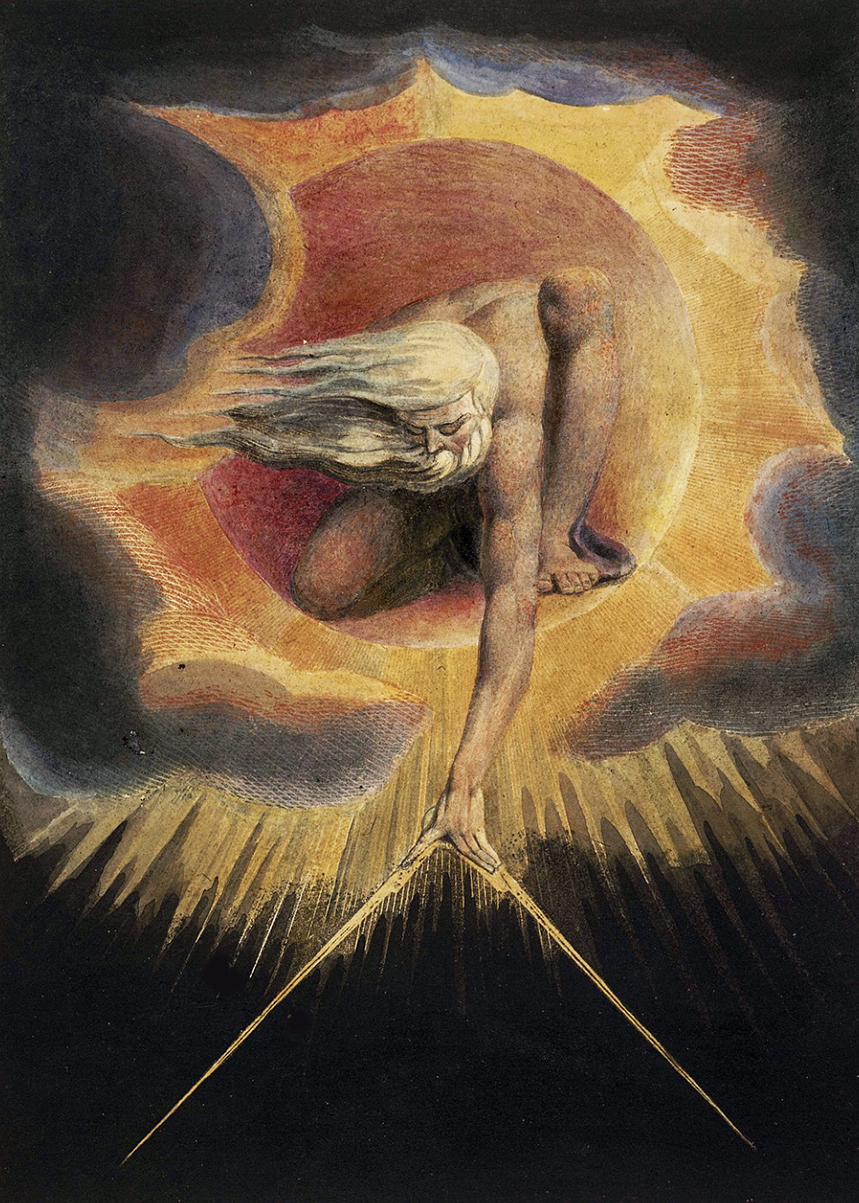
Blake’s artwork showing the Creator God is entitled “Ancient of Days,” which is one of the names for God from the book of Daniel. Daniel, along with Job, is known as one of the greatest prayer warriors, and it benefits us to pay attention to how he addresses God in prayer. I have pondered this as I’ve prepared this devotional. Addressing God as Ancient of Days helps me pray: “Ancient of Days, You have seen it all! Literally, you have seen it all!”
It puts my concerns and requests in context. I am addressing the One who has seen it all. Nothing is new to him; nothing is outside of His ken nor His reach. And since I am his daughter and so dear to him, I come to my Father, my Abba, the Ancient of Days—and He lovingly attends to me and my petitions.
He means us well. He made us for himself. God made us, Jesus came to save us, the Holy Spirit makes his home in us. Father, Son, and Holy Spirit invite us into perfect union.
The Almighty God, the Creator of time and space, the Ancient of Days joined us humans here on this planet and provided the way for us to join him. He showed us his very self.
The Ancient of Days had a birthday in order that we may have new birth. He loves us so much.
Fixing my mind and heart on this reality changes my prayer.
He alone is wise. He alone is king above all, having all dominion.
We are messy and ignorant, and we don’t know what we don’t know. But we can take comfort in this: in the end, we all are brought to him, and in our Judge—the High King, the Ancient of Days—we find the face of our Father, the face of our brother Jesus.
And so, we rest, and we trust him.
Prayer:
All glory to you, Lord Christ, Ancient of Days. In our limitation, trapped in time and space, we do not know our end from our beginning. But you are from eternity past; you are the author of time and space; you are the beginning and the end. All things come from you, and you rule over all. Ancient of Days, we bow in awe and worship you—and we also run to you because you have called us to yourself, and we are so thankful to be your own dear ones. We come to you our Father, through our Lord Jesus, by the Holy Spirit.
Amen.
Betsy A. Barber, Psy.D.
Faculty Emerita, Institute for Spiritual Formation
Talbot School of Theology
Supervisor, Biola Counseling Center
Biola University
About the Artwork #1:
The Ancient of Days
William Blake
Frontispiece in Blake’s book entitled Europe a Prophecy
1794
Color relief etching and white-line etching in blue, black, red, and yellow with added hand coloring
30.8 x 24.8 cm
British Museum
London, England
Public Domain
The Ancient of Days is a design created by artist William Blake, originally published as the frontispiece to the 1794 book entitled Europe a Prophecy. The figure in the work crouches in a circular design with a cloud-like background. His outstretched hand holds a compass over the darker void below. Ancient of Days is a name for God in the Book of Daniel and has been used as a source of inspiration in art and music—denoting the Creator's aspects of eternity combined with perfection.
https://en.wikipedia.org/wiki/Ancient_of_Days
About the Artist #1:
William Blake (1757–1827) was a nineteenth-century writer and artist who is regarded as a seminal figure of the Romantic Age. His writings and works of visual art have influenced countless writers and artists through the ages and he has been deemed both a major poet and an original thinker. Blake began writing at an early age and claimed to have had his first vision, which was of a tree full of angels, at the age of ten. He studied engraving and grew to love Gothic art, which he incorporated into his own unique works. A misunderstood poet, artist, and visionary throughout much of his life, Blake eventually found admirers late in life and has been vastly influential since his death.
https://en.wikipedia.org/wiki/William_Blake
https://www.tate.org.uk/art/artists/william-blake-39
About the Artwork #2:
The Trinity Icon (The Hospitality of Abraham) (overall and detail view)
Andrei Rublev
1425–1427
Tempera on wood
142 x 114 cm
Old Katholikon of the Trinity Lavra
Sergiyev Posad
Russia
Public Domain
The Trinity Icon painting by Russian artist Andrei Rublev is based on a story from Genesis called The Hospitality of Abraham in which the biblical patriarch Abraham was sitting in front of his tent when he saw three men standing in front of him. Without any hesitation, Abraham offered the strangers food, water, and a place to rest (Genesis 18:1–8). These three visitors whom Abraham entertained were heavenly—teaching us that God can send His heavenly messengers to fulfill His plans. It’s a reminder that we may not always realize whom we are speaking with, as Hebrews 13:2 (NKJV) reminds us: “Do not forget to entertain strangers, for by so doing some have unwittingly entertained angels.” Western Christian Art has traditional and stereotypically depicted God the Father as an old man with flowing white hair and beard. In contrast, Eastern Christian art refrained from depicting God the Father, because He has never been seen in human form. Eastern theologians insist that images of Christ in contrast, must be made because in His incarnation Christ took on human form. A rare exception is Rublev's Trinity Icon that shows Father, Son and Holy Spirit in the forms of visiting angels.
https://en.wikipedia.org/wiki/Trinity_(Andrei_Rublev)#:~:text=The%20Trinity%20was%20painted%20on,a%20mountain%20(Mount%20Moriah).
About the Artist #2:
Little is known about artist Andrei Rublev (1360–1430) except that he was a medieval Russian painter of Orthodox icons and frescoes. It is known that he worked with other masters of the art form in Moscow and Vladimir, but the only work that has been authenticated as his alone is The Trinity Icon.
https://en.wikipedia.org/wiki/Andrei_Rublev
About the Music #1: “Ancient of Days” from the album Hymns in the Round
Lyrics #1:
Though the nations rage,
Kingdoms rise and fall,
There is still one King
Reigning over all.
So I will not fear,
For this truth remains.
That my God is,
The Ancient of Days.
None above Him,
None before Him.
All of time is in His hands.
For His throne it shall remain,
And ever stand.
All the power, all the glory,
I will trust in His name,
For my God is the Ancient of Days.
Though the dread of night,
Overwhelms my soul.
He is here with me
I am not alone.
O His love is sure,
And He knows my name.
For my God is the Ancient of Days.
None above Him,
None before Him.
All of time is in His hands.
For His throne it shall remain,
And ever stand.
All the power, all the glory,
I will trust in His name.
For my God is the Ancient of Days.
Though I may not see
What the future brings.
I will watch and wait
For the Savior King.
Then my joy complete,
Standing face to face
In the presence of
The Ancient of Days.
None above Him,
None before Him.
All of time is in His hands.
For His throne it shall remain
And ever stand.
All the power, all the glory,
I will trust in His name
For my God is the Ancient of Days.
For my God is the Ancient of Days.
About the Composers #1: Jonny Robinson, Richard Thompson, Michael Farren, and Jesse Reeves
Jonny Robinson is a singer-songwriter whose most popular song is entitled “Yet Not I But Through Christ in Me.” Robinson, a key member of the Australian worship band CityAlight, believes that music for the church should be theologically rich, and accessible for the congregation. “When we write songs for the church, we’re thinking about songs that point people to Christ and the gospel in a way that they can grab hold of,” Robinson said. For Robinson and his team, songwriting is an act of service to the church—helping the congregation sing songs that reflect truth and the gospel message.
https://genius.com/artists/Jonny-robinson/q/most-popular-song
https://www.insights.uca.org.au/transforming-communities-through-music-and-worship/
Richard Thompson is an Australian singer-songwriter who is the co-founder of the Australian band CityAlight, which is the music ministry of St. Paul’s Castle Hill in Sydney, Australia. The vision of CityAlight is to write songs with biblically rich lyrics and simple melodies for the Christian church to sing.
https://www.challies.com/interviews/get-to-know-cityalight-and-their-new-album/
https://saltandlight.sg/news/behind-the-heart-hitting-lyrics-cityalights-songwriter-rich-thompson-who-wrote-yet-not-i-but-through-christ-in-me/
https://www.thegospelcoalition.org/article/australian-church-christian-songwriting/
Grammy-nominated and multiple Dove Award–winning songwriter and producer Michael Farren has shifted his focus from performing and touring to songwriting and music production. Raised with a deep love for all kinds of music, Michael has penned hundreds of songs that span multiple genres. His first commercial success was the global worship anthem “Let It Rain,” which appeared on Michael W. Smith’s double platinum album Worship. Over the last two decades, numerous artists have sung Michael’s songs, including Natlie Grant, Mandisa, Blind Boys of Alabama, Alisa Turner, Finding Favour, Unspoken, Big Daddy Weave, Karen Peck, Darlene Zschech, and CityAlight. https://curbwordmusicpublishing.com/blogs/writers/michael-farren#:~:text=Grammy%20nominated%20and%20multiple%20Dove,band%20Pocket%20Full%20Of%20Rocks.
Jesse Reeves is a father, musician, songwriter, church planter, and pastor. As a musician, Jesse spent seventeen years leading worship, touring, and playing bass guitar in the Chris Tomlin Band. As a songwriter, he has co-written several songs that are sung in the church around the world today, including “How Great is Our God,” “Our God,” “I Will Rise,” “Indescribable,” and “Lord, I Need You.” As a church planter, Reeves has been a part of planting the Austin Stone Community Church in Austin, Texas, and Passion City Church in Atlanta, Georgia.
https://www.becworship.com/jesse-reeves
About the Performers #1:
Shane & Shane is the combination of solo artists Shane Barnard and Shane Everett. After meeting in college, Shane & Shane began writing songs and touring the country leading worship. Over fifteen years later, they’re writing more music than ever, with no intention of slowing down. Their desire has always been to glorify the Lord instead of themselves, and they do so by writing music that is biblically based, lyrically rich, and sonically engaging. Over the past few years, Shane & Shane have dedicated their lives to encouraging and equipping worship leaders and their teams through an online resource called the Worship Initiative, an equipping ministry and collective of worship leaders that has grown into a thriving community.
https://www.shaneandshane.com/about
About the Music #2: “Immortal, Invisible” from the album Hymns of the Father (Reawaken Hymns)
Lyrics #2: “Immortal, Invisible, God Only Wise”
Immortal, invisible, God only wise,
In light inaccessible hid from our eyes,
Most blessed, most glorious, the Ancient of Days,
Almighty, victorious, Thy great Name we praise.
Unresting, unhasting, and silent as light,
Nor wanting, nor wasting, Thou rulest in might;
Thy justice, like mountains, high soaring above
Thy clouds, which are fountains of goodness and love.
Great Father of glory, pure Father of light,
Thine angels adore Thee, all veiling their sight;
Of all Thy rich graces this grace, Lord, impart
Take the veil from our faces, the vile from our heart.
All laud we would render; O help us to see
'Tis only the splendor of light hideth Thee,
And so let Thy glory, Almighty, impart,
Through Christ in His story, Thy Christ to the heart.
About the Composers #2: Lyrics by Walter Chalmers Smith; music is St. Denio (Joanna), a Welsh melody
Walter Chalmers Smith (1824–1908), was a hymnist, author, poet, and minister of the Free Church of Scotland, chiefly remembered for his hymn "Immortal, Invisible, God Only Wise." He attained considerable reputation as a poet. Some of his works were written under the names of Orwell or Hermann Kunst.
https://en.wikipedia.org/wiki/Walter_Chalmers_Smith
The St. Denio (Joanna) tune is used to sing the hymn "Immortal, Invisible, God only Wise," which is a traditional Welsh folk tune. It first appeared as a hymn tune in John Robert's Caniadau y Cyssegr, in 1839, where it is called PALESTINA. Gustav Holst published it in The English Hymnal, in 1906, bringing it into modern hymnody. The name refers to St. Denis, the patron saint of France.
https://songsandhymns.org/hymns/tunes/detail/st.-denio
About the Performer #2:
In 2015, Nathan Drake was serving as a worship leader in a small multigenerational church in St. Louis, Missouri. In an effort to create a worship experience accessible to everyone, he began to introduce classic hymns, but found it difficult to find arrangements that were both fully modern and true to the original song. He began writing his own arrangements for the church and sharing them on YouTube for others to use. As more churches started utilizing the arrangements, Nathan created Reawaken Hymns to help churches develop intentional, accessible, gospel-centered worship. Eight years later, Reawaken Hymns reaches millions of people every year and has been used by thousands of churches around the world.
https://www.reawakenhymns.com/about
About the Poetry & Poet:
Ursula Askham Fanthorpe (1929–2009) was an English poet, who published under the name U. A. Fanthorpe. Her poetry commented mainly on social issues. She earned a B.A. and an M.A. at Saint Anne’s College, Oxford University. She taught at Cheltenham Ladies’ College for sixteen years, serving as head of the English department for eight years. In her forties, she left education to work as a clerk and receptionist at a psychiatric hospital, an experience that led her to write the poems in her first book, Side Effects (1978). In an interview for The Poetry Archive, she stated, “Poetry is important because it reaches the places that other kinds of writing can't reach. Poetry has all the voices—wit, sincerity, pastiche, tragedy, delight, and most importantly it's with us from the start of our lives to the end: at the start of our lives, with lullabies and mothers crooning to babies, at the end of our life, with hymns over a grave.” Fanthorpe published nine volumes of poetry during her lifetime and received honorary doctorates from the University of Gloucestershire and the University of the West of England. In 1994, she was the first woman to be nominated to the post of Professor of Poetry at Oxford University.
https://www.poetryfoundation.org/poets/ua-fanthorpe
https://en.wikipedia.org/wiki/U._A._Fanthorpe
About the Devotion Author:
Betsy A. Barber, Psy.D.
Faculty Emerita, Institute for Spiritual Formation
Talbot School of Theology
Supervisor, Biola Counseling Center
Biola University
Betsy Barber has a clinical practice with specialization in the soul care and mental health of Christian workers. She has taught courses in spiritual formation, soul care, missions, maturity, and marital relationships. She has particular interest in spiritual formation and supervision of students in spiritual direction and mentoring. She worked with her husband as a missionary in Bible translation and counseling ministries for twenty-four years. In addition to being a licensed clinical psychologist, she has background and training in spiritual direction.