December 3: The Glory of the Lord | King of Glory
♫ Music:
Day 4 - Wednesday, December 03
Title: The Glory of the Lord | King of Glory
Scripture #1: Isaiah 40:3–5, 9 (NKJV)
The voice of one crying in the wilderness: “Prepare the way of the Lord; make straight in the desert a highway for our God. Every valley shall be exalted and every mountain and hill brought low; the crooked places shall be made straight and the rough places smooth; the glory of the Lord shall be revealed, and all flesh shall see it together; for the mouth of the Lord has spoken.”. . .O Zion, you who bring good tidings, get up into the high mountain; O Jerusalem, you who bring good tidings, lift up your voice with strength, lift it up, be not afraid; say to the cities of Judah, “Behold your God!”
Scripture #2: Psalm 24:7–10 (NKJV)
Lift up your heads, O you gates! And be lifted up, you everlasting doors! And the King of glory shall come in. Who is this King of glory? The Lord strong and mighty, The Lord mighty in battle. Lift up your heads, O you gates! Lift up, you everlasting doors! And the King of glory shall come in. Who is this King of glory? The Lord of hosts, He is the King of glory.
Poetry & Poet:
“The Wild”
by Wendell Berry
In the empty lot ” a place
not natural, but wild ” among
the trash of human absence,
the slough and shamble
of the city’s seasons, a few
old locusts bloom.
A few wood birds
fly and sing
in the new foliage
warblers and tanagers, birds
wild as leaves; in a million
each one would be rare,
new to the eyes. A man
couldn’t make a habit
of such color,
such flight and singing.
But they’re the habit of this
wasted place. In them
the ground is wise. They are
its remembrance of what is.
The Glory of the Lord
Sometimes it’s hard to look up.
Sometimes we have so much on our plates in the present moment and so much to occupy our minds that we forget to raise our eyes and look beyond our own circumstances.
Sometimes the present circumstances seem hopeless.
Sometimes all we see, is
‘...the empty lot “a place
not natural, but wild” among
the trash of human absence,
the slough and shamble
of the city’s seasons, a few
old locusts bloom’
(Berry, 1999).
In such times, in these ‘city’s seasons’ (Berry, 2019), to glorify God is more than our individual human habits can manage.
In such times, we need the encouragement of others who, like the birds in Berry’s poem, habitually partake in the ‘wise’ ground and call us to a corrected living in the present moment. A corrected living as participation in ‘a remembrance of what is’ (Berry, 2019). A remembrance of who God is and who we are in light of who he is.
In such times, we need the words of Scripture, the words of Isaiah and the writer of Psalm 24 to declare the glory of God when we are unable to ‘make a habit of such color.’ In today’s scripture passages we read (or hear in the musical selections) prophetic declarations of a glorious King- a Messiah who has come first in the incarnation, and who will also return to rule and reign in his second coming. We wait in this Advent season remembering and anticipating- remembering Christ’s first coming and anticipating his second.
Sometimes we wait well, a present moment participation in ‘a remembrance of what is.’ Sometimes we wait with disinterest and distraction -sometimes with impatience.
He is the King of Glory no matter our circumstances - no matter how we wait. The Psalmist encourages us,
‘...O Jerusalem, you who bring good tidings, lift up your voice with strength, lift it up, be not afraid; say to the cities of Judah, “Behold your God!” (Isaiah 40:9)
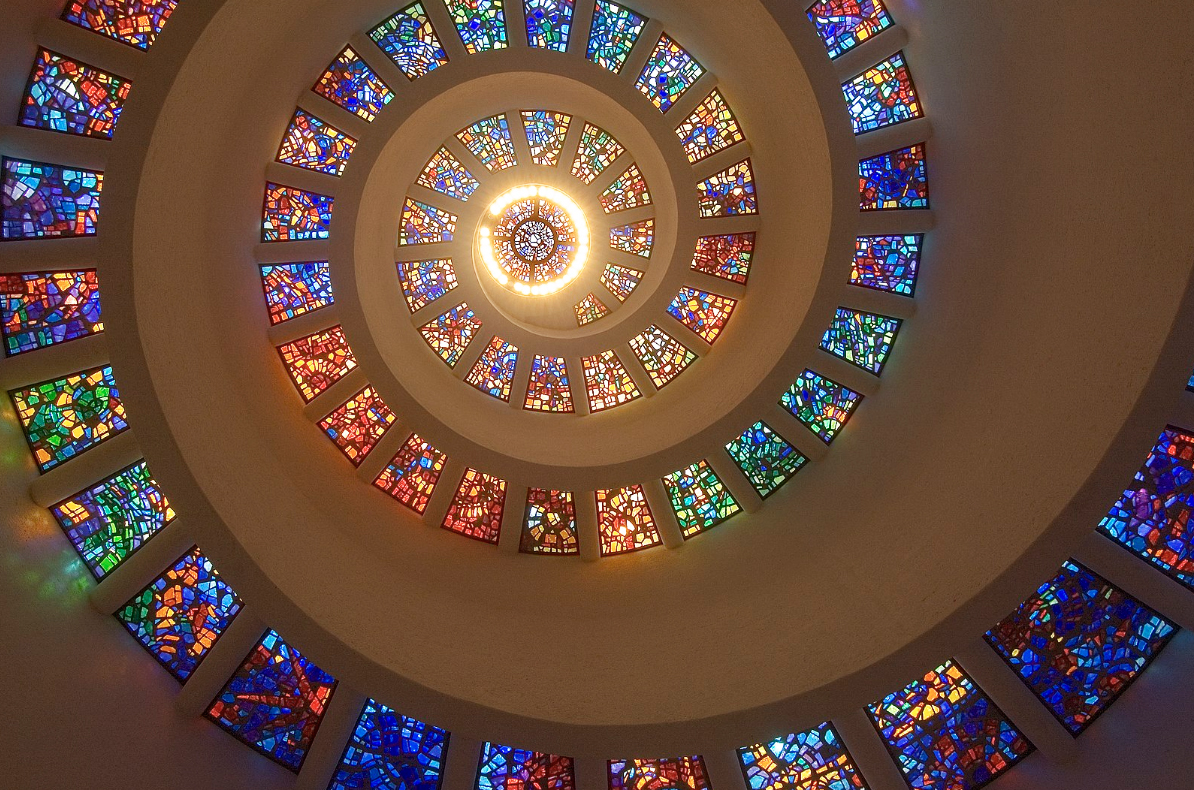
In such times of ‘remembrance of what is,’ our hearts will be stirred into a habit of praise even as our emotions are slow to catch up. Like Loire and Johnson’s Glory Window our hearts will twist upward toward our God - toward glory. Towards the King of Glory.
‘Lift up your heads, O you gates! And be lifted up, you everlasting doors! And the King of glory shall come in. Who is this King of glory? The Lord strong and mighty, The Lord mighty in battle.
Lift up your heads, O you gates! Lift up, you everlasting doors! And the King of glory shall come in. Who is this King of glory? The Lord of hosts, He is the King of glory.’ (Psalm 24:7-10)
He is indeed! Let us remind one another of this wisdom as we wait in a ‘remembrance of what is’ and as we lift up our heads and our hearts to the King of Glory.
Prayer:
You, Christ, are the King of glory,
the eternal Son of the Father.
When you took our flesh to set us free
you humbly chose the Virgin’s womb.
You overcame the sting of death
and opened the kingdom of heaven to all believers.
You are seated at God’s right hand in glory.
We believe that you will come and be our judge.
Come then, Lord, and help your people,
bought with the price of your own blood,
and bring us with your saints
to glory everlasting.
(Te Deum Laudamus, BCP, 2019)
Hallelujah - we praise you!
Amen
Siân Draycott
Instructor
Torrey Honors College
Biola University
About the Art:
Glory Window
Gabriel Loire, stained glass artist
Philip Johnson, architect
1975
Chapel of Thanksgiving
Thanks-Giving Square, Dallas, Texas
Photographer: John McStravick of Dallas, Texas
Creative Commons Attribution 2.0 Generic License
https://commons.wikimedia.org/wiki/File:Thanksgiving_Square_Chapel_From_the_Floor_-_Flickr_-_Schl%C3%BCsselbein2007.jpg

Chapel of Thanksgiving
The Glory Window of the Chapel of Thanks-Giving Square takes its name from Psalm 19 and contains seventy-three panels of faceted glass that follow the spiral shape of the ceiling. Lower panels feature varying shades of blue, which to French artist Gabriel Loire, the designer of the window, represent the color of peace. As the spiral continues inwards and upwards, the colors become warmer and brighter until they reach the center where, sixty feet above the floor, the panels give way to a circle of beaming yellow light. Loire meant this progression to express life with its difficulties, its forces, its joys, its torments, and its frightening aspects. Bit by bit, all of that gives way to an explosion of gold where the summit is reached. The spiral ceiling contains one of the largest horizontally mounted stained glass windows in the world.
Thanks-Giving Square
Pritzker Architecture Prize winner Philip Johnson was commissioned to bring the vision of Thanks-Giving Square in Dallas, Texas, to life. The Thanks-Giving Square is set fifteen feet below ground level with a four-foot wall blocking the sight of automobiles to create a serene, green island. At the western end of Thanks-Giving Square rises the bell tower where the processional experience begins. Walkways provide areas to sit and meditate in. At the east end of Thanks-Giving Square stands the interfaith Chapel of Thanksgiving, a curving white structure symbolizing the ancient spiral of life and suggesting the infinite upward reach of the human spirit. (From the director of the chapel.)
https://thanksgiving.org/
About the Artist and Architect: Gabriel Loire and Philip Johnson
Gabriel Loire (1904–1996) was a French stained glass artist of the twentieth century whose extensive works, portraying various persons or historical scenes, appear in many venues around the world. He founded the Loire Studio in Chartres, France, which continues to produce stained glass windows. Loire was a leader in the modern use of "slab glass,” which is much thicker and stronger than the stained glass technique of the Middle Ages. Loire often expressed the view, "La paix donne la joie" ("Peace gives joy") in his work and particularly liked working with shades of blue, which he said represented to him the color of peace. His stained glass artistry, blending modern and traditional elements, attained worldwide appreciation and commissions. In addition to more than 450 installations in France, Loire's works are found in Scotland, Germany, Ireland, South Africa, Japan, Chile, Canada, Australia, and the United States.
http://www.michiganstainedglass.org/collections/studiosartist.php?id=17-82-28
https://en.wikipedia.org/wiki/Gabriel_Loire
Philip Johnson (1906–2005) was an American architect best known for his works of modern architecture, including his personal residence, known as the Glass House, in Connecticut, and his works of postmodern architecture. In 1978 he was awarded an American Institute of Architects Gold Medal and in 1979 the first Pritzker Architecture Prize. Before designing his first building at the age of thirty-six, Johnson had been a client, critic, author, historian, museum director, but not an architect. By the fifties, Johnson was revising his earlier views, culminating with a building that proved to be one of the most controversial of his career—the AT&T headquarters in New York with its so-called “Chippendale" top. He became one of the most influential and sought-after architects of the late twentieth century.
https://en.wikipedia.org/wiki/Philip_Johnson
https://www.pritzkerprize.com/node/30
About the Music #1: “And the Glory of the Lord” from the album Messiah
Lyrics #1: (Isaiah 40:5)
And the glory of the Lord shall be revealed,
And all flesh shall see it together:
For the mouth of the Lord hath spoken it.
Messiah (HWV 56) is an English-language oratorio composed in 1741 by George Frideric Handel, with a scriptural text compiled by Charles Jennens from the King James Bible, and from the Psalms included with the Book of Common Prayer. It was first performed in Dublin on April 13, 1742, and received its London premiere nearly a year later. After an initially modest public reception, the oratorio gained in popularity, eventually becoming one of the best-known and most frequently performed choral works in Western music. Handel's reputation in England, where he had lived since 1712, had been established through his compositions of Italian opera. He turned to English oratorio in the 1730s, in response to changes in public taste; Messiah was his sixth work in this genre. Although its structure resembles that of opera, it is not in dramatic form; there are no impersonations of characters and very little direct speech. Instead, Jennens's text is an extended reflection on Jesus Christ as Messiah. The text begins in Part I with prophecies by Isaiah and others, and moves to the annunciation to the shepherds, the only "scene" taken from the Gospels. In Part II, Handel concentrates on the passion and ends with the "Hallelujah" chorus. In Part III, he covers the resurrection of the dead and Christ's glorification in heaven. Handel wrote Messiah for modest vocal and instrumental forces, with optional settings for many of the individual numbers. In the years after his death, the work was adapted for performance on a much larger scale, with giant orchestras and choirs. In other efforts to update it, its orchestration was revised and amplified by (among others) Mozart. In the late twentieth and early twenty-first centuries, the trend has been towards reproducing a greater fidelity to Handel's original intentions, although "big Messiah" productions continue to be mounted.
About the Composer #1:
George Frideric Handel (1685–1759) was a German baroque composer who spent the bulk of his career in London and became well-known for his operas, oratorios, anthems, and organ concertos. He was strongly influenced by the great composers of the Italian baroque and the middle-German polyphonic choral tradition. Musicologist Winton Dean writes that his operas show that "Handel was not only a great composer; he was a dramatic genius of the first order.” Handel’s Messiah was first performed in Dublin, Ireland, in April 1742 and received its London premiere nearly a year later. After an initially modest public reception, the oratorio gained in popularity, eventually becoming one of the best-known and most frequently performed choral works in Western music. Handel's Messiah has been described by the early-music scholar Richard Luckett as "a commentary on Jesus Christ's Nativity, Passion, Resurrection, and Ascension," beginning with God's promises as spoken by the prophets and ending with Christ's glorification in heaven. The music for the Messiah was completed in only twenty-four days and Handel wrote the letters SDG (Soli Deo Gloria, “To God Alone the Glory”) at the end of the manuscript. In many parts of the world, it is accepted practice for the audience to stand when the “Hallelujah” chorus is performed. The tradition is said to have originated with the first London performance of the Messiah, which was attended by King George II. As the first notes of the triumphant “Hallelujah” chorus rang out, the king was so moved that he rose to his feet and remained standing until the end of the chorus, initiating a tradition that has lasted well over two centuries. Indeed, the “Hallelujah” chorus is one of the most awe-inspiring pieces of music ever written.
https://en.wikipedia.org/wiki/Messiah_(Handel)
https://www.smithsonianmag.com/arts-culture/the-glorious-history-of-handels-messiah-148168540/
About the Librettist:
Charles Jennens (1700–1773) was a wealthy, reclusive English landowner and patron of the arts. Jennens attended Oxford University, where he formed his lifelong interest in music and literature and became a devout Anglican. As a friend of Handel, he helped author the libretti of several of his oratorios, most notably Messiah. Jennens' deep knowledge of the Bible and wide literary interest led him to prepare or contribute to many libretti for Handel, including Saul, L'Allegro, il Penseroso ed il Moderato, Messiah, Belshazzar, and possibly Israel in Egypt. It is also clear that, on occasion, Handel accepted Jennens' suggestions and improvements to his compositions. Their most famous collaboration is Jennens' libretto for Messiah, drawn entirely from the Bible. Musicologist Watkins Shaw describes it as "a meditation of our Lord as Messiah in Christian thought and belief” that "amounts to little short of a work of genius.”
https://en.wikipedia.org/wiki/Charles_Jennens
About the Performers #1: London Philharmonic Orchestra and London Philharmonic Choir
The London Philharmonic Orchestra (LPO) is one of the world's finest symphony orchestras, balancing a long and distinguished history with a reputation as one of the UK's most adventurous and forward-looking orchestras. The orchestra was founded by Sir Thomas Beecham in 1932, and since then has been headed by many of the great names in the conducting world, including Sir Adrian Boult, Bernard Haitink, Sir Georg Solti, Klaus Tennstedt, and Kurt Masur. The orchestra's current principal conductor is Vladimir Jurowski, who was appointed in 2007. The London Philharmonic Orchestra has been performing at Southbank Centre's Royal Festival Hall in London since it opened in 1951. Having long been embraced by the recording, broadcast, and film industries, the London Philharmonic Orchestra broadcasts regularly on TV and radio. The orchestra also works with the Hollywood and UK film industries, and has been recording soundtracks for over half a century.
https://www.lpo.org.uk/
London Philharmonic Choir was founded in 1947 as the chorus for the London Philharmonic Orchestra (LPO). Working under esteemed conductors such as Boulez, Elder, Gardner, Gatti, Haitink, Jurowski, Masur, Nézet-Séguin, Norrington, Rattle, Solti, Tennsted, and Welser-Möst, the choir has performed regularly with the LPO and other world-class orchestras at major venues and festivals throughout the years. From time to time, the choir tours abroad—recently to Budapest, Paris, Lucerne, Rome, Athens, Spain, Germany, the Czech Republic, Poland, the Canary Islands, and further afield to Hong Kong, Kuala Lumpur, and Perth. In January 2004 they were invited to sing in the Vatican’s Papal Concert of Reconciliation. They have also built up an impressive discography throughout their history and continue to participate in recording for CD, radio, and television.
https://lpc.org.uk/about-the-choir/
About the Music #2: “Lift Up Your Heads, O Ye Gates” from the album The New Young Messiah
Lyrics #2:
Lift up your heads,
O ye gates;
And be ye lifted up,
Ye everlasting doors.
And the King of Glory shall come in.
Who is the King of Glory?
Who is the King of Glory?
The King of Glory.
Who is the King of Glory?
Who is the King of Glory?
The Lord strong and mighty,
The Lord strong and mighty,
The Lord mighty in battle.
Lift up your heads,
O ye gates;
And be ye lifted up,
Ye everlasting doors;
And the King of Glory shall come in.
And the King of Glory shall come in.
Who is the King of Glory?
Who is the King of Glory?
Who is the King of Glory?
The Lord on High
The Lord on High
He is the King of Glory.
He is the King of Glory.
He is the King of Glory.
He is the King of Glory.
He is the King of Glory.
The Lord of Hosts.
He is the King of Glory
The King of Glory
He is the King of Glory.
The King of Glory
The King of Glory
The King of Glory
The King of Glory
He is the King of Glory.
He is the King of Glory.
He is the King of Glory.
Yes he is.
Jesus, Jesus,
He is the King of Glory.
He is the King of Glory.
He is the King of Glory.
The King
About the Composers #2: from George Frideric Handel’s “Messiah,” arranged by Robbie Buchanan
Robbie Buchanan (b. 1957) is a Canadian arranger, writer, and producer who works both in Canada and the United States.
https://robbiebuchanan.com/
About the Performer #2:
Michael English (b. 1962) is an American Christian singer and record producer. Initially he was a member of his family's singing group, but later he became a member of the Gaither Vocal Band. During his solo career, he recorded eight studio albums. English's highest-charting solo single was "Your Love Amazes Me.” In 2013, English announced he would be leaving the Gaither Vocal Band to devote more time to his solo career. His final appearance with the group was performing "Alpha and Omega" at the 2013 Dove Awards. Since his Gaither Vocal Band departure, Michael has appeared on numerous Gaither Vocal Band Reunion videos and has released three studio albums, a live album, and a greatest hits recording entitled The Best of Michael English.
https://michaelenglishmusic.com/
https://en.wikipedia.org/wiki/Michael_English_(American_singer)
About the Poetry & Poet:
Wendell Erdman Berry (b. 1934) is an American novelist, poet, environmental activist, cultural critic, and farmer who was educated at the University of Kentucky, where he became Distinguished Professor of English in 1971. The intensity of his writing’s involvement with the human and natural characters of his native locality has gained Berry recognition as one of the leading writers of the twentieth century. A prolific author, he has written many novels, short stories, poems, and essays. He is an advocate of Christian pacifism, as shown in his book Blessed Are the Peacemakers: Christ’s Teachings About Love, Compassion and Forgiveness. He states that the theme in his writing is “that all people in the society should be able to use the gifts that they have, their natural abilities, and they ought to use them responsibly for their benefit as individuals and as a community.” Berry was named the recipient of the 2013 Richard C. Holbrooke Distinguished Achievement Award, an annual US literary award recognizing the power of the written word to promote peace.
https://www.britannica.com/biography/Wendell-Berry
About the Devotion Author:
Siân Draycott
Instructor
Torrey Honors College
Biola University
Siân Draycott grew up in Wales and graduated from the University of Oxford with an M.A. in theology and from the Open University (UK) with an M.A. in classical studies. She is a Ph.D. student at Talbot School of Theology. Siân loves to discuss Great Books with students as an Instructor in the Torrey Honors College.