December 24: Son of God | Son of Man
♫ Music:
Day 25 - Wednesday, December 24
Christmas Eve
Title: Son of God | Son of Man
Scripture #1: Matthew 16:13–17 (NKJV)
When Jesus came into the region of Caesarea Philippi, He asked His disciples, saying, “Who do men say that I, the Son of Man, am?” So they said, “Some say John the Baptist, some Elijah, and others Jeremiah or one of the prophets.” He said to them, “But who do you say that I am?”Simon Peter answered and said, “You are the Christ, the Son of the living God.” Jesus answered and said to him, “Blessed are you, Simon Bar-Jonah, for flesh and blood has not revealed this to you, but My Father who is in heaven.”
Scripture #2: Galatians 4:4–7 (NKJV)
But when the fullness of the time had come, God sent forth His Son, born of a woman, born under the law, to redeem those who were under the law, that we might receive the adoption as sons. And because you are sons, God has sent forth the Spirit of His Son into your hearts, crying out, “Abba, Father!” Therefore you are no longer a slave but a son, and if a son, then an heir of God through Christ.
Scripture #3: Matthew 16:27 (NKJV)
“For the Son of Man will come in the glory of His Father with His angels, and then He will reward each according to his works.”
Poetry & Poet:
“Christ-Hymn”
by Sandra Duguid
O You!
You tiny who
Of Simeon's song
You shepherds shock
You singular star-bright
You student
Shunning company
And travel
For scholars light.
Just apprentice
Of your mothers husband
True measurer
And leveler
And line
Authoritative voice
Enlisting aid
Selector
And selected
And Divine.
Creative host
Of weddings, picnics, graves
Most social
And uncelebrated
Friend
You thoughtful martyr
You thirsty man
You dying God—
I hoped!
But this concludes . . .
Amen. Amen.
O
Heir of power
Crasher
Of closed meetings
The unsummoned
Inviting inspection—
You natural!
You Master
Of surprise.
Who Do We Say He Is?
My Dad fled the Ukraine as a child. He, his sister, and my grandparents had the choice of remaining in their village after Nazi forces occupied it (and being shot as spies by the advancing Stalinists) or being packed off to Germany where they would live in refugee camps. They chose to flee — in a mad rush that left their extended family shocked, confused, and in lament.
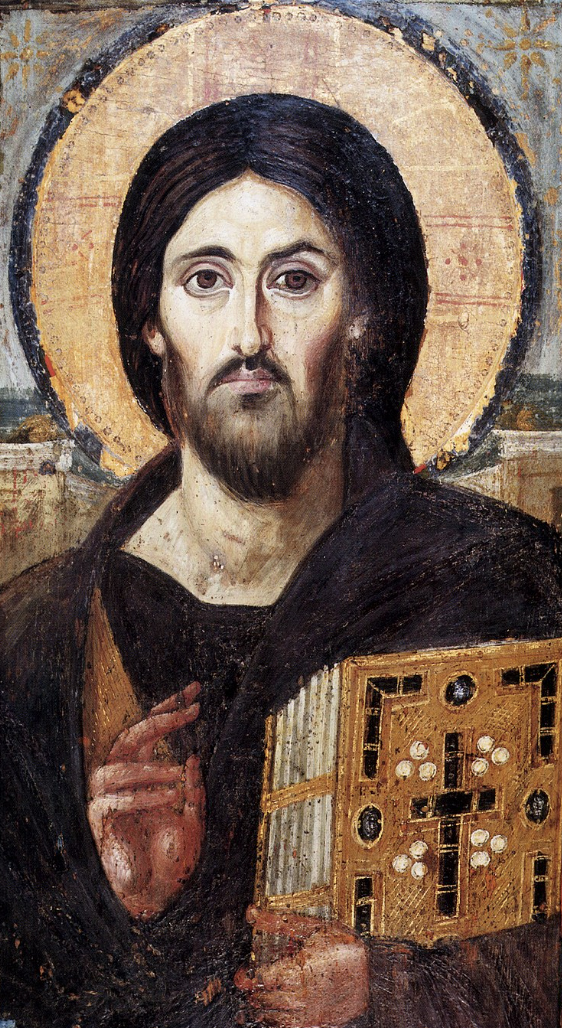
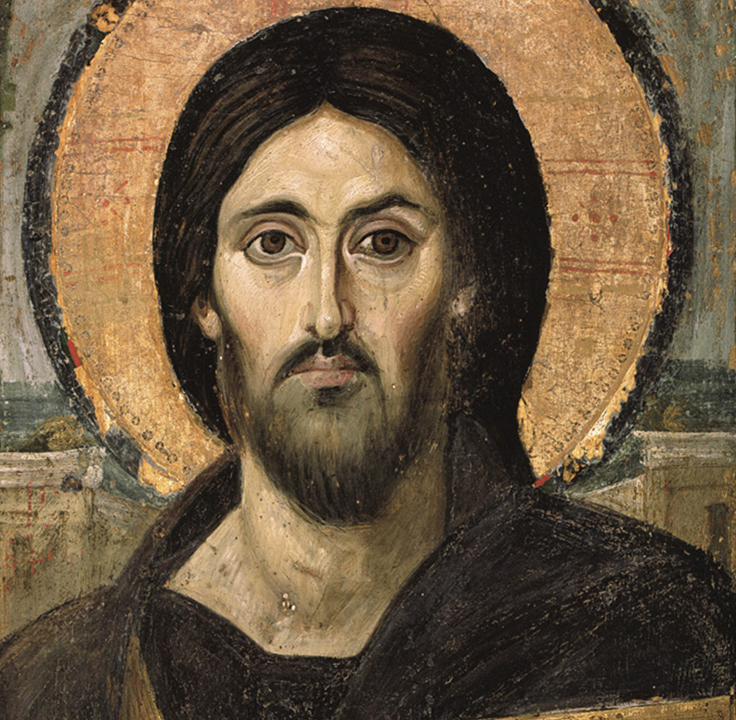
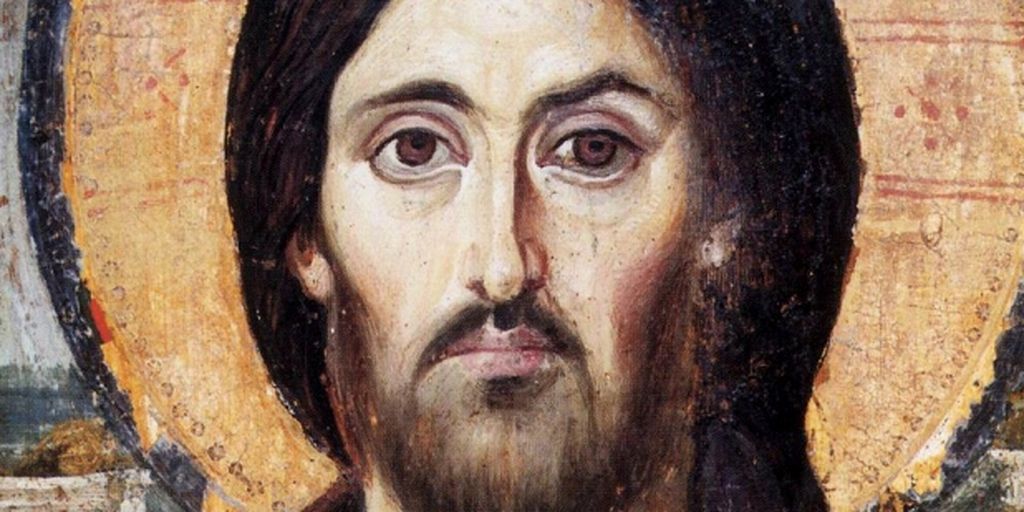
For years my Dad refused to tell us about it. He thought it too much to grasp. But eventually he recalled to us the horror of seeing a childhood friend being killed, of being loaded onto boxcars by Nazi soldiers. There was little food or water. Can a child fear death? He did, and also dreaded separation, abandonment. The darkness of that time left my Dad with terrors he never quite overcame. One was the sense that God was not there for him. Yet, somehow he believed. For years in his upstairs office in our house, he kept a Russian Orthodox icon leaning against his desk lamp — an image very similar to the icons in our devotional today. In it, Jesus’ eyes were penetrating, sorrowful, inviting, reassuring. The icon you see here, known as “Christ Pantocrator” has special significance: it depicts our Savior in two modes: one side of his face shows an all-knowing judge; the other side shows compassion and care.
The face of our Savior in this icon shows a balance of intimacy and distance, a mysterious separation that my Dad understood. God, to him, was almost unapproachable out of reverence and awe. My Dad had little patience with the easy informality of some evangelical Christians in God’s presence. His mindset was captured by Solomon in Ecclesiastes 5:2: “Do not be hasty in word or impulsive in thought to bring up a matter in the presence of God,” Solomon said. Better to “let your words be few.”
Jesus’ teaching in this passage builds on this sense of reverence for God, the mystery of the incarnation. Jesus' disciples, like many who observed His life, had trouble grasping the significance of this God-man. “Who do people say I am?” He asked them. They’d heard the talk, the crowd’s confusion. “But who do you say I am?” He then asked, with persistence. And His question speaks to us. “No man has seen God,” noted the Apostle. But Jesus, as this icon shows us, explains God (John 1:18).
We are adopted children; through the propitiation of Christ, we can come close to God, calling Him Abba — Papa, Daddy. The beauty of Advent and of Christmas is that in embracing this Christ-child who would one day bear our sin on a cruel cross, we are invited into intimacy with the eternal God. We can call Jesus a friend, He tells us in John 15:14 — if we do what He commands. He will judge one day according to our obedience. So, with Matt Redman, we adore Him, a worship best done in the calm, silent night of Franz Gruber.
Prayer
Oh, Lord Jesus. What a kind and patient teacher you were to your disciples. You helped them see You, or at least try harder. And you help us. Our eyes and our minds are so limited. So you help us. And we are taken again, this Christmas, with the wonder of your birth. You came for us; You came to us. You found us when we were lost in the dark, wandering alone. And like the star that came and stood over your cradle, you’ve illumined us. You are that light. We worship you and embrace you as our Savior and Lord. And we welcome you into another year of journey with us. Immanuel. We are not alone; we will not fall headlong on the uneven ground for you hold our hand.
Amen
Dr. Michael A. Longinow
Professor of Journalism and Integrated Media
Division of Communication
School of Fine Arts & Communication
Biola University
About the Artwork:
Christ Pantocrator (overall and detail views)
Anonymous iconographer
Sixth century AD
Encaustic on wood panel
84 x 45.5 cm
Sacred Autonomous Royal Monastery of Saint Catherine of the Holy and God-Trodden Mount Sinai
Sinai Peninsula, Egypt
Public Domain
Christ Pantocrator of Saint Catherine's monastery is one of the oldest Byzantine religious icons, dating from the sixth century AD. The earliest known surviving depiction of Jesus Christ as Pantocrator—which literally means “ruler of all”—it is regarded by historians and scholars as among the most important and recognizable works of Byzantine art as well as Eastern Orthodox and Eastern Catholic Christianity. Many agree that the icon of Christ Pantocrator represents the dual nature of Christ, illustrating traits of both man and God, perhaps influenced by the aftermath of the ecumenical councils of the previous century. Christ's features on His right side (the viewer's left) are said to represent the qualities of His human nature, while His left side (the viewer's right) represents His divinity. His right hand is shown opening outward, signifying His gift of blessing, while the left hand and arm are clutching a thick gospel book.
The Sacred Autonomous Royal Monastery of Saint Catherine of the Holy and God-Trodden Mount Sinai is located in the Sinai Peninsula of Egypt. Located at the foot of Mount Sinai, it was built between 548 and 565 AD, and is the world's oldest continuously inhabited Christian monastery. The monastery was built around the location of what is traditionally considered to be the place of the burning bush seen by Moses. The site is considered sacred by the three major Abrahamic religions—Judaism, Christianity, and Islam. Centuries after its foundation, the body of Saint Catherine of Alexandria was said to be found in a cave in the area. The relics of Saint Catherine, kept to this day inside the monastery, have made it a favorite site of pilgrimage.
https://en.wikipedia.org/wiki/Christ_Pantocrator_(Sinai)
About the Music #1: “God the Son” from the album In Excelsis
Lyrics #1:
God the Son,
Remaining what He was,
Became what He was not
Flesh and blood
Heart and breath and bones
Just like one of us.
Son of God
Son of man
O come let us adore Him
So holy His name
So humble His crown
O come let us adore Him now.
From everlasting
Born here into time
Grace and truth arrived
Completely human
But still completely God
Still perfectly divine.
Son of God
Son of man
O come let us adore Him
So holy His name
So humble His crown
O come let us adore Him now.
Son of God
Son of man
O come let us adore Him
So holy His name
So humble His crown
O come let us adore Him.
Son of God
Son of man
O come let us adore Him
So holy His name
So humble His crown
O come let us adore Him now.
So love came down
From power and majesty
Took on our frailty
Eternal One
Invisible now seen
Incarnate deity
God the Son.
O come let us adore Him
O come let us adore Him
O come let us adore Him
Christ the Lord.
About the Composers/Performers #1: Matt Redman, Andrew Bergthold, Quintin Trotter, and W. David O. Taylor
Matthew James Redman (b. 1974) is a British worship leader, singer-songwriter, and author. Redman has released sixteen albums, written eight books, and helped start three church plants. He is best-known for his Grammy Award–winning single "10,000 Reasons (Bless the Lord).” In 1993, Redman, alongside his pastor Mike Pilavachi, helped found Soul Survivor, a global Christian movement and yearly music festival aimed at youth. In 2008, Redman and his family moved to Atlanta, Georgia, to help plant Passion City Church with Louie Giglio and Chris Tomlin. In 2005, Redman co-wrote, with his wife, Beth, the 2005 Dove Award–winning "Blessed Be Your Name." Since then, Matt and Beth have co-created some of Redman's most successful songs, including "You Never Let Go," "Face Down," and "Let My Words Be Few.” Matt has won thirteen of the Gospel Music Association's Dove Awards. His songs have been covered by a number of contemporary Christian music artists, including Matt Maher, Michael W. Smith, Jeremy Camp, Rebecca St. James, Chris Tomlin, David Crowder Band, and Hillsong United. He has authored and edited multiple books on Christian worship, including The Unquenchable Worshiper and Facedown, which accompanied the album of the same name.
https://en.wikipedia.org/wiki/Matt_Redman
https://mattredman.com/
Raised amid the vibrant harmonies of a gospel choir in downtown Kansas City, Andrew Bergthold‘s earliest echoes of life were melodies sung in his home church. Throughout his high school and college days, Andrew's musical journey was marked by the formation and leadership of bands that spanned the genres from punk rock's electric rush to worship's reverent tones. His notable venture We The Kingdom found resurgence and new direction with the collaboration of the Cash Family. Beyond the stage, Andrew's influence extends to the realms of writing and producing. His creative signature can be heard in commercials for global brands like McDonald's, in the adrenaline-pumping soundtracks of major movie trailers, atop radio charts with #1 singles, and among the honored nominees of the Dove Awards. With every note and lyric, he directs the spotlight upwards, acknowledging Jesus as the master artist, the source of every perfect gift and the inspiration behind each chord he plays.
https://worshipleader.com/author/andrew-bergthold/
https://curbwordmusicpublishing.com/blogs/writers/andrew-bergthold
Quintin Trotter is a Christian musician and ardent lover of God.
https://www.youtube.com/watch?v=VmbN1O_0CiM
W. David O. Taylor is an associate professor of theology and culture at Fuller Theological Seminary, as well as the director of various initiatives in worship, theology, and the arts. He teaches courses in systematic theology, art and worship, art and theology, art and beauty, spiritual formation through the psalms and theology, and science fiction. He is the author of several books, including Prayers for the Pilgrimage: A Book of Collects for All of Life (2024), A Body of Praise: Understanding the Role of Our Physical Bodies in Worship (2023), Open and Unafraid: The Psalms as a Guide to Life (2020), Glimpses of the New Creation: Worship and the Formative Power of the Arts (2019), and The Theater of God’s Glory: Calvin, Creation and the Liturgical Arts (2017). He has written for The Washington Post, Religion News Service, Calvin Theological Journal, Christian Scholars Review, Image Journal, Worship, Comment, Theology Today, Books & Culture, The Gospel Coalition, Worship Leader Magazine, and Christianity Today, among others. For twelve years, in full- and part-time capacity, he served as a pastor at Hope Chapel in Austin, Texas. There he supervised an arts ministry and the adult education program, along with preaching regularly. His artistic interests include playwriting, modern dance, and film, and in recent years, science fiction literature. He is ordained as a priest in the Anglican Communion in North America and he lives in Austin with his artist wife, Phaedra, his daughter, Blythe, and his son, Sebastian.
https://books.google.com/books/about/A_Body_of_Praise.html?id=J8kszwEACAAJ&source=kp_author_description
https://www.wdavidotaylor.com/about
About the Music #2: “Silent Night” from the album Finding Christmas
Lyrics #2:
Silent night, holy night,
All is calm, all is bright
Round yon virgin mother and child!
Holy Infant so tender and mild,
Sleep in heavenly peace,
Sleep in heavenly peace.
Silent night! Holy night!
Shepherds quake at the sight!
Glories stream from heaven afar,
Heavenly hosts sing Alleluia!
Christ the Saviour is born!
Christ the Saviour is born!
Silent night, holy night,
Son of God, love's pure light
Radiant beams from Thy holy face,
With the dawn of redeeming grace,
Jesus, Lord, at Thy birth,
Jesus, Lord, at Thy birth.
Sleep in heavenly peace.
About the Composers #2: Music by Franz Gruber, lyrics by Josephus Mohr, arranged by Stephen Nelson
Franz Xaver Gruber (1787–1863) was an Austrian primary school teacher, church organist, and composer who is best-known for composing the music to "Stille Nacht" ("Silent Night"). Together with Josephus Franciscus Mohr (1792–1848), a Catholic priest who wrote the original German lyrics, Gruber composed the music for the Christmas carol. On Christmas Eve of 1818, Mohr, an assistant priest at the Nikolauskirche, showed Gruber a six-stanza poem he had written in 1816. He asked Gruber to set the poem to music for the evening's service. The two men sang “Stille Nacht” for the first time at Christmas Mass in St. Nicholas Church while Mohr played guitar and while Gruber played the organ. In later years, Gruber composed additional arrangements of the carol for organ and for organ with orchestra, as well as many scores of other carols and masses, many of which are still in print and sung today in Austrian churches.
https://en.wikipedia.org/wiki/Franz_Xaver_Gruber
https://en.wikipedia.org/wiki/Joseph_Mohr
Stephen Nelson is an award-winning composer, producer, and songwriter. Aside from producing for GENTRI, he has also worked with artists such as Lexi Walker, David Archuleta, Madilyn Paige, and the Gardiner Sisters. His music can be heard on radio, television, Emmy-winning films, and Billboard Chart–topping albums. Additionally, he has written and produced for major corporations, charity organizations, Disney, and Sony Masterworks. In 2017, Stephen had the opportunity to arrange the song for the vice president’s first dance at the presidential inaugural ball. He has also toured across the United States with symphonies, performing his original compositions.
https://gentrimusic.com/the-gents/stephen-nelson/
About the Performers #2:
GENTRI, which is short for “The Gentlemen Trio” was established in 2014 and is composed of three dynamic tenors: Brad Robins, Casey Elliott, and Bradley Quinn Lever. The fourth member of the group is the award-winning composer, arranger, and producer Stephen Nelson. To date, GENTRI has released four EPs and three full-length albums, the most recent being a Christmas album, Season of Light. The Gents are also known for their award-winning music videos, which have been featured on news outlets around the world, including ABC World News, NBC Nightly News, and Inside Edition. GENTRI has performed all over the United States and across the globe. They have shared the stage with world-renowned talent, including Kristin Chenoweth, Alfie Boe, Idina Menzel, and the rock bands Journey, Blondie, and One Republic.
https://gentrimusic.com/the-gents/
About the Poetry & Poet:
Sandra R. Duguid (b. 1947) is an American poet living in New Jersey. For twenty years she taught literature, composition, and creative writing at colleges in the New York/New Jersey metropolitan area and at East Stroudsburg University in Pennsylvania, before retiring in 2010 to devote more time to writing. She is a recipient of a Fellowship in Poetry from the New Jersey State Council on the Arts and author of the poetry collection Pails Scrubbed Silver (2013).
Thank you to:
https://artandtheology.org/tag/sandra-r-duguid/.
About the Devotion Author:
Dr. Michael A. Longinow
Professor of Journalism and Integrated Media
Division of Communication
School of Fine Arts & Communication
Biola University
Michael Longinow grew up in Oak Park, a suburb of Chicago where as a child he celebrated Christmas Eve and Christmas Day in long robes walking and singing down candle-lit stone aisles of a vaulted Episcopal sanctuary. He also heard gospel teaching about Christ from Moody Bible Institute’s programming on his grandparents’ kitchen and car radios. As a former city news reporter, he teaches media ethics, intercultural reporting, investigative approaches to journalism, and news- related writing and podcasting in the School of Fine Arts & Communication. He has written chapters for seventeen anthologies on topics ranging from the history of revivalism to the rise of Christian media to the paradoxes of evangelical pop culture. His most recent research explored the role of biblical empathy in an era of social media rage. He has three children, all of whom attended Biola, and seven grandchildren. He and his wife live in Yorba Linda with their golden retriever, Bentley.