December 31: Our Hope
♫ Music:
Day 32 - Wednesday, December 31
Title: Our Hope
Scripture #1: 1 Timothy 1:1
Paul, an apostle of Jesus Christ, by the commandment of God our Savior and the Lord Jesus Christ, our hope.
Scripture #2: Romans 15:13
Now may the God of hope fill you with all joy and peace in believing, that you may abound in hope by the power of the Holy Spirit.
Scripture #3: 1 Peter 1:3
Blessed be the God and Father of our Lord Jesus Christ, who according to His abundant mercy has begotten us again to a living hope through the resurrection of Jesus Christ from the dead…
Poetry & Poet:
from Richard III
by William Shakespeare
CLARENCE
Methoughts that I had broken from the Tower
And was embarked to cross to Burgundy,
And in my company my brother Gloucester,
Who from my cabin tempted me to walk
Upon the hatches. Thence we looked toward England
And cited up a thousand heavy times,
During the wars of York and Lancaster,
That had befall’n us. As we paced along
Upon the giddy footing of the hatches,
Methought that Gloucester stumbled, and in falling
Struck me, that thought to stay him, overboard
Into the tumbling billows of the main.
O Lord, methought what pain it was to drown,
What dreadful noise of waters in my ears,
What sights of ugly death within my eyes.
Methoughts I saw a thousand fearful wracks,
A thousand men that fishes gnawed upon,
Wedges of gold, great anchors, heaps of pearl,
Inestimable stones, unvalued jewels,
All scattered in the bottom of the sea.
Some lay in dead men’s skulls, and in the holes
Where eyes did once inhabit, there were crept—
As ’twere in scorn of eyes—reflecting gems,
That wooed the slimy bottom of the deep
And mocked the dead bones that lay scattered by.
KEEPER
Had you such leisure in the time of death
To gaze upon these secrets of the deep?
CLARENCE
Methought I had, and often did I strive
To yield the ghost, but still the envious flood
Stopped in my soul and would not let it forth
To find the empty, vast, and wand’ring air,
But smothered it within my panting bulk,
Who almost burst to belch it in the sea.
KEEPER
Awaked you not in this sore agony?
CLARENCE
No, no, my dream was lengthened after life.
O, then began the tempest to my soul.
I passed, methought, the melancholy flood,
With that sour ferryman which poets write of,
Unto the kingdom of perpetual night.
The first that there did greet my stranger-soul
Was my great father-in-law, renownèd Warwick,
Who spake aloud “What scourge for perjury
Can this dark monarchy afford false Clarence?”
And so he vanished. Then came wand’ring by
A shadow like an angel, with bright hair
Dabbled in blood, and he shrieked out aloud
“Clarence is come—false, fleeting, perjured Clarence,
That stabbed me in the field by Tewkesbury.
Seize on him, furies. Take him unto torment.”
With that, methoughts, a legion of foul fiends
Environed me and howlèd in mine ears
Such hideous cries that with the very noise
I trembling waked, and for a season after
Could not believe but that I was in hell,
Such terrible impression made my dream.
Christ, Our Hope in Life and Death
O Lord, methought what pain it was to drown,
What dreadful noise of waters in my ears,
What sights of ugly death within my eyes.
So says Clarence of his recent dream in Shakespeare’s play Richard III, painting with dreadful accuracy the horror of death.
In the play, Clarence doesn’t know that his dream is prophetic—he is about to die, by treachery and by drowning. The terrifying dream scenario he woke from is only a shadow of the real terror that awaits him.
What hope do we have, if the worst fears of our nightmares are actually things that might come true?
This. We have this, and it is our hope and our salvation:
Blessed be the God and Father of our Lord Jesus Christ, who according to His abundant mercy has begotten us again to a living hope through the resurrection of Jesus Christ from the dead.
Blessed be God! Blessed be God who has not left us alone, drowning and without hope!
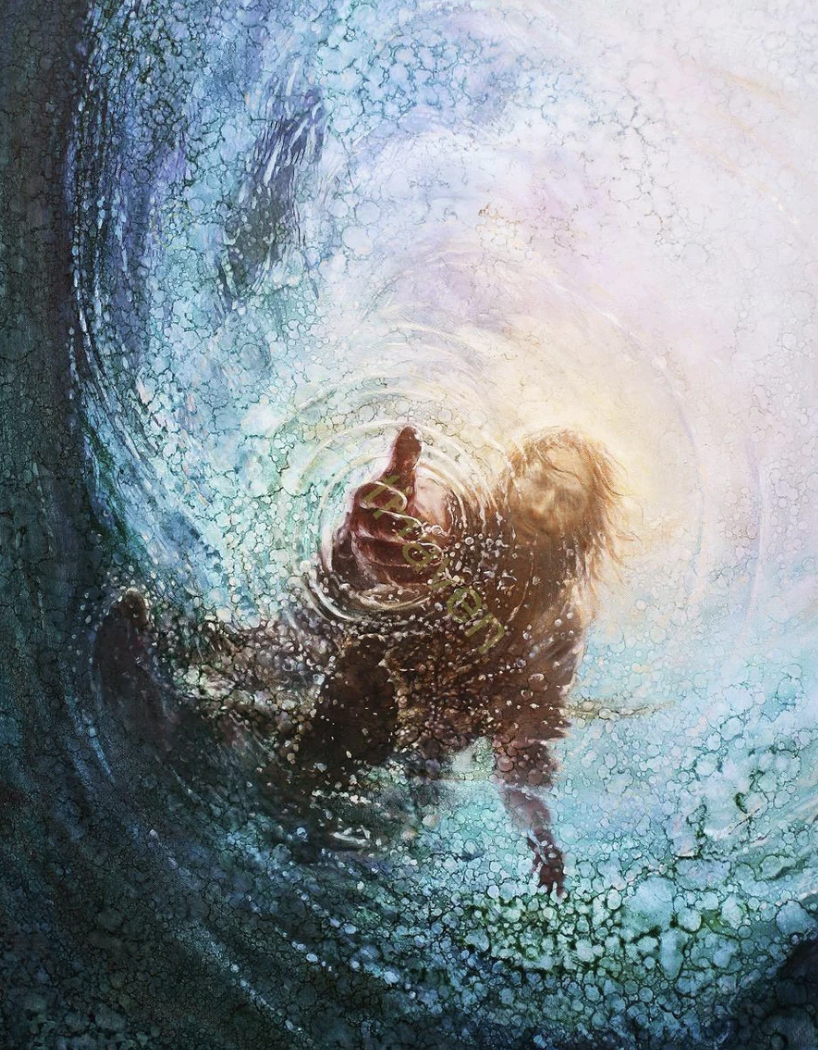
We are Clarence. We indeed “have done all this evil” (1 Samuel 12:20 ESV). But, just as we see in Yongsung Kim’s beautiful painting, we can look up from under the surface of the lake of the sins we are drowning in and see the most beautiful sight in the world: Jesus, our Lord and brother, our King and Shepherd, standing above us, looking down at us, and offering us a hand of rescue.
More than that, Christ is himself Lord over the storms. What troubles us does not trouble him. As Matt Papa and Kristyn Getty sing in today’s music:
Who holds our faith when fears arise?
Who stands above the stormy trial?
Who sends the waves that bring us nigh
Unto the shore, the rock of Christ?
The answer is Christ himself. Though never doing evil, the Lord does not hesitate to turn evil to his own good purposes, and to use the trials and sufferings of this life to draw us closer to himself. He will not abandon us in the midst of the waves. He will be with us, whether in the boat, walking on the water, or reaching out to draw us up out of the surf. As Paul says, he is “the Lord Jesus Christ, our hope” (emphasis mine).
And because of who he is—because we have him as our hope—we don’t need to be afraid. We don’t need to be afraid either of death or of the trials that precede it. As Paul says again:
Now may the God of hope fill you with all joy and peace in believing, that you may abound in hope by the power of the Holy Spirit.
This is what hope brings: peace and joy. Because, in the end, all will be well. All will be well with us, as long as we are his.
Think of it as knowing the genre of the story you’re reading, or of the movie you’re watching. If you are reading a traditional romance, you know that, as Shakespeare said, “Journeys end in lovers’ meeting” (Twelfth Night). The story will have a happy ending, because it is that kind of story.
If you are Christ’s, your story will have a happy ending—because it is that kind of story!
It’s not a tragedy. No matter how hard the events of Acts I–IV are, Act V will bring the reunion you long for.
O sing hallelujah!
Our hope springs eternal;
O sing hallelujah!
Now and ever we confess
Christ our hope in life and death.
This is our song, and we need not doubt its truth. Christ is alive, he has conquered, and he holds his people safe in his hand.
Christ, our hope in life and death. Thanks be to God!
Prayer:
O God, who by the glorious resurrection of your Son Jesus Christ destroyed death and brought life and immortality to light: Grant that we, who have been raised with him, may abide in his presence and rejoice in the hope of eternal glory; through Jesus Christ our Lord, to whom, with you and the Holy Spirit, be honor and glory, now and forever.
Amen.
—from The Book of Common Prayer, ACNA 2019 version
Jessica Snell
Writer and Editor
Alumna of Biola University
About the Artwork:
Hand of God
Yongsung Kim
Oil on canvas
Image courtesy of Havenlight
The Hand of God in art is a visual representation of God's active role in the world. Jesus is often described as having a search-and-rescue mission—seeking out those who are lost and offering them salvation. This is reflected in the stories of the lost sheep and the prodigal son, where Jesus demonstrates His compassion for those who are lost or have strayed from God. In this painting, Christ reaches down into the water as if offering His hand to save, lift, and comfort. It evokes thoughts of the story of Christ ushering Peter to walk on the water and then being there to save him when he faltered. The idea for this painting that would become Yongsung’s personal favorite—and one of his most famous—came as an answer to prayer. Yongsung planned a stunningly unique approach to one of the most famous accounts from the New Testament: the Savior rescuing the apostle Peter from the raging sea.
https://yongsungkimart.com/pages/about-yongsung-kim
https://havenlight.com/?tw_source=google&tw_adid=691727648067&tw_campaign=21046750220&gad_source=1&gad_campaignid=21046750220&gbraid=0AAAAACkaVvuTZo1CvvccHf44kORTTcvF0&gclid=CjwKCAjwtfvEBhAmEiwA-DsKjvEQYfqPP6QTDdPouRdp8Hxm-olj30pOFvE7DYtlPkm3ZrYZld97FRoC2m0QAvD_BwE
About the Artist:
Known for his peaceful landscapes and deeply moving depictions of the Savior, Korean artist Yongsung Kim creates paintings that are daily reminders of God's presence—calming, comforting. In Yongsung’s second year of high school, he was invited by Christian missionaries to attend church, and he soon became a believer. At the age of twenty, Kim had a dream that God asked him, "What are you doing with the gifts I've given you?" From then on, he felt compelled to paint images of Christ that share some of the light and hope that Jesus offers.
https://yongsungkimart.com/
About the Music: “Christ Our Hope in Life and Death”
Lyrics:
What is our hope in life and death?
Christ alone, Christ alone.
What is our only confidence?
That our souls to him belong.
Who holds our days within his hand?
What comes, apart from his command?
And what will keep us to the end?
The love of Christ, in which we stand.
O sing hallelujah!
Our hope springs eternal;
O sing hallelujah!
Now and ever we confess
Christ our hope in life and death.
What truth can calm the troubled soul?
God is good, God is good.
Where is his grace and goodness known?
In our great Redeemer’s blood.
Who holds our faith when fears arise?
Who stands above the stormy trial?
Who sends the waves that bring us nigh
Unto the shore, the rock of Christ?
O sing hallelujah!
Our hope springs eternal;
O sing hallelujah!
Now and ever we confess
Christ our hope in life and death.
Unto the grave, what shall we sing?
“Christ, he lives; Christ, he lives!”
And what reward will heaven bring?
Everlasting life with him.
There we will rise to meet the Lord,
Then sin and death will be destroyed,
And we will feast in endless joy,
When Christ is ours forevermore.
O sing hallelujah!
Our hope springs eternal;
O sing hallelujah!
Now and ever we confess
Christ our hope in life and death.
O sing hallelujah!
Our hope springs eternal;
O sing hallelujah!
Now and ever we confess
Christ our hope in life and death.
Now and ever we confess
Christ our hope in life and death.
About the Composers: Keith Getty, Matt Boswell, Jordan Kauflin, Matt Merker, and Matt Papa
Keith and Kristyn Getty occupy a unique place in the world of contemporary Christian music today as preeminent modern hymn writers. In reinventing the traditional hymn form, they have created a distinguished catalog of songs teaching Christian doctrine and crossing genres by connecting the world of traditional and classical composition with contemporary and globally accessible melodies. These modern hymns are rooted in the traditions of Celtic and English hymns handed down to the North Ireland–born couple and their longtime writing partner, Stuart Townend. Their best-known hymn,“In Christ Alone” (penned by Keith and Stuart and recorded by Keith and Kristyn), echoes this heritage and has been voted one of the best-loved hymns of all time in the UK.
https://www.gettymusic.com/
Matt Boswell is a widely respected hymn writer and leading figure in church music. Currently the founding pastor of the Trails Church in Prosper, Texas, he came to a saving faith in Christ at age seven while his father, a pastor, was planting a church. Matt has been involved in church planting and pastoral ministry since 1998, and is also an author and hymn writer. Matt is a graduate of the Southern Baptist Theological Seminary (M.A., Christian ministry), and is also a Ph.D. candidate at Southern Seminary with an emphasis in Christian worship and biblical spirituality. He has released multiple albums and has authored or co-authored widely acclaimed songs, including “Christ the Sure and Steady Anchor” and “Come Behold the Wondrous Mystery.” Boswell is well-regarded not only for his hymn writing, but also his training of worship leaders for church ministry. He is the author of Doxology and Theology: How the Gospel Forms the Worship Leader. Boswell also is the founder of Doxology and Theology, a ministry focused on equipping and encouraging worship leaders in the practice of gospel-centered worship.
https://www.thetrails.org/matt-boswell
Jordan Kauflin is a worship leader, pastor, and singer-songwriter of Christian music. In 2020, he moved to Atlanta, Georgia, to be the worship pastor at Christ Covenant Church. He loves to lead congregational singing, write songs for churches to sing, and train and develop worship leaders. Kauflin primarily writes with Getty Music and Sovereign Grace Music. Songs he has written or co-written include “All I Have is Christ,” “I Will Wait For You (Psalm 130),” and “Christ Our Hope in Life and Death.”
https://www.jordankauflin.com/about
Matt Merker serves as director of creative resources and training for Getty Music. He has contributed to several modern hymns and is the author of the book Corporate Worship: How the Church Gathers as God's People. Matt and his wife, Erica, are members of Trinity Church and live in Nashville, TN, with their two children.
https://books.google.com/books/about/Corporate_Worship_ISTENTISZTELET_K%C3%96Z%C3%96S.html?id=RneJ0AEACAAJ&source=kp_author_description
As a veteran songwriter and Christian musician, Matt Papa (b. 1983) has carved out an even more unique space for himself as one of the world’s top modern-day hymn writers. With songs like “His Mercy Is More,” “Christ Our Hope in Life and Death,” and “Come Behold the Wondrous Mystery," Matt tours regularly across the US as a songwriter with Getty Music and frequently is a guest on their tours. A two-time Dove Award–nominated artist, Matt is on a mission to write songs that are singable, beautiful, and timeless. He currently serves as an artist-in-residence at Marco Presbyterian Church on Marco Island in Florida.
https://www.mattpapa.com/
About the Performers: Matt Papa and Kristyn Getty
About the Poetry & Poet:
William Shakespeare (1564–1616) was an English poet, playwright, and actor, widely regarded as the greatest writer in the English language and the world's preeminent dramatist. He is often called England's national poet and the "Bard of Avon." His extant works, including collaborations, consist of approximately thirty-nine plays, 154 sonnets, two long narrative poems, and a few other verses, some of uncertain authorship. His plays have been translated into every major living language and are performed more often than those of any other playwright. Published in 1609, the Sonnets were the last of Shakespeare's nondramatic works to be printed. Scholars are not certain when each of the 154 sonnets was composed, but evidence suggests that Shakespeare wrote sonnets throughout his career for a private readership. Even before the two unauthorized sonnets appeared in The Passionate Pilgrim in 1599, English author Francis Meres had referred in 1598 to Shakespeare's "sugared Sonnets among his private friends."
https://en.wikipedia.org/wiki/William_Shakespeare
About the Devotion Author:
Jessica Snell
Writer and Editor
Alumna of Biola University
Jessica Snell is a freelance editor who loves helping authors polish their books till they shine! She is also a writer, and her work has appeared in Compelling Science Fiction, Christ and Pop Culture, Focus on the Family, and more. In her free time, she reads, knits, and spends time with her husband and their four children. You can follow her on Twitter (X) at @theJessicaSnell, and her website is jessicasnell.com