November 30: Names Associated with the Deity of Christ
♫ Music:
Week One Introduction
November 30–December 6
Title: Names Associated with the Deity of Christ
Most world religions acknowledge the historic Jesus as a great prophet/teacher. Yet, the trajectory of Scripture from beginning to end proclaims the deity of Jesus Christ, the Son of God and second person of the Trinity, who took on flesh to redeem the world from sin. The Nicene Creed, an early statement of faith recited by Christians for hundreds of years, articulates that Jesus is "the only-begotten Son of God, eternally begotten of the Father, God from God, Light from Light, true God from true God, begotten, not made, of one Being with the Father; through him all things were made. For us and for our salvation he came down from heaven, was incarnate from the Holy Spirit and the Virgin Mary, and was made man."
We understand Jesus to be the visible image of the invisible God. That Christ, the “Great I Am,” would leave the heavenly realm and humble Himself to walk among mere mortals is the awe-inspiring story of Christmas. The real significance of the Nativity is to be found in the incarnation of Christ. Our Advent meditation begins by pondering names that identify Christ as one with the Godhead. Each title has something particular to tell us about the Messiah in His relationship to God the Father. So come, let us worship and fall down before Christ Himself, our King and our God.
Day 1 - Sunday, November 30
Title: The Word
Scripture: John 1:1–5,14,16–18 (NKJV)
In the beginning was the Word, and the Word was with God, and the Word was God. He was in the beginning with God. All things were made through Him, and without Him nothing was made that was made. In Him was life, and the life was the light of men. And the light shines in the darkness, and the darkness did not comprehend it….And the Word became flesh and dwelt among us, and we beheld His glory, the glory as of the only begotten of the Father, full of grace and truth….And of His fullness we have all received, and grace for grace. For the law was given through Moses, but grace and truth came through Jesus Christ. No one has seen God at any time. The only begotten Son, who is in the bosom of the Father, He has declared Him.
Poetry & Poet:
“Creation”
by Philip C. Kolin
He peoples the darkness with stars:
Eyes in all that vastness.
He stores sunlight in his tabernacle
Doling out each day enough to gladden
The trees and moons with their changing
Colors. Vestments over land and sea.
Space is a trellis in his garden
He scatters organelles, pods, bulbs,
Protozoa, spermatazoa, ovaries
All bursting into blossom. Every womb
Awaits the coronation of its birth.
Stone fruits and star apples.
He breathes obbligatos,
By turns symphonic, volcanic.
The seasons speak through him.
In the fullness of time, bread's bounty
The sacrifice of grapes becoming wine.
Hidden Glories
What is essential is invisible to the eye.
—Antoine de Saint-Exupéry
Sometimes, I can see Venus from my window. It doesn’t look like a planet; it shines like a star. The Babylonians watched it wander and called it the morning and evening star. The tiny point of light was visible, but its massive, spherical properties were as yet invisible.
Creation is full of God’s hidden glories. We can’t see God Himself, but like the wind rustling through the trees, His presence and redemptive ways are made manifest by the movement of His Spirit.
Believers are often revealers of our invisible God. Ebed-Melek was a Cushite, in service to King Zedekiah of Judah. Though not an Israelite, he was among the few who had the Spirit of God moving in his heart. He believed Jeremiah’s warnings about Babylon bringing “the sword, famine and plague.” Zedekiah’s officials, incensed over Jeremiah’s prophecies, lowered him into a cistern, leaving him to die. Ebed-Melek disregarded his own safety to appeal to the king to rescue him. With permission granted, he gathered thirty men to help.
The Holy Spirit wanted us to see a tender picture of mercy tucked inside the telling of his bold move. Ebed-Melek stopped to gather some rags and old clothes. He lowered them to Jeremiah to pad the ropes so they wouldn’t hurt him. Later, God told Jeremiah to tell Ebed-Melek that he would be saved from the Babylonians because he trusted in God. Ebed-Melek’s actions, big and small, made the Holy Spirit visible.
Our poem, “Creation” by Philip C. Kolin, speaks of invisibilities. It tells us that seed, even before it’s sown, is encoded with latent miracles that come to life. Pods, bulbs, protozoa, and the child all begin as invisibilities, yet come “bursting into blossom.” They become vibrant realities. All creation had its beginnings in the unseen realm, in the mind of God, before He made it visible.
Jesus, existing eternally with the Father, was unseen before the Incarnation except in some gracious theophanies. At the right time, heralded by angels with the backdrop of a magnificent star, the promised Word of God entered the world, His glory “wrapt in night’s mantle.” Our music imagines the angel’s song with its jubilant and joyful crescendos. When the angels vanished, darkness and silence returned. Surely the shepherds wondered if what they had just witnessed was real.
Now after Christ’s ascension, Kolin’s poem points us to the Lord’s Supper:
In the fullness of time, bread's bounty
The sacrifice of grapes becoming wine.
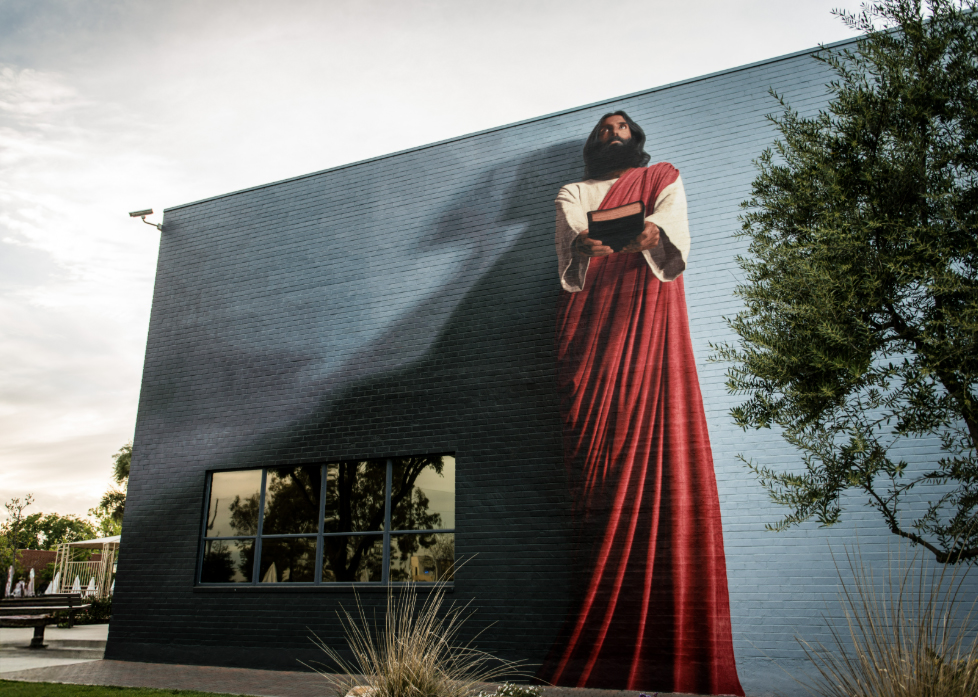
Today we partake of Communion until Jesus returns, a visible sign of an invisible grace, as Augustine expressed. That return, as Kent Twitchell’s painting The Word reminds us, will be larger than life, so visible that “every eye will see Him.” As Luke tells us, we will touch His flesh and bones. We will worship in His presence.
Some realities are just hinted at, the planet behind the shining star, God’s presence in the soul of man, and God’s glory in the Incarnation. We don’t see Him now, but when Christ, the Morning Star, rises, we will see the full weight of His glorious visibilities.
Prayer:
“O Lord, I look forward to the time when I shall see the visible display of thy glory;
when, after I have enjoyed the manifestations of thyself in this world,
I shall also have the full enjoyment of thee in heaven.
Until then let faith be the eye of my soul,
and let it behold thee continually in thy promises, ordinances, and providences.”
From: The Valley of Vision
Jayne English
Essayist
About the Art:
The Word (The Jesus Mural)
Kent Twitchell
Created in 1970
Restored in 1990
Acrylic on parachute cloth
30 x 50 ft.
Eastern wall of the Bardwell Art Department Building
Biola University
La Mirada, California
The Chimes Newspaper
The mural, a gift to Biola University from renowned Los Angeles muralist Kent Twitchell, depicts Jesus in red robes holding out a Bible to the viewer. The artist purposefully painted the pages of the Bible to match the pigment of Jesus' skin, representing the divine Logos (Word) taking on a physical body to live among us. Originally painted in 1970, the mural has been met with controversy surrounding the cultural representation of Jesus. During one such flare-up in 2008, Biola art professor Barry Krammes issued a historical position piece to document the facts about The Word, saying that “Kent’s image of Jesus, a bit intimidating and reserved, finds its parallel in ancient…church domes. The centrality of Christ and the massive scale in which He is always painted in these high ceiling church interiors, speaks of His presence permeating all things. Twitchell’s Christ is an expansive vision of the…all-encompassing Christ who unites male and female; slave and free; Jew and Greek; east and west so that distinctive differences melt away in His all consuming love. Two subtle shadows to the left of Christ reference the trinity.’’
https://chimesnewspaper.com/12800/archives/features/jesus-mural-sofar/
About the Artist:
Kent Twitchell (b. 1942) is an American muralist who was most active in the Los Angeles area. He is most famous for his larger-than-life mural portraits, often of celebrities and artists. In 1980, Twitchell's murals to date, including Bride and Groom and The Freeway Lady, were featured extensively in a documentary, Mur Murs, directed by Agnès Varda. In November 2009, Twitchell painted two murals on two pieces of the Berlin Wall for the twenty-year anniversary of the fall of the Berlin Wall. One was a portrait of President John Kennedy and the other was of President Ronald Reagan. They depicted the US presidents at the beginning and at the fall of the Berlin Wall. Twitchell has received honorary doctorate degrees from Biola University, Otis College of Art and Design, and California State University, Los Angeles.
https://en.wikipedia.org/wiki/Kent_Twitchell
About the Music #1: “The Word Was God” from the album For God So Loved the World
Lyrics #1:
In the beginning was the Word,
And the Word was with God,
And the Word was God.
The same was in the beginning with God.
All things were made by him;
And without him was not anything made
That was made.
This musical composition, “The Word Was God,” is a sacred choral anthem for unaccompanied mixed voices and was written in 1996. It is a setting of John 1:1–3. As you listen, take note of the six iterations of “in the beginning was the Word, and the Word was with God, and the Word was God…” Each repetition increases in dynamic intensity, from piano to fortissimo. You’ll notice that the various voice groups, soprano, alto, tenor, and bass, seem to chase one another around on the text—not just an ordinary, every-day “round,” but a three-part canon with the bass part droning on perfect fifths.
https://exponentii.org/blog/sacred-music-the-word-was-god/
About the Composer #1:
Rosephanye Powell is professor of voice at Auburn University in Auburn, Alabama. She teaches applied voice, art song literature, and vocal pedagogy courses. She conducts the women’s chorus and co-conducts the Concert Choir and AU Gospel Choir. Powell holds degrees from Florida State University, Westminster Choir College, and Alabama State University. Powell’s primary performance and research areas are the African American spiritual, the art songs of William Grant Still, known as the "Dean of African American Composers,” and voice-care concerns for choral singers and directors. Powell has performed as an oratorio soloist and recitalist, and serves regularly as an adjudicator, lecturer, and clinician at conferences and venues nationally and internationally. Powell has been hailed as one of America’s premier women composers of choral and solo vocal music. Additionally, she was honored with the “Living Legend Award” presented by California State University African Diaspora Sacred Music Festival in Los Angeles, California.
https://cla.auburn.edu/directory/rosephanye-powell/
About the Performers #1:
The St. Olaf Choir, with seventy-five mixed voices, is a premier a cappella choir in the United States. For over a century, the choir has set a standard of choral excellence and remained at the forefront of choral artistry. Conducted since 1990 by Anton Armstrong, the St. Olaf Choir has set a standard in the choral art, serving as a model for choirs of all levels. The ensemble’s annual tour brings its artistry and message to thousands of people across the nation and around the world. The St. Olaf Choir has undertaken international tours and performed for capacity audiences in the major concert halls of Norway, France, South Korea, New Zealand, Australia, New York City, Washington, D.C., Chicago, Los Angeles, Dallas, and the Twin Cities.
https://wp.stolaf.edu/choir/
Anton Armstrong is the Harry R. and Thora H. Tosdal Chair in Music, professor of music at St. Olaf College, and conductor of the St. Olaf Choir, a position he assumed in 1990. A graduate of St. Olaf College, Armstrong earned a M.A. at the University of Illinois and a Ph.D. from Michigan State University. Dr. Armstrong is widely recognized for his work in the area of youth and children’s choral music. In 2005, the St. Olaf Choir shared the stage with the Tabernacle Choir at Temple Square in presenting the finale concert for the national conference of the American Choral Directors Association at the Walt Disney Hall in Los Angeles, California. In 2006, Baylor University selected Anton Armstrong from a field of 118 distinguished nominees to receive the Robert Foster Cherry Award for Great Teaching. He spent February–June 2007 in residency at Baylor University as a visiting professor. In 2014, the St. Olaf Choir and Dr. Armstrong received a regional Emmy for the PBS special entitled Christmas in Norway with the St. Olaf Choir.
https://www.stolaf.edu/profile/armstrong
About the Music #2: “Overture/Come All Ye Faithful” from the album The Ultimate Christmas Collection
Lyrics #2: (Lyrics begin after an instrumental overture)
O come, all ye faithful, joyful and triumphant,
O come ye, O come ye to Bethlehem!
Come, and behold Him, born the King of angels!
[Refrain]
O come, let us adore Him;
O come, let us adore Him;
O come, let us adore Him, Christ, the Lord!
God of God, Light of Light,
Lo, He abhors not the virgin's womb;
very God, begotten not created;
[Refrain]
Sing, choirs of angels; sing in exultation;
Sing, all ye citizens of heav'n above!
Glory to God, all glory in the highest!
[Refrain]
Yea, Lord, we greet Thee, born this happy morning;
Jesus, to Thee be all glory giv'n!
Word of the Father, now in flesh appearing!
[Refrain]
About the Composers #2: John Francis Wade, lyricist: Latin hymn; trans. by Frederick Oakeley, and arranged by Ronn Huff
John Francis Wade (1711–1786) was an English hymnist who is usually credited with writing and composing the hymn "Adeste Fideles," which was translated as "O Come All Ye Faithful" in 1841 by Frederick Oakeley. The authorship of the hymn has been disputed, with thirteenth-century Cardinal St. Bonaventure and King John IV of Portugal being proposed as alternative composers, although the earliest known manuscripts of the hymn discovered from 1946 all bear John Francis Wade's signature.
https://en.wikipedia.org/wiki/John_Francis_Wade
Inducted as a nonperforming member of the GMA Gospel Music Hall of Fame, Ronn Huff’s (1938–2018) legacy is well-known to those who have directed church choirs in the last thirty years. While minister of music in a Denver church, he arranged and published two highly successful books of hymns––Celebration, Music for Festival Choir and Celebration II. But his arrangements and recording of Bill and Gloria Gaither’s songs into a 1973 musical called Alleluia, A Praise Gathering brought national prominence. Huff claimed to be an arranger, not a composer, but his work is found on many recordings, both sacred and secular. In the past several years his name has appeared in the recordings of Faith Hill, Charlotte Church, Amy Grant, Sandi Patty, John Michael Talbot, Keith Urban, George Strait, and the Boston Pops.
https://gospelmusichalloffame.org/hall-of-fame-inductees-and-honorees/ronn-huff
About the Performer #2:
Michael W. Smith (b. 1957) is an American musician who has charted in both contemporary Christian and mainstream charts. His biggest success in mainstream music was in 1991 when "Place in This World" hit number six on the Billboard Hot 100. Over the course of his career, he has sold more than eighteen million albums. Smith is a three-time Grammy Award winner, an American Music Award recipient, and has earned forty-five Dove Awards. In 1999, ASCAP awarded him with the "Golden Note" Award for lifetime achievement in songwriting, and in 2014, they honored him as the "cornerstone of Christian music" for his significant influence on the genre. He has also starred in two films and published fourteen books, including This Is Your Time, which he co-wrote with author Gary Thomas. At the age of ten, he had "an intense spiritual experience" that led to his becoming a devout Christian. After high school, he attended Marshall University while developing his songwriting skills but dropped out to move to Nashville and pursue a career in music. In 1979, Smith recommitted himself to the Lord, and following that, he auditioned for a new contemporary Christian music group, Higher Ground, as a keyboardist and got the job. In 1981, while he was playing keyboards for Higher Ground, Smith was signed as a writer to Meadowgreen Music, where he wrote numerous gospel hits which have become worship standards for artists such as Sandi Patty, Bill Gaither, and Amy Grant. The following year, Smith began touring as a keyboardist for Grant on her Age to Age tour. He would eventually become Grant's opening act and recorded his first Grammy-nominated solo album, The Michael W. Smith Project, in 1983. By the time Smith's second album, Michael W. Smith 2, was released in 1984, he was headlining his own tours.
https://en.wikipedia.org/wiki/Michael_W._Smith
https://michaelwsmith.com/
About the Poetry & Poet:
Philip C. Kolin (b. 1945) is the Distinguished Professor of English (Emeritus) at the University of Southern Mississippi, where he edited The Southern Quarterly for many years. He has published more than forty books on Shakespeare, Tennessee Williams, Edward Albee, a collection of contemporary African American women playwrights, and twelve poetry collections. Among the most recent are Reaching Forever (2019), Delta Tears (2020), Wholly God's (2021), and, forthcoming, Americorona: Poems about the Pandemic in America. Kolin has also co-edited three eco-poetry anthologies on Katrina, the Mississippi River, and the moon.
About the Devotion Author:
Jayne English
Essayist
Jayne English is an essayist. She has a B.A. in humanities from Florida Southern College. She has published devotional articles in various publications and articles on art and faith for Relief Journal’s blog. She is thankful daily for the beauty God brings her way in nature, poetry, and amazing family and friends. She lives in Central Florida, where she enjoys reading, writing, and the blue sweep of sky. You can find more of her writing at jayneenglish.substack.com.