January 5: Lord of All

♫ Music:
Day 37 - Monday, January 05
Title: Lord of All
Scripture #1: Acts 10:35–37 (NKJV)
“But in every nation whoever fears Him and works righteousness is accepted by Him. The word which God sent to the children of Israel, preaching peace through Jesus Christ—He is Lord of all— that word you know, which was proclaimed throughout all Judea, and began from Galilee after the baptism which John preached…”
Scripture #2: Romans 10:11–13 (NKJV)
For the Scripture says, “Whoever believes on Him will not be put to shame.” For there is no distinction between Jew and Greek, for the same Lord over all is rich to all who call upon Him. For “whoever calls on the name of the Lord shall be saved.”
Scripture #3: Jeremiah 32:27 (NKJV)
“Behold, I am the Lord, the God of all flesh. Is there anything too hard for Me?”
Poetry & Poet:
Wir dürfen dich nicht eigenmächtig malen
by Rainer Maria Rilke
(translated by Anita Burrows and Joanna Macy)
We must not portray you in king’s robes,
you drifting mist that brought forth the morning.
Once again from the old paintboxes
we take the same gold for scepter and crown
that has disguised you through the ages.
Piously we produce our images of you
till they stand around you like a thousand walls.
And when our hearts would simply open,
our fervent hands hide you.
Lord of All
Tomorrow begins the Feast of Epiphany, and traditionally Advent reflections shift from the twelve days of Christmas toward the recognition, journey, and gifts of the Magi. The visit and tribute of the noble travelers from the East is a key early sign that the baby born to Mary and Joseph in Bethlehem wielded authority and power that were not immediately obvious. Herod’s response to the visit of the Magi revealed that he would stop at nothing to maintain power.
As Jesus walked the earth and eventually began His public ministry, those invested with earthly authority, be it religious, political, scholarly, or economic, had to situate themselves in relation to this Man who bore authority naturally and gently. Then, as now, abusers of power were ever-present, seeking to obtain, and maintain, and wield lordship for personal advantage, or to impose their societal vision. To these “lords” Jesus was a frustrating enigma at best, and a threat to their positions and the established order at worst.
Gradually, through His teaching, signs, and deeds, He (mostly) gently asserted and demonstrated his authority over the various domains of nature and human life. Recognition of His authority often came from those outside of His own community. The Magi brought tribute, the Roman Centurion in Luke 7 intuitively understood the authority of Jesus, and even Pilate, for all his political dealing in half-truths, writes that Jesus is the “King of the Jews.” Of course, all of these are moments of testimony, though the attestants could only have understood the thousandth part.
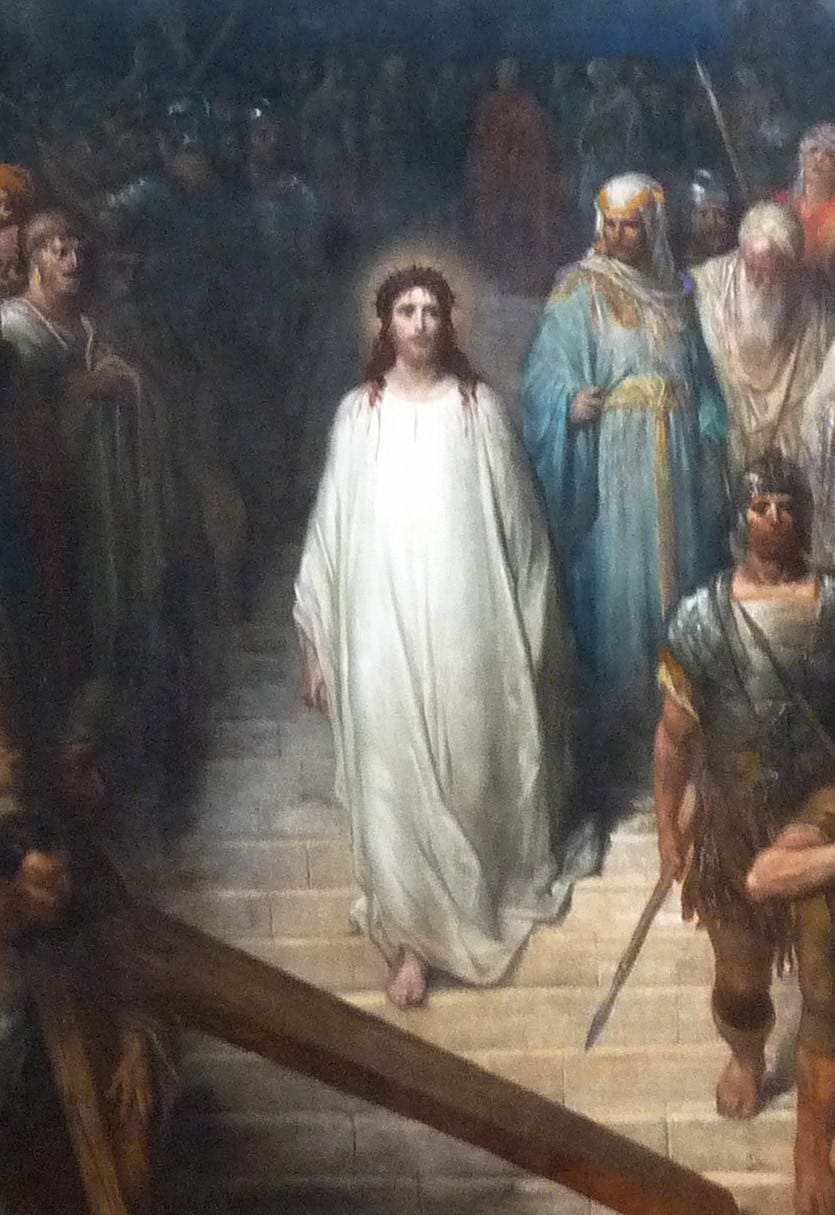
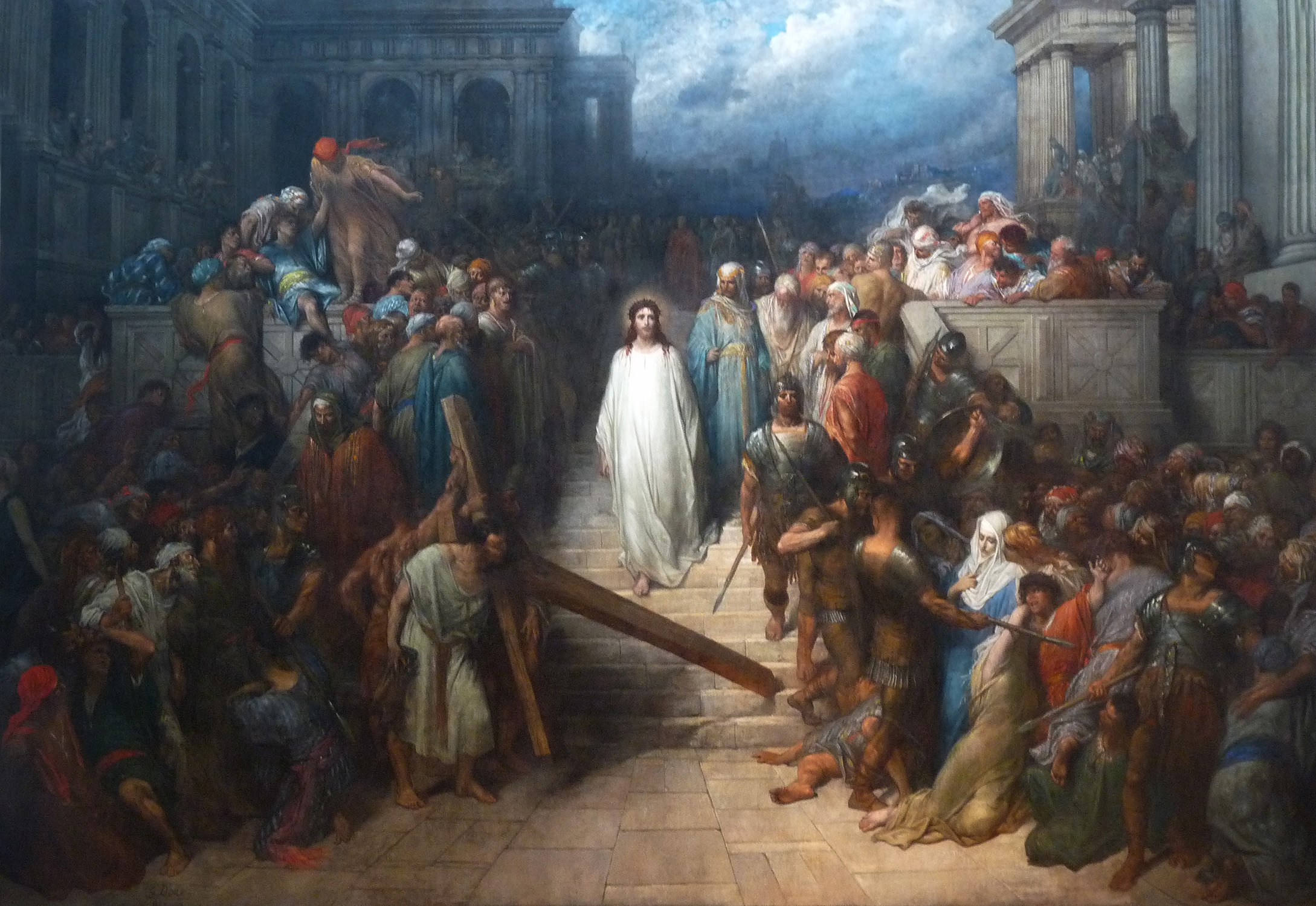
Gustave Doré’s monumental oil painting Christ Leaving the Praetorium depicts Jesus walking out of his final interaction with the powers of his age. Doré shows Jesus as the central figure, walking out under his own power, a luminous figure in a mostly dark space. Doré’s painting is a reminder that even at the moment when Jesus seemed most subject to the earthly authority, He was still orchestrating the events and circumstances that would bring about His redemptive suffering and death. Jesus is Lord of Pontius Pilate, though Pilate certainly didn’t know it at the moment he sentenced Jesus to death. Jesus is Lord of Jerusalem, Lord of Rome, Lord of the highest and the lowest, and He willingly laid down his life.
Today’s poem by Rainer Maria Rilke is a favorite of mine. I am a painter by training and trade, and this phrase by Rilke reminds me that no image, not even one as beautifully wrought as Doré’s, is capable of expressing the Lordship of Christ. The penultimate line reminds me that the only appropriate response to Christ’s Lordship is for my heart to “simply open.” Our response to the Lordship of Christ (an eternal reality whether we understand it or not), is to yield, to open our hearts in love. This is what Jesus offers to us first, the Incarnation is the ultimate expression of loving openness and vulnerability from the One who rules all things, and in whom all things hold together. This mystery is beyond beautiful, and as Rilke suggests, is beyond any picturing.
Prayer (A Declaration):
Jesus, You are Lord
Lord of stars and dark matter
Lord of chirping crickets in cool autumn nights
Lord of nations and neighborhoods
Lord of feasting and fullness
Lord of the hungry and hurting
You are Lord of the powerful,
And Lord of the weak.
You are Lord of my enemies
And of those who find enmity in me.
With absolute dominion over all,
Your heart is open to every one of your creatures.
All praise belongs to You.
Amen.
Jonathan Puls, M.F.A., M.A.
Chair of the Art Department
Associate Professor of Art History and Painting
Biola University
About the Artwork:
Christ Leaving the Praetorium (Christ Quittant le Prétoire)
Gustave Doré
1874–1880
Oil on canvas
240 × 360 in.
Strasbourg Museum of Modern and Contemporary Art
Strasbourg, France
Public Domain
Christ Leaving the Praetorium is a painting by French artist Gustave Doré, created between 1867 and 1872. It was the largest of his religious paintings and is considered to be "the work of his life." The painting was a great success and it was reproduced as an engraving in 1877. In the painting, the Roman governor Pontius Pilate, wearing a purple toga, stands at the top of the steps, completely drowned in dark shadows. The high priest Caiaphas, and two others, on the right side of the steps, rejoice at Christ’s condemnation. Judas Iscariot, immersed in the crowd on the left, turns away with remorse from Jesus. Most of the figures in the crowd face Jesus. At the bottom right of the steps stands Mary, the mother of Jesus, recognizable by her blue and white clothes. In accordance with tradition, she is surrounded by the holy women and John the apostle, on whose shoulder Mary Magdalene faints. Dressed in white, with his head bloodied by the crown of thorns, a radiant Jesus descends the steps, which he illuminates with his mere presence. The Roman soldiers brutally push the crowd to the right as a whole range of emotions from the crowd can be found in the attitudes of those in attendance—from curiosity, grief, compassion, pain, and hatred to satisfaction.
https://en.wikipedia.org/wiki/Christ_Leaving_the_Praetorium
About the Artist:
Gustave Doré (1832–1883) is considered one of the most successful and prolific illustrators of the late nineteenth century. A French artist, printmaker, illustrator, and sculptor who primarily worked with wood engraving, he began his career at the age of fifteen as a caricaturist for the French paper Le Journal Pour Rire and obtained a number of commissions to illustrate scenes from books by writers such as Balzac, Byron, Milton, Poe, and Dante. Doré also created epic canvases, enormous sculptures, numerous etchings, and watercolors, but his production as an illustrator remains unmatched in its scope and ambition. His exuberant imagination is apparent in his dreamlike scenes and fantastical style. His achievements as an illustrator brought him tremendous public praise and critical acclaim, and his work helped shape the world of today’s comic books and graphic novels.
https://en.wikipedia.org/wiki/Gustave_Dor%C3%A9
About the Music #1: “Who Is He in Yonder Stall” from the album Feels Like Christmas
Lyrics #1:
Who is he born in the stall,
At whose feet the shepherds fall?
Who is he who softly cries
Who created earth and stars.
It’s the Lord, O wondrous story!
It’s the Lord, the King of glory!
At his feet we humbly fall,
Crown him, crown him, Lord of all!
Who is he in deep distress
Fasting in the wilderness.
Who is he the people bless
For his words of gentleness?
It’s the Lord, O wondrous story!
It’s the Lord, the King of glory!
At his feet we humbly fall,
Crown him, crown him, Lord of all!
Lo! at midnight, who is he
Prays in dark Gethsemane?
Who is he upon the tree
Dies in grief and agony?
[Musical break]
At his feet we humbly fall,
Crown him, crown him, Lord of all!
Who is he who left the grave,
By the power which now can save?
Who is he who from his throne
Rules thro' all the world alone?
It’s the Lord, O wondrous story!
It’s the Lord, the King of glory!
At his feet we humbly fall,
Crown him, crown him, Lord of all!
It’s the Lord, O wondrous story!
It’s the Lord, the King of glory!
At his feet we humbly fall,
Crown him, crown him, Lord of all!
About the Composers #1: Benjamin Hanby and Patricia Pope
Benjamin Russell Hanby (1833–1867) was an American composer, educator, pastor, and abolitionist. He is known for composing approximately eighty songs and hymns. Hanby, with his father Bishop William Hanby, was a "conductor" on the Underground Railroad—his home was a stop for slaves escaping to Canada and is now a national historic site, a Methodist church landmark, and a Network to Freedom site for the National Park Service. In his short life Benjamin graduated from Otterbein, taught school, became a United Brethren minister, started a singing school, was an editor for John Church Publishers in Cincinnati, and composed many songs and hymns. Best-known for the songs "Up on the Housetop" and "Darling Nellie Gray," Hanby published many hymns, including "Little Eyes" and "Who is He?”
https://hymnary.org/person/Hanby_BR
Patricia Pope is a composer of Christian music and a pianist and worship planner at First Baptist Church in Covington, Kentucky.
https://www.linkedin.com/in/patricia-pope-b38b0371/
About the Performers #1:
Collingsworth Family Singers is a Southern gospel/inspirational group started by Phil and Kim Collingsworth and features their family. The Collingsworth Family received the 2007 Harmony Award in the New Artist of the Year category from the Southern Gospel Music Guild. Their album The Best of The Collingsworth Family – Volume 1 was nominated for Best Roots Gospel Album in the 2018 Grammy Awards.
https://www.thecollingsworthfamily.com/
https://en.wikipedia.org/wiki/The_Collingsworth_Family#:~:text=The%20Collingsworth%20Family%20is%20a,%2C%20and%20(Olivia%20Diane).
About the Music #2: “The Name of Jesus” from the album Folk Anthems for Choir
Lyrics #2:
All hail the power of Jesus’ name.
Let angels past recall
Bring forth the royal diadem,
And crown him Lord of all.
And crown him Lord of all.
All hail the power of Jesus’ name.
Let angels prostrate fall.
Bring forth the royal diadem.
And crown him Lord of all.
And crown him Lord of all.
How sweet the name of Jesus,
Sounds in a believer’s ear.
It soothes my sorrows,
Heals my wounds,
And drives away my fear.
He makes the wounded spirit whole,
And comforts the troubled breast;
It satisfies the hungry soul,
And gives the weary rest,
All hail the power of Jesus’ name.
Let angels past recall
Bring forth the royal diadem,
And crown him Lord of all.
And crown him Lord of all.
He makes a rock on which I build;
My shield and hiding place;
My never-ending treasury filled.
With boundless stores of grace.
He’s my Saviour, Shepherd, Friend,
My Prophet, Priest, and King;
My Lord, my Life, my Way, my End,
Accept the praise I bring.
All hail the power of Jesus’ name.
Let angels past recall
Bring forth the royal diadem.
And crown him Lord of all.
And crown him Lord of all.
Weak is the effort of my heart,
And cold my warmest thought;
But when I see You as You are,
I’ll praise You as I ought.
‘Till then I would Your love proclaim,
With every fleeting breath.
And may the music of Your name,
Refresh my soul in death.
All hail the power of Jesus’ name.
Let angels past recall
Bring forth the royal diadem.
And crown him Lord of all.
And crown him Lord of all.
All hail the power of Jesus’ name.
Let angels past recall
Bring forth the royal diadem.
And crown him Lord of all.
And crown him Lord of all.
And crown him Lord of all.
Composers #2: Lyrics by Edward Perronet, music by Craig Courtney
Edward Perronet (1721–1792) was the son of an Anglican priest who worked closely with Anglican John Wesley and his brother Charles for many years in England's eighteenth-century Christian revival. He is perhaps most famous for penning the lyrics to the well-known hymn "All Hail the Power of Jesus' Name."
Craig Courtney is an American composer and musician. He received a B.A. and an M.A. degree in piano performance at the University of Cincinnati. Following a three-year stay in Milan, Italy, where Courtney studied the piano, performed, and worked extensively as a vocal coach, he was invited to join the music faculty of the famed Mozarteum in Salzburg, Austria, serving as piano teacher and accompanist for the woodwind and brass department. It was during this six-year period, while serving in the music ministry of the Salzburg International Baptist Church, that Mr. Courtney began directing a church choir and composing sacred choral music. In 1985, his compositions came to the attention of John Ness Beck, initiating a close working relationship between the two men, which continued until Beck's death in 1987. In making plans for the ongoing work of Beckenhorst Press, Beck appointed Courtney to assume his responsibilities as staff composer and editor. At this point in time, Courtney's published works include more than one hundred sixty choral octavos, eight vocal collections, a piano solo collection, and six extended works for choir and orchestra. In demand throughout the country as a choral clinician and featured composer, Courtney now resides in Columbus, Ohio.
https://www.ecspublishing.com/composers/c/craig-courtney.html
About the Performers #2: Beckenhorst Singers
Beckenhorst Press was founded by two talented composers, John Ness Beck and John Tatgenhorst. At the time, John Beck owned a retail sheet music establishment and was writing principally choral music while John Tatgenhorst was engaged in various musical pursuits. The initial intent was to publish choral, band, and orchestra music, with John Beck focusing on choral music and John Tatgenhorst directing his efforts toward instrumental works.
https://beckenhorstpress.com/our-history/
About the Poetry & Poet:
Rainer Maria Rilke (1875–1926) was a Bohemian-Austrian poet and novelist "widely recognized as one of the most lyrically intense German-language poets," writing in both verse and highly lyrical prose. Several critics have described Rilke's work as inherently "mystical." His writings include one novel, several collections of poetry, and several volumes of correspondence in which he invokes haunting images that focus on the difficulty of communion with the ineffable in an age of disbelief, solitude, and profound anxiety.
https://en.wikipedia.org/wiki/Rainer_Maria_Rilke
About the Devotion Author:
Jonathan Puls, M.F.A., M.A.
Chair of the Art Department
Associate Professor of Art History and Painting
Biola University
Jonathan Puls (M.F.A., M.A.) is a family man, a painter, and sometimes a writer. He teaches drawing, painting, and art history courses in Biola’s Department of Art and currently serves as its Chair. Jonathan enjoys working with young artists and supporting creative work of all kinds.