December 22: Immanuel | God with Us
♫ Music:
Day 23 - Monday, December 22
Title: Immanuel | God with Us
Scripture #1: Isaiah 7:14 (NKJV)
“Therefore the Lord Himself will give you a sign: Behold, the virgin shall conceive and bear a Son, and shall call His name Immanuel.”
Scripture #2: Matthew 1:22–23 (NKJV)
So all this was done that it might be fulfilled which was spoken by the Lord through the prophet, saying: “Behold, the virgin shall be with child, and bear a Son, and they shall call His name Immanuel,” which is translated, “God with us.”
Poetry & Poet:
“Wer siens Lebens viele Widersinne”
by Rainer Maria Rilke (trans. by Anita Burrows and Joanna Macy)
She who reconciles the ill-matched threads
of her life, and weaves them gratefully
into a single cloth —
it’s she who drives the loudmouths from the hall
and clears it for a different celebration
where the one guest is you.
In the softness of evening
it’s you she receives.
You are the partner of her loneliness,
the unspeaking centre of her monologues.
With each disclosure you encompass more
and she stretches beyond what limits her,
to hold you.
“God with Us”
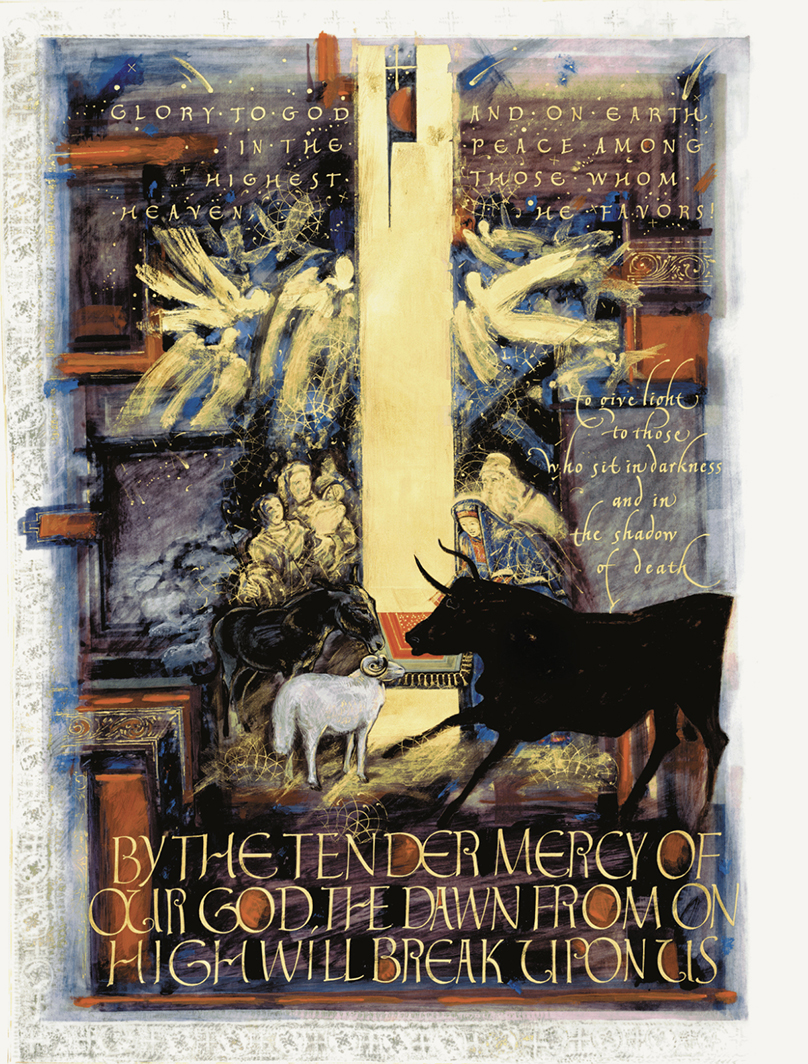
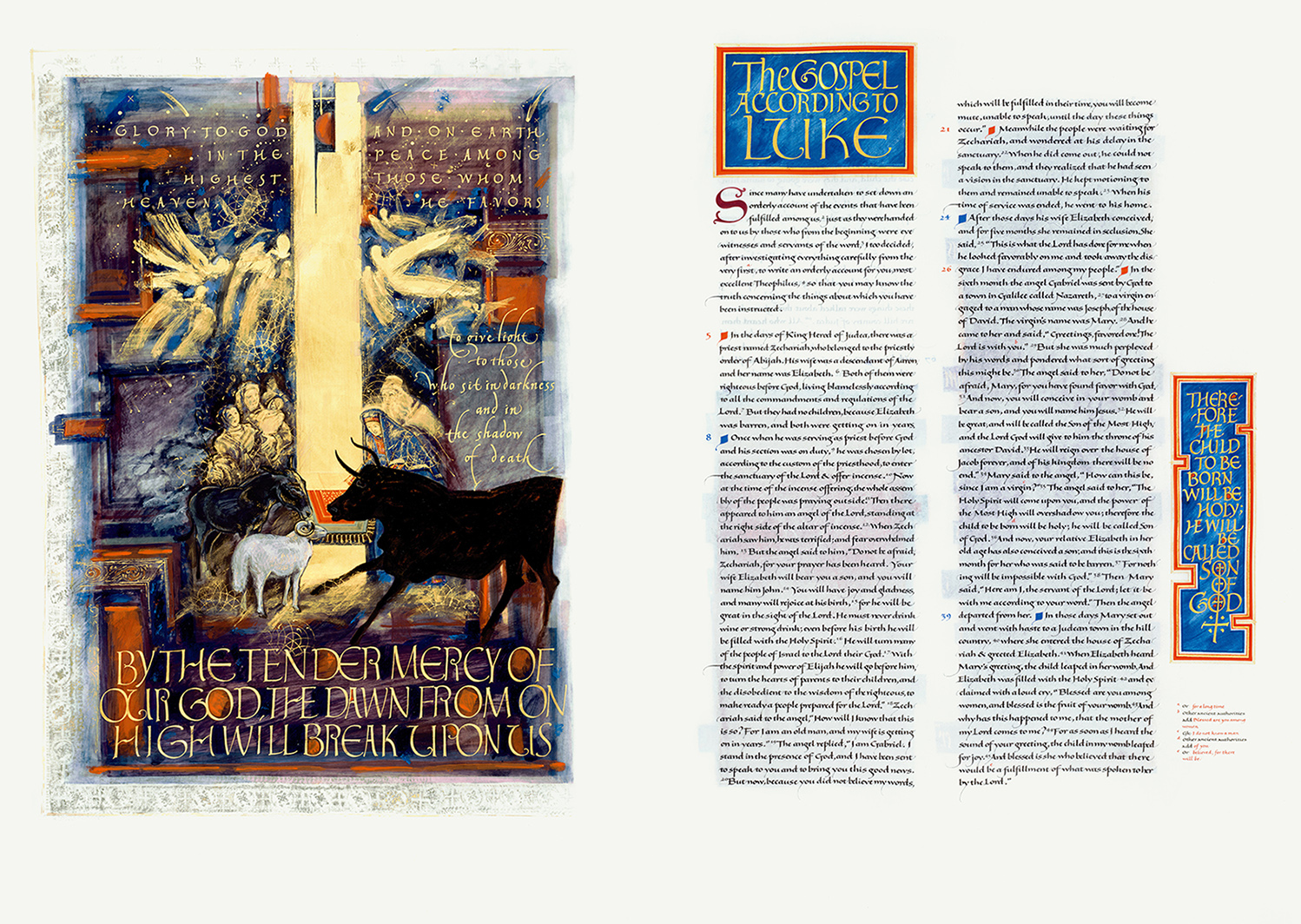
I was struck by the flurry of activity in Donald Jackson’s work, Birth of Christ, with angels’ wings fluttering madly in the air while curious folk peer into the manger next to Mary to view the newborn child Jesus. In the foreground, a donkey and a ram seem to face off with a charging ox that looks like a refugee from a neolithic cave drawing. The first two animals appear to be at peace. The ox seems ready for a fight.
The word Immanuel, “God with us,” can truly be a comfort to us during the Advent season. We think of Jesus, “. . .the reflection of God’s glory and the exact imprint of God’s very being” (Hebrews 1:3) and we marvel that God has made himself known in the one for whom we wait. And we prefer to wait in peace, like the restful farm animals in Donald Jackson’s art.
The reference to “Immanuel” in Matthew comes from the Old Testament prophet Isaiah. And while the promise truly gives the people hope for their future, the context into which Isaiah spoke was one of uncertainty and conflict. It was a time when many people were suffering loss and displacement as if they had been gored by a wild ox. Yes, there was the conviction of “God with us,” but the reality probably caused some to wonder if God had abandoned his people.
It is not unusual for people in our time to wonder where God might be when times are difficult. Is God only with us when the events of our lives are going as planned? Does suffering mean that God might be with us somewhere down the line, but for now He is nowhere to be found? Why does God seem to go silent when we’re hurting?
Silence, however, does not equate to absence.
Resting in silence before God in difficult times is not a practice that comes easily for many people (including this writer). Resolution seems preferable to resting before God in a posture of trust. But if our gospel narratives about the coming of Jesus tell us anything, it’s that waiting when God seems to be silent is a crucial aspect of our shared calling as followers of Jesus. Simeon and Anna, like many in Israel over the years, had been waiting for God’s redemption to come, and now saw it being fulfilled in the child Jesus. Mary saw all that was unfolding around her and rested, pondering it all in her heart (Luke 2:19).
The Advent season can be a mixed bag. For some, it’s a time of joy and celebration. For others it’s a time that seems to accentuate suffering and regrets and disillusionment. But for all, it is a time to be drawn into the story in which we live, the story of God reconciling the world to himself in and through Jesus. And we continue to live in God’s story, even when times are rough and as we wait for comfort to come to us.
In the waiting, God might be silent, but He is not absent. God is with us.
Prayer
This is another day, O Lord. I know not what it will bring forth, but make me ready, Lord, for whatever it may be. If I am to stand up, help me to stand bravely, If I am to sit still, help me to sit quietly. If I am to lie low, help me to do it patiently, and if I am to do nothing, let me do it gallantly. Make these words more than words; give me the Spirit of Jesus.
Amen.
(from Celtic Daily Prayer, Book Two, p. 1039)
Michael McNichols, D.Min.
Pastor and Author
About the Artwork:
Birth of Christ, Luke Frontispiece
Donald Jackson
© 2002
The Saint John’s Bible
Saint John’s University, Collegeville, Minnesota, USA.
Scripture quotations are from the New Revised Standard Version of the Bible, Catholic Edition, © 1993, 1989
National Council of the Churches of Christ in the United States of America
Used with permission
All rights reserved
Gold is used throughout The Saint John’s Bible to indicate the divine. Here a brilliant shaft of light, executed in gold leaf, rises from the child’s crib, making the Christ child the focal point of this scene, although He is not pictured. His mother, Mary, gazes tenderly on the infant. Between the viewer and the unseen infant, the animals form a protective barrier. The ox is modeled on one of the Neolithic cave paintings of great aurochs at Lascaux, France. In the well-known imagery of the Nativity, we see the coexistence of earthly energy, animal energy, and spiritual energy, represented by the angels and the powerful light of God. The upper text is the angels’ song, the central text refers to this child’s role as “light to those who sit in darkness,” and the lower text anchors the entire illumination in a metaphor of divine light.
https://collegevilleinstitute.org/bearings/art-of-the-saint-johns-bible-part-two/
About The Saint John's Bible:
The Saint John's Bible is the first completely handwritten and illuminated Bible commissioned since the invention of the printing press. After a Saint John’s University–sponsored calligraphy presentation in 1995, master calligrapher Donald Jackson proposed a handwritten Bible to Fr. Eric Hollas, OSB, the former executive director of the Hill Museum & Manuscript Library at Saint John's University in Minnesota. Between 1996 and 1997, Jackson created the first sample illuminations for the proposed Bible while theologians at Saint John’s University developed an illumination schema for the project. The Saint John’s Bible, officially commissioned in 1998, was completed in 2011. During production, artistic director Donald Jackson oversaw a group of artists working in a scriptorium located in Monmouth, Wales. Using a mixture of the ancient techniques of calligraphy and illumination, the artists created illuminated manuscripts that were handwritten with quills on calfskin vellum decorated with gold and platinum leaf and hand-ground pigments. Gold leaf was used liberally to represent the divine, silver/platinum to reflect the principle of wisdom, and rainbows to show God’s faithful promises. A wide range of artistic styles, including iconography, abstraction, chrysography, and illustration, were incorporated to create a contemporary visual vocabulary for the sacred. A new script for the sacred text was devised by Donald Jackson to be readable, modern, and appropriately dignified. Meanwhile at Saint John’s Abbey and University in Minnesota, a team of biblical scholars, art historians, and theologians gathered weekly to develop the theological content behind the illuminations. This included not only developing the schema for the illuminations, but also identifying underlying themes and elements for the artists to incorporate. The Saint John’s Bible is divided into seven volumes and is two feet tall by three feet wide when open. It is made of vellum, with 160 illuminations across 1,165 pages. The Saint John’s Bible contains the text and notes of the New Revised Standard Version (NRSV).
https://saintjohnsbible.org/
About the Artist:
Donald Jackson (b. 1938) is one of the world's leading calligraphers and the artistic director and illuminator of The Saint John's Bible, a handwritten and illuminated Bible commissioned by the Benedictine Monastery of Saint John's Abbey in Collegeville, Minnesota. At the age of twenty, Jackson was appointed to be a visiting lecturer at the Camberwell College of Art, London. Within six years he became the youngest artist calligrapher chosen to take part in the Victoria and Albert Museum’s first International Calligraphy Show after the war and appointed a scribe to the Crown Office at the House of Lords. As a scribe to her majesty Queen Elizabeth II, he was responsible for the creation of official state documents. In 1985, he received the Medal of the Royal Victorian Order (MVO). Jackson is an elected fellow and past chairman of the Society of Scribes and Illuminators and, in 1997, was named master of the six-hundred-year-old Guild of Scriveners of the city of London. He is the author of The Story of Writing and The Calligrapher's Art. Jackson and his wife, Mabel, live and work in the Hendre, a converted town hall and outbuildings in Monmouth, Wales.
https://saintjohnsbible.org/creative-team/
About the Music: “Emmanuel”
Lyrics:
Emma, Emmanuel
Emmanuel
Emmanuel
Emmanuel
Your name be praised
Emma, Emmanuel
Emmanuel
Emmanuel
Emmanuel
Your name be praised
When we come in your name
You are right within our midst
Emmanuel
Your name be praised
You're God with us
And the God who is in us
Emmanuel
Your name be praised
Emma, Emmanuel (Emmanuel)
Emmanuel (Emmanuel)
Emmanuel
Your name (Your name be praised)
My God, Emmanuel (Emmanuel)
We cry Emmanuel (Emmanuel)
Emmanuel (Emmanuel)
Your name be praised (Your name be praised)
God with us
And God in us
You deserve the highest praise
Emmanuel, I praise your name
The Redeemer of my soul
And you're the Keeper, Keeper of my heart
Oh Emmanuel, I praise your name
We pray, Emmanuel (Emmanuel)
Emmanuel (Emmanuel)
I call you Emmanuel
I praise your name
You are the Son of the living God
I call you Emmanuel
Emmanuel, Emmanuel, Emmanuel
Jesus, Jesus
I praise your name
No can be there for me like You are (Emmanuel)
I praise your name (Your name be praised)
Ooh
Emmanuel
Your Name be Praised
Though I walk through valley of the shadow of death
And I am not fear of you because your with me
Oh, lion of the tribe, Judah
I know you aren't because I feel your presence with me
Emmanuel
I will shout it to the rooftops, Jesus
Hey, with the thousands times I will praise you
Oh yeah, your name be Praised
You never leave me
You never forsake me
You are always with me
Emmanuel
Emmanuel
Emmanuel
Ooh
You are god with us
Always with us
About the Composer:
Nathaniel Bassey (b. 1981) is a Nigerian singer, pastor, trumpeter, and gospel songwriter popularly known for his songs "Imela," "Onise Iyanu," and "Olowogbogboro." Over the years, Bassey has established himself as one of the prominent and most listened-to gospel ministers in Nigeria. His music spans across different genres, such as jazz, worship, hymns, and medley. He attends the Redeemed Christian Church of God and pastors the Oasis Lagos, the youth church of the RCCG Kings Court in Victoria Island in Lagos, Nigeria.
https://en.wikipedia.org/wiki/Nathaniel_Bassey
About the Performers: Nathaniel Bassey featuring Grace Omosebi and Ifiok Ezenwa
Grace Omosebi is a worshipper, singer, and songwriter from Anambra State in the African country of Nigeria. She has a gifting for leading her audience into the throne room with her worship leading.
https://lapislm.org/grace-omosebi/
Ifiok Ezenwa is a worship singer who studied at University of Lagos in Nigeria.
About the Poetry & Poet:
Rainer Maria Rilke (1875–1926) was a Bohemian-Austrian poet and novelist "widely recognized as one of the most lyrically intense German-language poets," writing in both verse and highly lyrical prose. Several critics have described Rilke's work as inherently "mystical." His writings include one novel, several collections of poetry, and several volumes of correspondence in which he invokes haunting images that focus on the difficulty of communion with the ineffable in an age of disbelief, solitude, and profound anxiety. Rilke is one of the best-selling poets in the United States. In popular culture, Rilke is frequently quoted or referenced in television shows, motion pictures, music, and other works when these works discuss the subject of love or angels. Rilke has been reinterpreted "as a master who can lead us to a more fulfilled and less anxious life.”
https://en.wikipedia.org/wiki/Rainer_Maria_Rilke
Devotion Author:
Michael McNichols, D.Min.
Pastor and Author
Mike McNichols is a pastor and served as director of Fuller Seminary’s regional campus in Irvine, California, for over thirteen years. He and his wife, Emily, live in Orange County, California.