December 2: Alpha & Omega | The Beginning & the End | Who Was, Who Is, Who Is to Come | The First & the Last
♫ Music:
Day 3 - Tuesday, December 02
Title: Alpha & Omega | The Beginning & the End | Who Was, Who Is, Who Is to Come | The First & the Last
Scripture #1: Revelation 1:8 (NKJV)
“I am the Alpha and the Omega, the Beginning and the End,” says the Lord, “who is and who was and who is to come, the Almighty.”
Scripture #2: Revelation 21:6–7 (NKJV)
And He said to me, “It is done! I am the Alpha and the Omega, the Beginning and the End. I will give of the fountain of the water of life freely to him who thirsts. He who overcomes shall inherit all things, and I will be his God and he shall be My son.”
Scripture #3: Isaiah 44:6–8 (NKJV)
“Thus says the Lord, the King of Israel, and his Redeemer, the Lord of hosts: ‘I am the First and I am the Last; besides Me there is no God. And who can proclaim as I do? Then let him declare it and set it in order for Me, since I appointed the ancient people. And the things that are coming and shall come, Let them show these to them. Do not fear, nor be afraid; have I not told you from that time, and declared it? You are My witnesses. Is there a God besides Me? Indeed there is no other Rock; I know not one.’ ”
Poetry & Poet:
from “Little Gidding”
by T.S. Eliot
With the drawing of this Love and the voice of this Calling
We shall not cease from exploration
And the end of all our exploring
Will be to arrive where we started
And know the place for the first time.
Through the unknown, unremembered gate
When the last of earth left to discover
Is that which was the beginning;
At the source of the longest river
The voice of the hidden waterfall
And the children in the apple-tree
Not known, because not looked for
But heard, half-heard, in the stillness
Between two waves of the sea.
Quick now, here, now, always—
A condition of complete simplicity
(Costing not less than everything)
And all shall be well and
All manner of thing shall be well
When the tongues of flame are in-folded
Into the crowned knot of fire
And the fire and the rose are one.
Nihil moritur in te ––– “Nothing dies in You”
My grandmother, one of the most influential people in my life, was only 47 when I was born. She grew up in Mount Hermon where her parents managed the grounds and accommodations, she worked in the dining hall in high-school, was married in the Youth Memorial Building, and sent her daughters to Biola because she had not only appreciated hearing J. Vernon McGee and Louis Talbot preach the gospel in the auditorium, but also loved watching them laugh as they crashed their bumper cars into each other at the Santa Cruz boardwalk. Last Christmas, thanks to the entrepreneurial Biola students who founded the startup Remembrance, we had the opportunity to capture her memories on video. When I asked my grandmother questions in preparation, however, instead of my grandmother sharing her stories with me, I found myself frequently telling her ones she had shared with me long ago. Her progressing dementia had caused her to forget them.
In the poignant sadness of this realization, I recalled Augustine’s succinct but powerful statement in his Confessions: nihil moritur in te. Augustine says to the Lord that he has forgotten the days of his own infancy (Conf. 1.9). Additionally, the days of many other people have passed away before him and will pass after him; however, God is the ever living one, the one who was before the beginning of the ages and whose years do not fail, who holds everyone’s days in his eternal present, for “nothing dies in you” (Conf. 1.9-10).
As our passages from Isaiah and Revelation reveal, God declares himself to be “the First” and “the Last,” a name that is also claimed by Christ, who testifies to his own divinity and oneness with the Father when he calls himself the “Alpha and Omega, the Beginning and the End…who is and who was and who is to come, the Almighty.” The fragility and fleetingness of our lives could cause us to cower in fear beside such unfathomable power and timelessness. However, Christ is not only the eternal and majestic God, but also the babe who came in human flesh, the one who walked as a man among humankind, healing their diseases, raising loved ones from the dead, speaking words of peace and comfort, and saving them from their sins.
When my sister was very young, she would take pictures with her hands, believing that God would save them in heaven for her. My sister’s pictures, my grandmother’s stories, sweet moments of my life that I have now forgotten, are all remembered by the One who came two thousand years ago. Nothing dies in him, not only the people whom we have loved and lost for a time, but even our memories of them. T.S. Eliot reminds us in “Little Gidding” of Julian of Norwich’s unwavering trust that, “And all shall be well and / All manner of thing shall be well." We also can hold to this declaration in times of loss because we are held in the hands of a loving Father and of a personal Savior, who will never allow any good part of us to disappear or be forgotten.
Prayer:
Dear God and Father, thank you for holding us in your incomprehensible eternity. In this time of advent, we thank you especially for the gift of your Son, Jesus Christ, who although he is everlasting, came and met us in our finitude.
Amen.
Dr. Laurie Wilson
Assistant Professor
Torrey Honors College
Biola University
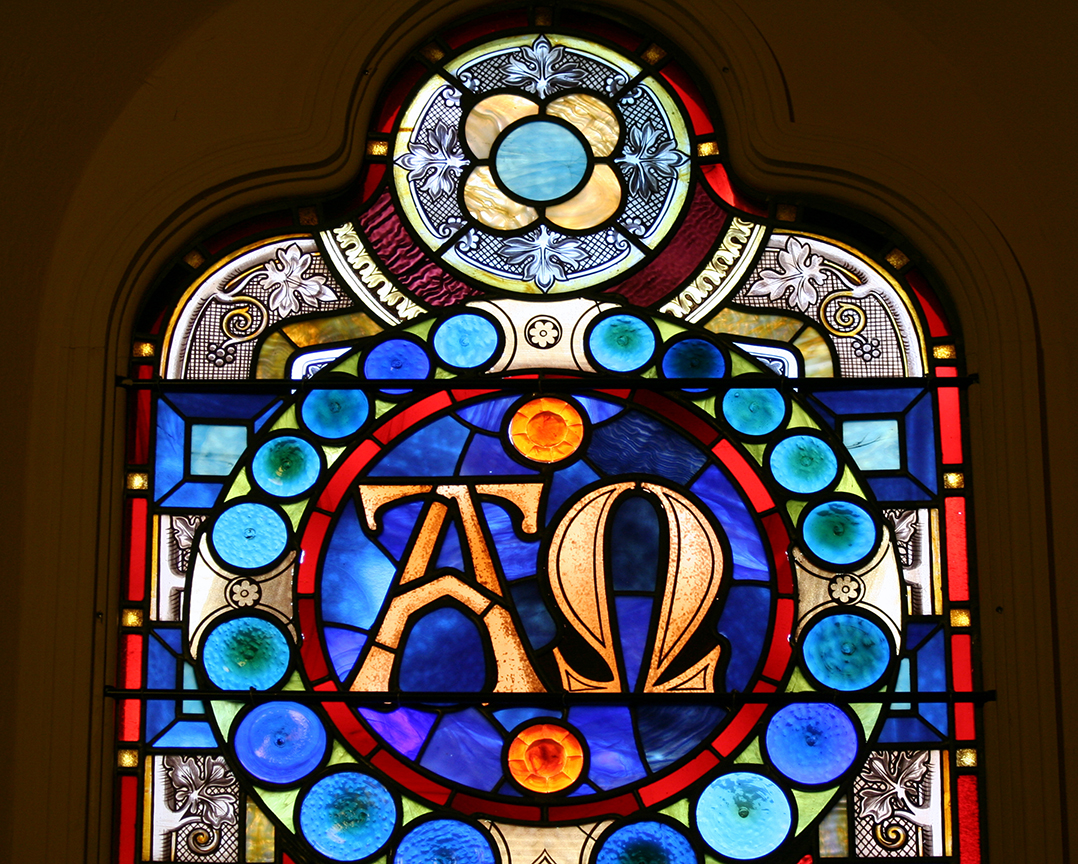
About the Artwork #1:
Alpha and Omega
Stained glass window
Artisan Unknown
c. 1883
Near the front door of St. Paul's Episcopal Church
Milwaukee, Wisconsin
Jonathunder, Public domain, via Wikimedia Commons
Alpha (Α) and Omega (Ω) are the first and last letters, respectively, of the classical Greek alphabet. Thus, the phrase "I am the alpha and the omega" is further clarified with the additional phrase "the beginning and the end" spoken by Jesus in Revelation 21:6; 22:13. The first and last letters of the Greek alphabet were used because the book of Revelation was originally written in Greek. St. Paul’s American Protestant Episcopal Church (original title of church) was officially founded in 1838, making it the first Episcopal parish in Milwaukee, Wisconsin. The church is noted on the National Register of Historic Places (NRHP), the United States federal government's official list of sites, buildings, structures, districts, and objects deemed worthy of preservation for their historical significance of "great artistic value.”
https://stpaulsmilwaukee.org/
https://en.wikipedia.org/wiki/Alpha_and_Omega#:~:text=Alpha%20(%CE%91%2C%20%CE%B1)%20and,in%20the%20Book%20of%20Revelation.
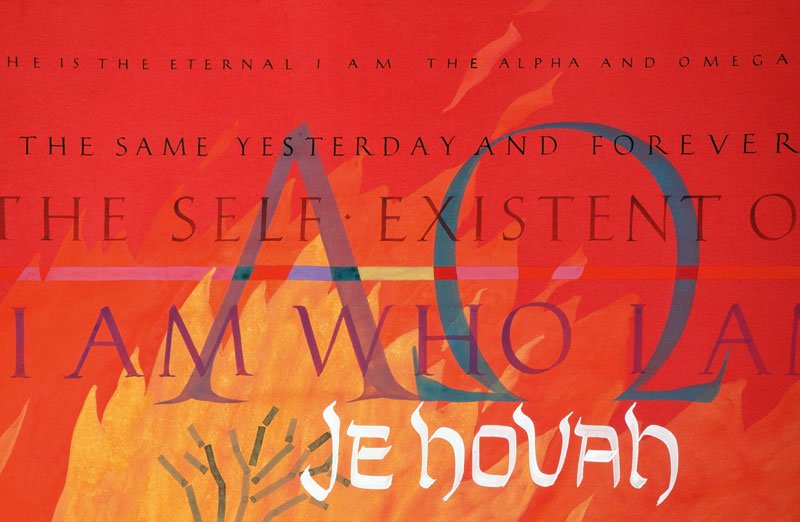
About the Artwork #2:
Jehovah—Alpha & Omega
Timothy R. Botts
Calligraphy
13 x 19 in.
Limited Edition Prints
Printed on fine art paper with archival pigment-based inks
Used with permission from the artist
About the Artist #2:
Timothy R. Botts is an American artist who has focused on the art of calligraphy. He is well known for his transformation of Bible verses into pieces of art. Throughout his career, Botts has formed his own font, or what he refers to as a visual language with the use of colors, letter styles, letter paths, contrast, and repetition. Botts has painted on walls of churches and other places of worship with murals of Scripture that can be found at Good Shepherd Lutheran, Cornerstone Church, Naperville Bible Church, Trinity Church of the Nazarene, St. Francis House High School in Wheaton, and Advocate Good Samaritan Hospital in Downers Grove. He hosts weekend calligraphy workshops throughout the United States as well as at the International Calligraphy Convention. Botts is quoted as saying, "Historically, the tradition of calligraphy has been to celebrate the text by embellishing it. In addition to that worthy goal, I seek to portray the words so that the meaning is expressed visually––what I call word pictures. I make use of the principles of graphic design to aid in this communication––color, style, contrast, depth, symbolism and movement—to name a few."
https://www.timbottscalligraphy.com/
https://en.wikipedia.org/wiki/Timothy_Botts
https://www.eyekons.com/tim_botts/timothy_r_botts_home
About the Music: “Alpha and Omega” from the album Best of the Gaither Vocal Band
Lyrics:
I heard a great voice out of Heaven saying
"Behold the tabernacle of God is with man
He shall dwell within them
They shall be His people
And Almighty God will be with them."
"He shall wipe away all tears from their eyes
There shall be no more death.
Neither sorrow nor crying and no more pain.
The former things have all past away"
He that sat upon the throne said,
"Behold, I make all things new"
He said unto me, "Write these words
For they are faithful and true."
And it is done.
It is done.
It is done.
It is done.
It is done.
He is the Alpha and Omega
The Beginning and the End
The Son of God, the King of kings
Lord of lords, He’s everything
Messiah, Jehovah, the Prince of Peace is He
The Son of Man, Seed of Abraham
Second Person in the Trinity.
He is the Alpha and Omega
The Beginning and the End
The Son of God, the King of kings
Lord of lords, He’s everything
Messiah, Jehovah, the Prince of Peace is He
The Son of Man, Seed of Abraham
Second Person in the Trinity
He is the Alpha and Omega
The Beginning and the End
The Son of God, the King of kings
Lord of lords, He’s everything
Messiah, Jehovah, the Prince of Peace is He
The Son of Man, Seed of Abraham
Second Person in the Trinity
He is the Alpha and Omega
The Beginning and the End
The Son of God, the King of kings
Lord of lords, He’s everything
Messiah, Jehovah, the Prince of Peace is He
The Son of Man, Seed of Abraham
Second Person in the Trinity
About the Composer:
Robbie Trice is an American professional singer, songwriter, and acoustic guitarist. Both of his parents were singers and their home was always filled with music, which gave Trice an appreciation and love for the artists and songs that are now staples in his performances. When he was thirteen years old, his father gave him an acoustic guitar and a Mel Bay instruction book. In just three weeks he was playing proficiently enough to write his first song, "I Don't Wanna.” Trice then met two friends who were also singer-songwriters and they soon formed a band with several other musicians called Kinfolk. In 1972, Robbie wrote the song called “Alpha and Omega” that became very popular and synonymous with the band. A few years after the group disbanded, “Alpha and Omega” was recorded by the Gaither Vocal Band and is now considered to be a gospel classic.
https://www.robbietrice.com/about
About the Performers:
Since the early 1990s, the Gaither Vocal Band has served as a standard-bearer in the world of gospel music. Founded by legendary songwriter and producer Bill Gaither, this Grammy-winning vocal group has performed in the world’s most prestigious venues, including the Sydney Opera House, the Kennedy Center, and Carnegie Hall. The list of men who have composed the Gaither Vocal Band over the past thirty years reads like a Who’s Who among the gospel music industry’s best-loved voices, including Steve Green, Larnelle Harris, Mark Lowry, Michael English, David Phelps, and many others. Today, the Gaither Vocal Band roster is composed of five gospel voices, including Bill Gaither, Wes Hampton, Adam Crabb, Todd Suttles, and Reggie Smith. Individually, these men are gifted artists and men of authentic faith, but together, they are known around the world for their stunning vocals, innovative harmonies, and life-altering message—a message of grace, hope, and redemption through Jesus Christ.
https://gaither.com/artists/gaither-vocal-band/
About the Poetry & Poet:
T. S. Eliot (1888–1965), one of the twentieth century's major poets, was also an essayist, publisher, playwright, and literary critic. Born in Missouri to a prominent family, in 1914 he moved to England, where he settled, worked, and became a British subject. It was poet Ezra Pound, in his role as a friend and editor, who helped establish Eliot as a preeminent figure in the modernist poetic movement, particularly through his editorial assistance on The Waste Land (1922). With its collage of voices, its violent disjunctions in tone, and wealth of cultural allusion, Eliot’s The Waste Land resonated as a depiction of the ruins of post-war European civilization. The 1920s also saw Eliot become increasingly conservative in his outlook, particularly following his conversion to the Anglican Church. His religious conversion would have a far-reaching impact on the rest of his career, culminating in the Christian meditations found in Four Quartets (1943), which garnered him the 1948 Nobel Prize for Literature. He was also known for his seven plays, particularly Murder in the Cathedral (1935) and The Cocktail Party (1949).
https://en.wikipedia.org/wiki/T._S._Eliot
https://www.poetryfoundation.org/poets/t-s-eliot
About the Devotion Author:
Dr. Laurie Wilson
Assistant Professor
Torrey Honors College
Biola University
Laurie Wilson, an assistant professor in the Torrey Honors College at Biola University, received her master’s degree in Greek and Latin and her doctoral degree in classics from the University of St. Andrews in Scotland, where she was an H. B. Earhart Foundation fellow and a postgraduate fellow in the James Wilson Programme for Constitutional Studies. This background reflects her passion for classical studies and for her interdisciplinary research, which has focused on Augustine, Cicero, and writings from the American founders.